
Skip to content
Common Diving-petrel source reference

EXPEDITION GUIDES / ANIMAL LIBRARY

Common Diving-petrel

A small stout diving petrel with short broad wings, dark upperparts, pale underparts, and fast whirring flight low over the sea.

SPECIES LIBRARY / FIELD FACT SHEET

Common Diving-petrel

Pelecanoides urinatrix · Diving Petrels

Working fact sheet · 1 sections need source detail

Drawn from the existing guide record (app screenshot). Regional tags are library coverage, not a prediction of sightings. Blank fields remain open for research; imported notes have not been independently re-verified.

HABITAT & DISTRIBUTION

Where in the world?

Open full map ↗
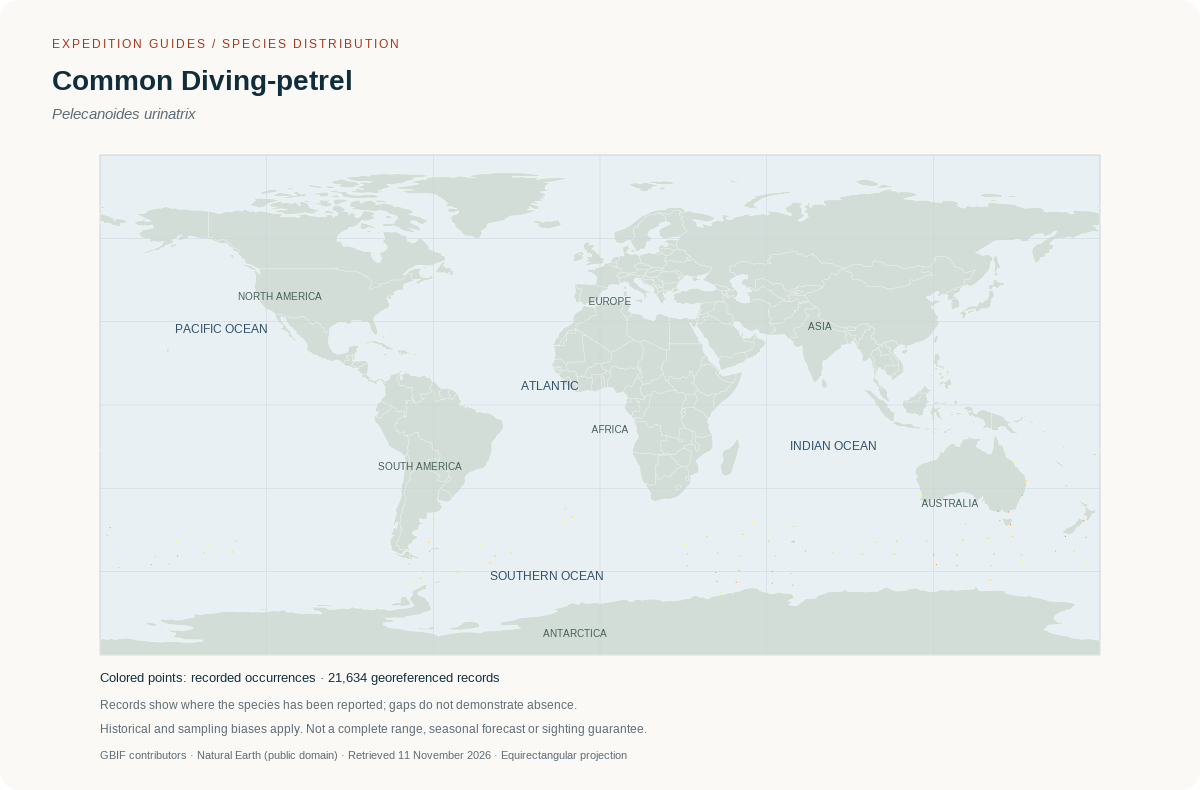
World map showing recorded occurrences of Common Diving-petrel; not a complete range map
Colored points show georeferenced records shared through GBIF. Records can be historical and unevenly sampled; gaps do not establish absence. This is a record map, not a complete range or a guarantee of sightings.

Habitat & range notes

  • Complex group of subspecies breeding on Falkland Islands, South Georgia, Tristan da Cunha, Gough Island, islands near the Antarctic Convergence, New Zealand, Tasmania, and nearby Australian coast
  • In the region can be found in waters around South Georgia and between the Falklands and South America

View GBIF records & contributor details ↗ · Base map: Natural Earth, public domain · Retrieved 2026-11-11

Identification

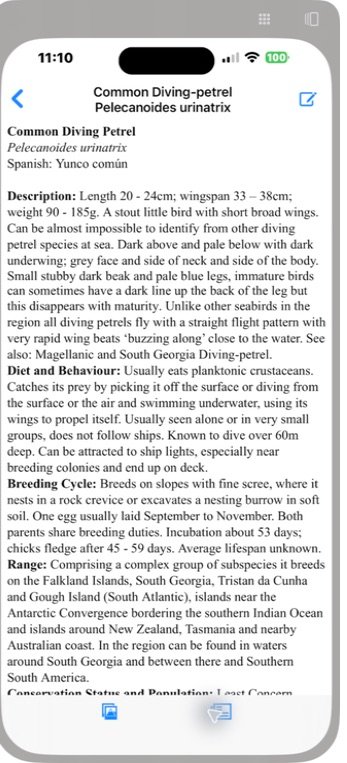
  • Length about 20-24 cm, wingspan about 33-38 cm, and weight about 90-185 g in app detail
  • Stout little bird with short broad wings
  • Dark above and pale below with dark underwing
  • Small stubby dark beak, pale blue legs, and immature birds may show a dark line up the back of the leg
Size & measurements

  • Length about 20-24 cm
  • Wingspan about 33-38 cm
  • Weight about 90-185 g
  • Length about 20-24 cm, wingspan about 33-38 cm, and weight about 90-185 g in app detail

Habitat & range

  • Falklands
  • South Georgia
  • Complex group of subspecies breeding on Falkland Islands, South Georgia, Tristan da Cunha, Gough Island, islands near the Antarctic Convergence, New Zealand, Tasmania, and nearby Australian coast
  • In the region can be found in waters around South Georgia and between the Falklands and South America

Feeding

  • Usually planktonic crustaceans

Behavior

  • Picks prey off the surface or dives from the surface or air
  • Uses wings to propel itself while swimming underwater
  • Known to dive over 60 m deep
  • App detail notes that diving petrels can be difficult to identify at sea
  • Unlike other seabirds in the region, all diving petrels fly with a straight flight pattern and very rapid wingbeats
  • Does not follow ships, but can be attracted to ship lights near breeding colonies

Breeding & season

  • Breeds on slopes with fine scree where it nests in a rock crevice or excavates a burrow in soft soil
  • One egg is usually laid September to November
  • Incubation is about 53 days and chicks fledge after about 45-59 days
  • Does not follow ships, but can be attracted to ship lights near breeding colonies

Eggs, chicks & young

  • One egg is usually laid September to November
  • Incubation is about 53 days and chicks fledge after about 45-59 days

Lifespan

Source detail still needed.