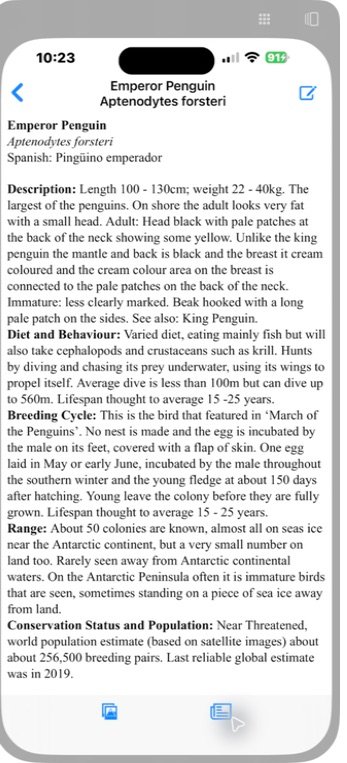
Drawn from the existing guide record (app screenshot). Regional tags are library coverage, not a prediction of sightings. Blank fields remain open for research; imported notes have not been independently re-verified.
Colored points show georeferenced records shared through GBIF. Records can be historical and unevenly sampled; gaps do not establish absence. This is a record map, not a complete range or a guarantee of sightings.
Habitat & range notes
About 50 colonies are known, almost all on sea ice near the Antarctic continent
Rarely seen away from Antarctic continental waters
On the Antarctic Peninsula, sightings are often immature birds or adults on sea ice away from land
No phone capture action is currently queued for this animal.
App photo target
/wildlife-photos/emperor-penguin.jpg
Source target
/interp/source/emperor-penguin-info.jpg
Animal information
Field marks and guide-facing detail.
Field Marks
Length about 100-130 cm and weight about 22-40 kg in app detail
Largest penguin; adult looks very fat on shore with small head
Head black with pale patches at the back of the neck showing some yellow
Immature birds are less clearly marked; beak is hooked with a long pale side patch
Guide Facts
App detail notes varied diet of mainly fish plus cephalopods and crustaceans such as krill
Average dive is less than 100 m but can be up to 560 m
Male incubates the single egg on his feet under a flap of skin through the southern winter
On the Antarctic Peninsula, sightings are often immature birds or adults on sea ice away from land
Measurements
Length 100-130 cmWeight 22-40 kg
Diet
Mainly fish, with cephalopods and crustaceans such as krill
Behavior
Hunts by diving and chasing prey underwater, using wings for propulsionAverage dive is less than 100 m but can reach 560 mLifespan is thought to average 15-25 years
Breeding
Featured in March of the PenguinsDoes not make a nest; the egg is incubated by the male on his feet under a flap of skinOne egg is laid in May or early June and incubated by the male through the southern winterYoung leave the colony before fully grown and fledge at about 150 days
Range
About 50 colonies are known, almost all on sea ice near the Antarctic continentRarely seen away from Antarctic continental watersOn the Antarctic Peninsula, sightings are often immature birds or adults on sea ice away from land
Comparison Notes
Similar to King Penguin, but mantle and back are black and breast is cream rather than orangeHead has pale yellow patches at the back of the neck rather than bright orange side patches
Conservation
Near Threatened; app detail cites an estimate of about 256,500 breeding pairs from satellite images, with last reliable global estimate in 2019.
Keratin plates used by baleen whales to filter krill and small schooling prey from seawater.26 animal matches / 26 captured / 0 pending / 1 location filesGuide draft readyOpen Glossary term
Animal ID
drafted-from-current-records
Krill
Small shrimp-like crustaceans that are a major Antarctic food source for many whales, penguins, seals, and seabirds.27 animal matches / 27 captured / 0 pending / 1 location filesGuide draft readyOpen Glossary term
Animal ID
drafted-from-current-records
Pelagic
Living or feeding in open ocean waters away from land.32 animal matches / 23 captured / 9 pending / 4 location filesGuide draft readyOpen Glossary term
Animal ID
drafted-from-current-records
Pinniped
A fin-footed marine mammal group that includes seals, fur seals, and sea lions.24 animal matches / 21 captured / 3 pending / 5 location filesGuide draft readyOpen Glossary term