Albatrosses0 of 7 app-captured
7 starter / 0 pending / 0 unresolved
Interp library
Antarctic wildlife guide content, structured for field teams.
This is the first migration layer for the Antarctic Wildlife Guide-style content: birds, seals, toothed whales and dolphins, baleen whales, locations, glossary terms, facts, photos, and source links organized as reusable guide records.
Scoped guide surface
Locations, animal records, and Glossary are the active build.
The current page now routes the guide team into the content that matters for the Antarctic interp library, while the workbench keeps the remaining phone-dependent capture rows visible.
Location files5Falklands, South Georgia, Antarctic Peninsula, Drake Passage, and Ushuaia/Beagle Channel.Animal pages110Every known animal row has a site record, even when phone evidence is still pending.Glossary terms10Guide-facing definitions now share the same linkable page model as animals and locations.Phone captures53Animal records still waiting on source-app screenshots or app photos.List verification1Ambiguous source-app rows that need a full-list pass before final import.No-phone cleanup0Captured rows left to structure from existing local evidence.
App-matched categories
Built around the same field-guide buckets.
The current site scope is animal information, operating locations, animal discovery checklists, and Glossary support. Other app menu features stay outside this build unless they directly help those records.
AlbatrossesPetrels and ShearwatersStorm PetrelsDiving PetrelsGrebesGulls, Terns and SkuasPenguinsCormorants and ShagsDucks and GeeseShorebirdsHerons and IbisesKingfishersOwls, Vultures, Hawks and CaracarasLand BirdsSealsToothed Whales and DolphinsBaleen Whales
FalklandsSouth GeorgiaAntarctic PeninsulaDrake PassageUshuaia and Beagle Channel
Animal library index
Jump by category or migration status.
Captured app records56Animal pages already carrying app-derived detail fields.Pending phone import53Starter and scaffolded records waiting on screenshots or app photos.Search/list review1Ambiguous animal-list row that needs source-app verification.
Albatrosses7 records / 0 capturedPetrels and Shearwaters15 records / 15 capturedStorm Petrels4 records / 2 capturedDiving Petrels3 records / 3 capturedGrebes3 records / 0 capturedGulls, Terns and Skuas9 records / 0 capturedPenguins8 records / 8 capturedCormorants and Shags3 records / 0 capturedDucks and Geese6 records / 0 capturedShorebirds5 records / 0 capturedHerons and Ibises2 records / 0 capturedKingfishers1 records / 0 capturedOwls, Vultures, Hawks and Caracaras12 records / 0 capturedLand Birds4 records / 0 capturedSeals8 records / 8 capturedToothed Whales and Dolphins13 records / 13 capturedBaleen Whales7 records / 7 captured
Petrels and Shearwaters15 of 15 app-captured
0 starter / 0 pending / 0 unresolvedStorm Petrels2 of 4 app-captured
0 starter / 1 pending / 1 unresolvedDiving Petrels3 of 3 app-captured
0 starter / 0 pending / 0 unresolvedGrebes0 of 3 app-captured
2 starter / 1 pending / 0 unresolvedGulls, Terns and Skuas0 of 9 app-captured
1 starter / 8 pending / 0 unresolvedPenguins8 of 8 app-captured
0 starter / 0 pending / 0 unresolvedCormorants and Shags0 of 3 app-captured
0 starter / 3 pending / 0 unresolvedDucks and Geese0 of 6 app-captured
0 starter / 6 pending / 0 unresolvedShorebirds0 of 5 app-captured
0 starter / 5 pending / 0 unresolvedHerons and Ibises0 of 2 app-captured
0 starter / 2 pending / 0 unresolvedKingfishers0 of 1 app-captured
0 starter / 1 pending / 0 unresolvedOwls, Vultures, Hawks and Caracaras0 of 12 app-captured
0 starter / 12 pending / 0 unresolvedLand Birds0 of 4 app-captured
0 starter / 4 pending / 0 unresolvedSeals8 of 8 app-captured
0 starter / 0 pending / 0 unresolvedToothed Whales and Dolphins13 of 13 app-captured
0 starter / 0 pending / 0 unresolvedBaleen Whales7 of 7 app-captured
0 starter / 0 pending / 0 unresolvedOriginal app sections
Source-app grouping is preserved for audit and rebuild work.
The website can keep more precise guide categories while still tracking the original Antarctic Wildlife Guide sections used during capture.
Petrels, Prions, Shearwaters etc.20 of 22 app-captured
0 starter / 1 pending / 1 unresolvedAlbatrosses0 of 7 app-captured
7 starter / 0 pending / 0 unresolvedGrebes0 of 3 app-captured
2 starter / 1 pending / 0 unresolvedGulls, Terns and Skuas0 of 9 app-captured
1 starter / 8 pending / 0 unresolvedPenguins8 of 8 app-captured
0 starter / 0 pending / 0 unresolvedSeals8 of 8 app-captured
0 starter / 0 pending / 0 unresolvedToothed Whales and Dolphins13 of 13 app-captured
0 starter / 0 pending / 0 unresolvedBaleen Whales7 of 7 app-captured
0 starter / 0 pending / 0 unresolvedCormorants and Shags0 of 3 app-captured
0 starter / 3 pending / 0 unresolvedDucks and Geese0 of 6 app-captured
0 starter / 6 pending / 0 unresolvedShorebirds0 of 5 app-captured
0 starter / 5 pending / 0 unresolvedLand Birds0 of 4 app-captured
0 starter / 4 pending / 0 unresolvedHerons and Ibises0 of 2 app-captured
0 starter / 2 pending / 0 unresolvedKingfishers0 of 1 app-captured
0 starter / 1 pending / 0 unresolvedOwls, Vultures, Hawks and Caracaras0 of 12 app-captured
0 starter / 12 pending / 0 unresolvedLocation files
Regional interp, history, itinerary, and weather structure.
Each operating region now has a storage target for local animal files, historical context, full voyage itinerary notes, daily operations, and forecast layers that can later connect to Windy APIs.
captured-shell
Falklands
App filter: FalklandsGuide-facing draftUse the Falklands as the warm-up or wrap-up layer for South Atlantic wildlife: penguin colonies, tussac habitat, coastal birds, and settlement context can all sit close together.Drafted from current animal region tags and operations fields; source-app location overview still pending.
Overview: needs-app-overviewSpecies list: filter-confirmed58 tagged animals / 22 captured / 36 pending0 list review
Top pending animal groups
PenguinsGeese and ducksShorebirdsRaptorsFur seals and sea lions
ItineraryArrival/departure windowLanding or zodiac planTender/shore rotation notesBiosecurity timing
WeatherWindy map layerWind directionGustsSwellVisibilityForecast confidence
InterpWildlife by siteHistorical contextConservation notesGuest lecture links
OperationsLanding siteGuide assignmentsGuest group rotationSafety notes
Separate Falklands-only animal rows from broader South Atlantic recordsBuild landing-site context around colonies, tussac habitat, and settlement historyFlag weather exposure and tender/landing timing for guide notes
Open the Falklands filter, capture the filtered species list, then add place overviews for common landing sites.Open Falklands location pagecaptured-shell
South Georgia
App filter: South GeorgiaGuide-facing draftUse South Georgia as the high-density wildlife file: king penguins, fur seals, elephant seals, albatrosses, and endemic bird records need landing-site scale context.Drafted from current animal region tags and operations fields; source-app location overview still pending.
Overview: needs-app-overviewSpecies list: filter-confirmed42 tagged animals / 27 captured / 15 pending1 list review
Top pending animal groups
King penguinsAlbatrossesFur sealsElephant sealsPipits and pintails
ItineraryTransit windowLanding site sequencePermit/IAATO constraintsBiosecurity timing
WeatherWindy map layerKatabatic riskGustsSwellSea stateForecast confidence
InterpKing penguin coloniesSealing and whaling historyShackleton contextHabitat restoration
OperationsLanding siteGuide assignmentsBoot-wash planWildlife distance reminders
Tie animal files to landing-site scale and crowding realitiesKeep Shackleton, whaling, restoration, and biosecurity notes near animal recordsSeparate South Georgia endemics or regional subspecies from broader Antarctic records
Open the South Georgia filter, capture the filtered species list, then build history/interp files for key sites.Open South Georgia location pagecaptured-shell
Antarctic Peninsula
App filter: Antarctic Peninsula and Drake PassageGuide-facing draftUse the Antarctic Peninsula as the main ice-and-wildlife operating file, tying penguins, seals, whales, seabirds, glaciology, and landing flexibility into one place.Drafted from current animal region tags and operations fields; source-app location overview still pending.
Overview: needs-app-overviewSpecies list: filter-confirmed34 tagged animals / 25 captured / 9 pending0 list review
Top pending animal groups
PenguinsSealsBaleen whalesToothed whalesSnow and giant petrels
ItineraryIce/weather decision pointsLanding or ship-cruise planZodiac routeAlternative site plan
WeatherWindy map layerIce edge contextWind directionGustsSwellTemperature
InterpPenguin ecologyMarine mammalsExploration historyGlaciology and sea ice
OperationsLanding siteZodiac driver assignmentsWildlife approach notesContingency plan
Keep landing, zodiac-cruise, and ship-cruise variants visibleSeparate peninsula species context from Drake transit sightings when possiblePair animal notes with ice, glaciology, and weather decision points
Open the Antarctic Peninsula and Drake Passage filter and split peninsula-only species from Drake transit species where the app allows.Open Antarctic Peninsula location pagecaptured-shell
Drake Passage
App filter: Antarctic Peninsula and Drake PassageGuide-facing draftUse the Drake Passage file as a deck-watch and sea-day layer, with pelagic bird ID, whale possibilities, weather systems, and convergence-zone interpretation close together.Drafted from current animal region tags and operations fields; source-app location overview still pending.
Overview: needs-app-overviewSpecies list: filter-confirmed42 tagged animals / 31 captured / 11 pending1 list review
Top pending animal groups
AlbatrossesPetrelsShearwatersPrionsPelagic cetaceans
ItinerarySea-day programBridge/deck watch planLecture timingCrossing ETA
WeatherWindy map layerWind directionGustsSwellPressure trendSea temperature
InterpPelagic bird IDOceanographyConvergence zonesWeather systems
OperationsDeck-watch scheduleLecture teamMotion/safety remindersDaily recap notes
Prioritize deck-watch identification cues and similar-species notesConnect sightings to convergence zones and weather systemsKeep sea-day lecture and recap prompts close to the animal queue
Use the combined Antarctic Peninsula and Drake Passage filter, then tag pelagic/transit species for Drake operations.Open Drake Passage location pagecaptured-shell
Ushuaia and Beagle Channel
App filter: Beagle ChannelGuide-facing draftUse Ushuaia and the Beagle Channel as the embarkation, sailaway, and return-context file for coastal birds, sea lions, Fuegian natural history, and port logistics.Drafted from current animal region tags and operations fields; source-app location overview still pending.
Overview: needs-app-overviewSpecies list: filter-confirmed41 tagged animals / 9 captured / 32 pending0 list review
Top pending animal groups
Cormorants and shagsDucks and geeseGulls and ternsSea lionsCoastal birds
ItineraryEmbarkation timingPilotage windowSailaway deck watchArrival/departure logistics
WeatherWindy map layerWind directionGustsPrecipitationVisibilityForecast confidence
InterpFuegian natural historyBeagle Channel wildlifeYamana/Yaghan contextPort orientation
OperationsEmbarkation teamGangway timingGuest briefingPort-agent notes
Build pre-Antarctic orientation notes for guests joining in UshuaiaSeparate Beagle Channel sightings from offshore Drake recordsKeep port, pilotage, and sailaway timing attached to guide talking points
Open the Beagle Channel filter, capture local bird/marine mammal list, then add Ushuaia and channel history files.Open Ushuaia and Beagle Channel location pageAnimal migration workbench
Clean what we have; capture what is still missing.
This queue separates no-phone cleanup from phone-dependent capture work. Captured records can be structured from existing local app evidence; placeholders stay grouped with their exact photo, source, and screenshot requirements.
Without-phone work boundary
Everything structural is usable now; evidence capture stays explicit.
The site can keep moving on locations, animal pages, Glossary routing, ledgers, and visual polish without pretending the remaining source-app proof is finished.
Evidence command center
Run, open, and verify the next capture pass from one place.
These commands and files are the handoff between the polished site structure and the phone-dependent source-app proof that still blocks completion.
npm run migration:refreshRegenerates capture plans, status reports, route manifests, completion audit, and phone packet.npm run migration:checkVerifies that the generated migration files still agree with the narrowed app scope.npm run migration:packetRewrites the next source-app screenshot and app-photo capture packet.migration/antarctic-app/current-capture-session.mdmigration/antarctic-app/next-capture.mdmigration/antarctic-app/completion-audit.mdmigration/antarctic-app/phone-evidence-packet.mdPhone capture handoff
Next source-app pass starts with these rows.
53 animal records and 1 Glossary screen still need phone evidence.
Phone evidence packet
Use this as the next capture run.
/interp/wilsons-storm-petrel-app-photo.jpg/interp/source/wilsons-storm-petrel-info.png<next>-wilsons-storm-petrel-search-result.png<next>-wilsons-storm-petrel-photo.png<next>-wilsons-storm-petrel-info.pngmigration/antarctic-app/screenshots/228-white-bellied-storm-petrel-search-result.pngmigration/antarctic-app/screenshots/229-white-bellied-storm-petrel-search-retry.png<next>-white-bellied-storm-petrel-list-verification.png/interp/black-browed-albatross-app-photo.jpg/interp/source/black-browed-albatross-info.png<next>-black-browed-albatross-search-result.png<next>-black-browed-albatross-photo.png<next>-black-browed-albatross-info.pngmigration/antarctic-app/phone-evidence-packet.mdmigration/antarctic-app/phone-evidence-packet.jsonnpm run migration:packetLocation capture priorities
Run the next phone pass by place when that is easier.
Falklands36
58 tagged / 22 captured / 0 list reviewBlack-browed AlbatrossOpen location fileSouth Georgia15
42 tagged / 27 captured / 1 list reviewBlack-browed AlbatrossOpen location fileAntarctic Peninsula9
34 tagged / 25 captured / 0 list reviewBrown SkuaOpen location fileDrake Passage11
42 tagged / 31 captured / 1 list reviewBlack-browed AlbatrossOpen location fileUshuaia and Beagle Channel32
41 tagged / 9 captured / 0 list reviewSouthern Silvery GrebeOwls, Vultures, Hawks and Caracaras11 pendingGulls, Terns and Skuas5 pendingDucks and Geese4 pending
Open location filemigration/antarctic-app/current-capture-session.mdmigration/antarctic-app/next-capture.mdmigration/antarctic-app/batch-import-checklist.csvNo-phone cleanup
0captured records still needing structured appDetail reviewPhone capture needed
53known animal rows with placeholder or starter content- Antarctic Shag<next>-antarctic-shag-search-result.png / <next>-antarctic-shag-photo.png / <next>-antarctic-shag-info.png
- Imperial Shag<next>-imperial-shag-search-result.png / <next>-imperial-shag-photo.png / <next>-imperial-shag-info.png
- South Georgia Shag<next>-south-georgia-shag-search-result.png / <next>-south-georgia-shag-photo.png / <next>-south-georgia-shag-info.png
- Crested Duck<next>-crested-duck-search-result.png / <next>-crested-duck-photo.png / <next>-crested-duck-info.png
- Falkland Steamer Duck<next>-falkland-steamer-duck-search-result.png / <next>-falkland-steamer-duck-photo.png / <next>-falkland-steamer-duck-info.png
- Flying Steamer Duck<next>-flying-steamer-duck-search-result.png / <next>-flying-steamer-duck-photo.png / <next>-flying-steamer-duck-info.png
List verification
1ambiguous source-app search rows to resolve by full-list capture- White-bellied Storm PetrelOpen the full source-app section list and resolve the failed search/name issue before importing.
Animal records
Photos, field marks, guide facts, and overview links.
These records are intentionally modular: each can later accept additional app photos, conservation status, regional notes, and guide-only context.
Animal route index
Every animal page, sorted by evidence need.
Phone pendingBlack-browed AlbatrossAlbatrossesFalklands / South Georgia / Drake PassageAudit the app row, capture detail/photo/evidence, then replace starter content with app-derived fields.Phone pendingGrey-headed AlbatrossAlbatrossesSouth Georgia / Drake PassageAudit the app row, capture detail/photo/evidence, then replace starter content with app-derived fields.Phone pendingLight-mantled AlbatrossAlbatrossesSouth Georgia / Drake PassageAudit the app row, capture detail/photo/evidence, then replace starter content with app-derived fields.Phone pendingNorthern Royal AlbatrossAlbatrossesDrake PassageAudit the app row, capture detail/photo/evidence, then replace starter content with app-derived fields.Phone pendingSooty AlbatrossAlbatrossesSouth Georgia / Drake PassageAudit the app row, capture detail/photo/evidence, then replace starter content with app-derived fields.Phone pendingSouthern Royal AlbatrossAlbatrossesDrake PassageAudit the app row, capture detail/photo/evidence, then replace starter content with app-derived fields.Phone pendingWandering AlbatrossAlbatrossesSouth Georgia / Drake PassageAudit the app row, capture detail/photo/evidence, then replace starter content with app-derived fields.Phone pendingAntarctic ShagCormorants and ShagsAntarctic PeninsulaCapture search result, photo, and info screens; crop the app photo; copy source evidence; then import app-derived fields.Phone pendingImperial ShagCormorants and ShagsFalklands / Ushuaia and Beagle Channel / Antarctic PeninsulaCapture search result, photo, and info screens; crop the app photo; copy source evidence; then import app-derived fields.Phone pendingSouth Georgia ShagCormorants and ShagsSouth GeorgiaCapture search result, photo, and info screens; crop the app photo; copy source evidence; then import app-derived fields.Phone pendingCrested DuckDucks and GeeseFalklands / Ushuaia and Beagle ChannelCapture search result, photo, and info screens; crop the app photo; copy source evidence; then import app-derived fields.Phone pendingFalkland Steamer DuckDucks and GeeseFalklandsCapture search result, photo, and info screens; crop the app photo; copy source evidence; then import app-derived fields.Phone pendingFlying Steamer DuckDucks and GeeseFalklands / Ushuaia and Beagle ChannelCapture search result, photo, and info screens; crop the app photo; copy source evidence; then import app-derived fields.Phone pendingKelp GooseDucks and GeeseFalklands / Ushuaia and Beagle ChannelCapture search result, photo, and info screens; crop the app photo; copy source evidence; then import app-derived fields.Phone pendingSouth Georgia PintailDucks and GeeseSouth GeorgiaCapture search result, photo, and info screens; crop the app photo; copy source evidence; then import app-derived fields.Phone pendingUpland GooseDucks and GeeseFalklands / Ushuaia and Beagle ChannelCapture search result, photo, and info screens; crop the app photo; copy source evidence; then import app-derived fields.Phone pendingGreat GrebeGrebesFalklands / Ushuaia and Beagle ChannelCapture search result, photo, and info screens; crop the app photo; copy source evidence; then import app-derived fields.Phone pendingSouthern Silvery GrebeGrebesFalklands / Ushuaia and Beagle ChannelAudit the app row, capture detail/photo/evidence, then replace starter content with app-derived fields.Phone pendingWhite-tufted/Falkland GrebeGrebesFalklands / Ushuaia and Beagle ChannelAudit the app row, capture detail/photo/evidence, then replace starter content with app-derived fields.Phone pendingAntarctic TernGulls, Terns and SkuasSouth Georgia / Antarctic PeninsulaCapture search result, photo, and info screens; crop the app photo; copy source evidence; then import app-derived fields.Phone pendingArctic TernGulls, Terns and SkuasFalklands / South Georgia / Antarctic Peninsula / Drake PassageCapture search result, photo, and info screens; crop the app photo; copy source evidence; then import app-derived fields.Phone pendingBrown SkuaGulls, Terns and SkuasFalklands / South Georgia / Antarctic PeninsulaAudit the app row, capture detail/photo/evidence, then replace starter content with app-derived fields.Phone pendingBrown-hooded GullGulls, Terns and SkuasFalklands / Ushuaia and Beagle ChannelCapture search result, photo, and info screens; crop the app photo; copy source evidence; then import app-derived fields.Phone pendingChilean SkuaGulls, Terns and SkuasFalklands / Ushuaia and Beagle ChannelCapture search result, photo, and info screens; crop the app photo; copy source evidence; then import app-derived fields.Phone pendingDolphin GullGulls, Terns and SkuasFalklands / Ushuaia and Beagle ChannelCapture search result, photo, and info screens; crop the app photo; copy source evidence; then import app-derived fields.Phone pendingKelp GullGulls, Terns and SkuasFalklands / South Georgia / Antarctic Peninsula / Ushuaia and Beagle ChannelCapture search result, photo, and info screens; crop the app photo; copy source evidence; then import app-derived fields.Phone pendingSouth American TernGulls, Terns and SkuasFalklands / Ushuaia and Beagle ChannelCapture search result, photo, and info screens; crop the app photo; copy source evidence; then import app-derived fields.Phone pendingSouth Polar SkuaGulls, Terns and SkuasAntarctic Peninsula / Drake PassageCapture search result, photo, and info screens; crop the app photo; copy source evidence; then import app-derived fields.Phone pendingBlack-crowned Night HeronHerons and IbisesFalklands / Ushuaia and Beagle ChannelCapture search result, photo, and info screens; crop the app photo; copy source evidence; then import app-derived fields.Phone pendingBlack-faced IbisHerons and IbisesFalklands / Ushuaia and Beagle ChannelCapture search result, photo, and info screens; crop the app photo; copy source evidence; then import app-derived fields.Phone pendingRinged KingfisherKingfishersUshuaia and Beagle ChannelCapture search result, photo, and info screens; crop the app photo; copy source evidence; then import app-derived fields.Phone pendingCobb's WrenLand BirdsFalklandsCapture search result, photo, and info screens; crop the app photo; copy source evidence; then import app-derived fields.Phone pendingDark-faced Ground TyrantLand BirdsFalklands / Ushuaia and Beagle ChannelCapture search result, photo, and info screens; crop the app photo; copy source evidence; then import app-derived fields.Phone pendingSouth Georgia PipitLand BirdsSouth GeorgiaCapture search result, photo, and info screens; crop the app photo; copy source evidence; then import app-derived fields.Phone pendingTussacbirdLand BirdsFalklandsCapture search result, photo, and info screens; crop the app photo; copy source evidence; then import app-derived fields.Phone pendingAmerican KestrelOwls, Vultures, Hawks and CaracarasFalklands / Ushuaia and Beagle ChannelCapture search result, photo, and info screens; crop the app photo; copy source evidence; then import app-derived fields.Phone pendingAndean CondorOwls, Vultures, Hawks and CaracarasUshuaia and Beagle ChannelCapture search result, photo, and info screens; crop the app photo; copy source evidence; then import app-derived fields.Phone pendingAustral Pygmy OwlOwls, Vultures, Hawks and CaracarasUshuaia and Beagle ChannelCapture search result, photo, and info screens; crop the app photo; copy source evidence; then import app-derived fields.Phone pendingBlack-chested Buzzard-eagleOwls, Vultures, Hawks and CaracarasFalklands / Ushuaia and Beagle ChannelCapture search result, photo, and info screens; crop the app photo; copy source evidence; then import app-derived fields.Phone pendingChimango CaracaraOwls, Vultures, Hawks and CaracarasFalklands / Ushuaia and Beagle ChannelCapture search result, photo, and info screens; crop the app photo; copy source evidence; then import app-derived fields.Phone pendingPeregrine FalconOwls, Vultures, Hawks and CaracarasFalklands / Ushuaia and Beagle ChannelCapture search result, photo, and info screens; crop the app photo; copy source evidence; then import app-derived fields.Phone pendingShort-eared OwlOwls, Vultures, Hawks and CaracarasFalklands / Ushuaia and Beagle ChannelCapture search result, photo, and info screens; crop the app photo; copy source evidence; then import app-derived fields.Phone pendingSouthern CaracaraOwls, Vultures, Hawks and CaracarasFalklands / Ushuaia and Beagle ChannelCapture search result, photo, and info screens; crop the app photo; copy source evidence; then import app-derived fields.Phone pendingStriated CaracaraOwls, Vultures, Hawks and CaracarasFalklandsCapture search result, photo, and info screens; crop the app photo; copy source evidence; then import app-derived fields.Phone pendingTurkey VultureOwls, Vultures, Hawks and CaracarasFalklands / Ushuaia and Beagle ChannelCapture search result, photo, and info screens; crop the app photo; copy source evidence; then import app-derived fields.Phone pendingVariable/Red-backed HawkOwls, Vultures, Hawks and CaracarasFalklands / Ushuaia and Beagle ChannelCapture search result, photo, and info screens; crop the app photo; copy source evidence; then import app-derived fields.Phone pendingWhite-throated CaracaraOwls, Vultures, Hawks and CaracarasUshuaia and Beagle ChannelCapture search result, photo, and info screens; crop the app photo; copy source evidence; then import app-derived fields.Phone pendingBlackish OystercatcherShorebirdsFalklands / Ushuaia and Beagle ChannelCapture search result, photo, and info screens; crop the app photo; copy source evidence; then import app-derived fields.Phone pendingMagellanic OystercatcherShorebirdsFalklands / Ushuaia and Beagle ChannelCapture search result, photo, and info screens; crop the app photo; copy source evidence; then import app-derived fields.Phone pendingRufous-chested DotterelShorebirdsFalklands / Ushuaia and Beagle ChannelCapture search result, photo, and info screens; crop the app photo; copy source evidence; then import app-derived fields.Phone pendingSnowy SheathbillShorebirdsFalklands / South Georgia / Antarctic PeninsulaCapture search result, photo, and info screens; crop the app photo; copy source evidence; then import app-derived fields.Phone pendingTwo-banded PloverShorebirdsFalklands / Ushuaia and Beagle ChannelCapture search result, photo, and info screens; crop the app photo; copy source evidence; then import app-derived fields.Phone pendingWilson's Storm PetrelStorm PetrelsSouth Georgia / Antarctic Peninsula / Drake PassageCapture search result, photo, and info screens; crop the app photo; copy source evidence; then import app-derived fields.List reviewWhite-bellied Storm PetrelStorm PetrelsSouth Georgia / Drake PassageOpen the full source-app section list and resolve the failed search/name issue before importing.CapturedAntarctic Minke WhaleBaleen WhalesAntarctic Peninsula / Drake PassageNo migration action remaining for the current phase.CapturedBlue WhaleBaleen WhalesAntarctic Peninsula / Drake PassageNo migration action remaining for the current phase.CapturedCommon (Dwarf) Minke WhaleBaleen WhalesFalklands / South Georgia / Drake PassageNo migration action remaining for the current phase.CapturedFin WhaleBaleen WhalesAntarctic Peninsula / Drake PassageNo migration action remaining for the current phase.CapturedHumpback WhaleBaleen WhalesAntarctic Peninsula / Drake PassageNo migration action remaining for the current phase.CapturedSei WhaleBaleen WhalesDrake PassageNo migration action remaining for the current phase.CapturedSouthern Right WhaleBaleen WhalesFalklands / South GeorgiaNo migration action remaining for the current phase.CapturedCommon Diving-petrelDiving PetrelsFalklands / South GeorgiaNo migration action remaining for the current phase.CapturedMagellanic Diving-petrelDiving PetrelsFalklands / Ushuaia and Beagle ChannelNo migration action remaining for the current phase.CapturedSouth Georgia Diving PetrelDiving PetrelsSouth GeorgiaNo migration action remaining for the current phase.CapturedAdelie PenguinPenguinsAntarctic PeninsulaNo migration action remaining for the current phase.CapturedChinstrap PenguinPenguinsSouth Georgia / Antarctic PeninsulaNo migration action remaining for the current phase.CapturedEmperor PenguinPenguinsAntarctic PeninsulaNo migration action remaining for the current phase.CapturedGentoo PenguinPenguinsFalklands / South Georgia / Antarctic PeninsulaNo migration action remaining for the current phase.CapturedKing PenguinPenguinsFalklands / South GeorgiaNo migration action remaining for the current phase.CapturedMacaroni PenguinPenguinsFalklands / South GeorgiaNo migration action remaining for the current phase.CapturedMagellanic PenguinPenguinsFalklands / Ushuaia and Beagle ChannelNo migration action remaining for the current phase.CapturedSouthern Rockhopper PenguinPenguinsFalklandsNo migration action remaining for the current phase.CapturedAntarctic PetrelPetrels and ShearwatersAntarctic Peninsula / Drake PassageNo migration action remaining for the current phase.CapturedAntarctic PrionPetrels and ShearwatersSouth Georgia / Antarctic Peninsula / Drake PassageNo migration action remaining for the current phase.CapturedAtlantic PetrelPetrels and ShearwatersSouth Georgia / Drake PassageNo migration action remaining for the current phase.CapturedBlue PetrelPetrels and ShearwatersSouth Georgia / Antarctic Peninsula / Drake PassageNo migration action remaining for the current phase.CapturedCape PetrelPetrels and ShearwatersSouth Georgia / Antarctic Peninsula / Drake PassageNo migration action remaining for the current phase.CapturedFairy PrionPetrels and ShearwatersFalklands / South Georgia / Drake PassageNo migration action remaining for the current phase.CapturedGreat ShearwaterPetrels and ShearwatersFalklands / Drake PassageNo migration action remaining for the current phase.CapturedGrey PetrelPetrels and ShearwatersSouth Georgia / Drake PassageNo migration action remaining for the current phase.CapturedKerguelen PetrelPetrels and ShearwatersSouth Georgia / Drake PassageNo migration action remaining for the current phase.CapturedNorthern Giant PetrelPetrels and ShearwatersFalklands / South Georgia / Drake PassageNo migration action remaining for the current phase.CapturedSnow PetrelPetrels and ShearwatersAntarctic Peninsula / Drake PassageNo migration action remaining for the current phase.CapturedSoft-plumaged PetrelPetrels and ShearwatersSouth Georgia / Drake PassageNo migration action remaining for the current phase.CapturedSooty ShearwaterPetrels and ShearwatersFalklands / Ushuaia and Beagle Channel / Drake PassageNo migration action remaining for the current phase.CapturedSouthern Giant PetrelPetrels and ShearwatersFalklands / South Georgia / Antarctic Peninsula / Drake PassageNo migration action remaining for the current phase.CapturedWhite-chinned PetrelPetrels and ShearwatersSouth Georgia / Drake PassageNo migration action remaining for the current phase.CapturedAntarctic Fur SealSealsSouth Georgia / Antarctic PeninsulaNo migration action remaining for the current phase.CapturedCrabeater SealSealsAntarctic PeninsulaNo migration action remaining for the current phase.CapturedLeopard SealSealsAntarctic PeninsulaNo migration action remaining for the current phase.CapturedRoss SealSealsAntarctic PeninsulaNo migration action remaining for the current phase.CapturedSouth American Fur SealSealsFalklands / Ushuaia and Beagle ChannelNo migration action remaining for the current phase.CapturedSouth American Sea LionSealsFalklands / Ushuaia and Beagle ChannelNo migration action remaining for the current phase.CapturedSouthern Elephant SealSealsSouth Georgia / Antarctic PeninsulaNo migration action remaining for the current phase.CapturedWeddell SealSealsAntarctic PeninsulaNo migration action remaining for the current phase.CapturedBlack-bellied Storm-petrelStorm PetrelsSouth Georgia / Antarctic Peninsula / Drake PassageNo migration action remaining for the current phase.CapturedGrey-backed Storm-petrelStorm PetrelsFalklands / South GeorgiaNo migration action remaining for the current phase.CapturedArnoux's Beaked WhaleToothed Whales and DolphinsAntarctic Peninsula / Drake PassageNo migration action remaining for the current phase.CapturedCommerson's DolphinToothed Whales and DolphinsFalklands / Ushuaia and Beagle ChannelNo migration action remaining for the current phase.CapturedCuvier's Beaked WhaleToothed Whales and DolphinsDrake PassageNo migration action remaining for the current phase.CapturedDusky DolphinToothed Whales and DolphinsFalklands / Ushuaia and Beagle ChannelNo migration action remaining for the current phase.CapturedHourglass DolphinToothed Whales and DolphinsDrake Passage / Antarctic PeninsulaNo migration action remaining for the current phase.CapturedLong-finned Pilot WhaleToothed Whales and DolphinsFalklands / Drake PassageNo migration action remaining for the current phase.CapturedOrcaToothed Whales and DolphinsSouth Georgia / Antarctic Peninsula / Drake PassageNo migration action remaining for the current phase.CapturedPeale's DolphinToothed Whales and DolphinsFalklands / Ushuaia and Beagle ChannelNo migration action remaining for the current phase.CapturedSouthern Bottlenose WhaleToothed Whales and DolphinsAntarctic Peninsula / Drake Passage / South GeorgiaNo migration action remaining for the current phase.CapturedSouthern Right Whale DolphinToothed Whales and DolphinsDrake PassageNo migration action remaining for the current phase.CapturedSpectacled PorpoiseToothed Whales and DolphinsFalklands / Ushuaia and Beagle ChannelNo migration action remaining for the current phase.CapturedSperm WhaleToothed Whales and DolphinsDrake Passage / South GeorgiaNo migration action remaining for the current phase.CapturedStrap-toothed Beaked WhaleToothed Whales and DolphinsDrake Passage / South GeorgiaNo migration action remaining for the current phase.
Petrels and Shearwaters
App section: Petrels, Prions, Shearwaters etc.App detail capturedprimary: captured / app-captureadditional: pending / pending-app-capture
Detail: structuredSource: app-screenshotRights: licensed-app-content
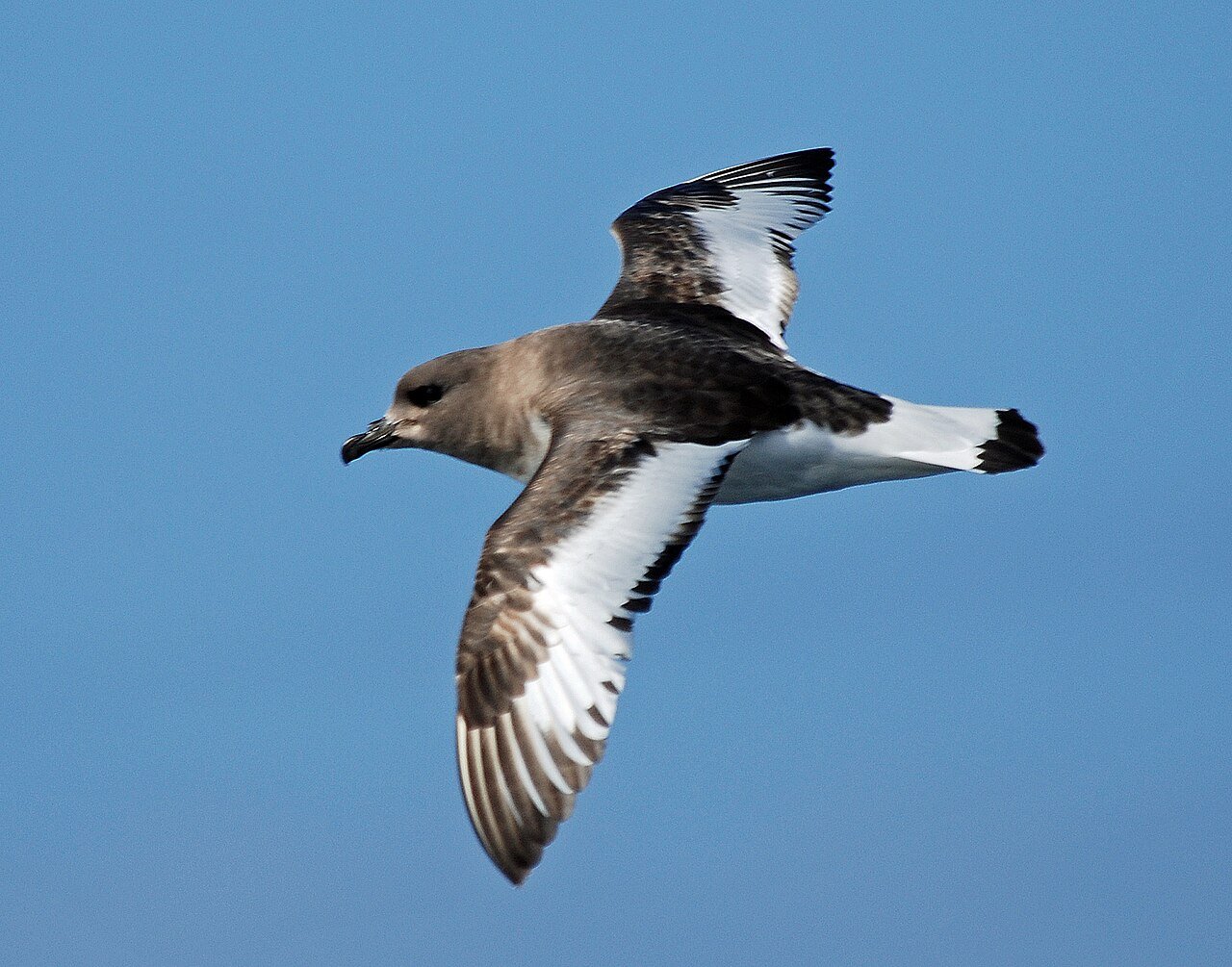
Antarctic Petrel
Thalassoica antarcticaA dark-headed southern petrel with bold white underwing panels, dark upperwings, and a strong gliding flight over Antarctic and subantarctic waters.Field marks
- Length about 40-46 cm, wingspan about 1.0-1.1 m, and weight about 680 g in app detail
- Dark brown head, neck, mantle, and back with white underside
- White tail with a narrow dark tail band
- Upperwing dark brown with a broad white stripe toward the trailing edge
Guide facts
- App detail notes a varied diet, mainly krill, squid, and fish
- Feeds by picking prey from or near the water surface and occasionally follows ships
- Breeds annually in colonies on cliffs and steep rocky slopes
- May be difficult to find in the region, especially from January onward

Petrels and Shearwaters
App section: Petrels, Prions, Shearwaters etc.App detail capturedprimary: captured / app-captureadditional: pending / pending-app-capture
Detail: structuredSource: app-screenshotRights: licensed-app-content
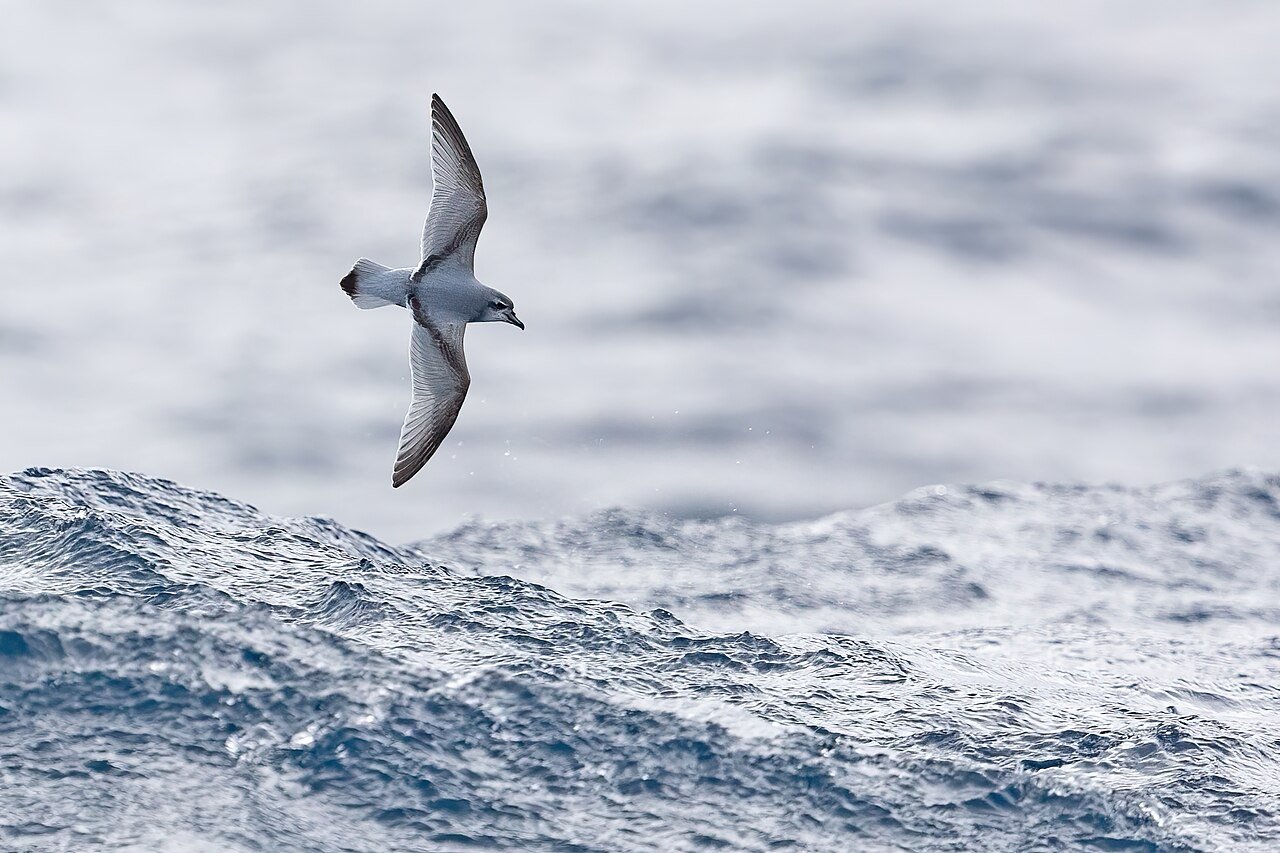
Antarctic Prion
Pachyptila desolataA small pale blue-grey prion with a dark eye stripe, grey breast patching, a dark wing pattern, and fast low flight over Antarctic waters.Field marks
- Length about 25-28 cm, wingspan about 58-66 cm, and weight about 100-200 g in app detail
- Pale blue-grey above with a white supercilium and thick dark eye stripe
- Grey patch on the side of the breast, dark M across the wings, and a noticeable dark tail tip
- Grey beak with a small tubenose, dark legs, and pale underside with some dark on the undertail
Guide facts
- App detail notes mainly krill, planktonic copepods, and amphipods in the diet
- Feeds by scooping water while flying, straining prey through mouth lamellae, and picking prey near the surface
- Can be attracted to ship lights, especially near breeding colonies
- Flies fast with stiff wingbeats, glides, and soars in arcs above waves in strong winds


Petrels and Shearwaters
App section: Petrels, Prions, Shearwaters etc.App detail capturedprimary: captured / app-captureadditional: pending / pending-app-capture
Detail: structuredSource: app-screenshotRights: licensed-app-content
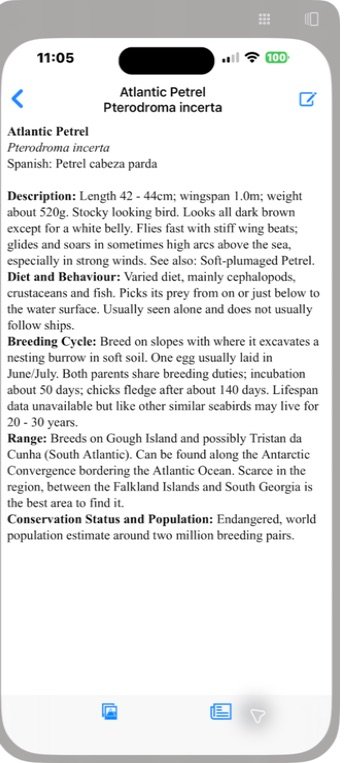
Atlantic Petrel
Pterodroma incertaA stocky dark-brown gadfly petrel with a contrasting white belly, fast stiff-winged flight, and scarce regional occurrence near the Atlantic sector of the Antarctic Convergence.Field marks
- Length about 42-44 cm, wingspan about 1.0 m, and weight about 520 g in app detail
- Stocky dark-brown bird that can look all dark except for the white belly
- Fast stiff wingbeats mixed with glides and high arcing soars over the sea
- App detail notes strong-wind soaring and comparison with Soft-plumaged Petrel
Guide facts
- App detail notes a varied diet, mainly cephalopods, crustaceans, and fish
- Picks prey from on or just below the water surface
- Usually seen alone and does not usually follow ships
- Best regional search area noted by the app is between the Falkland Islands and South Georgia


Petrels and Shearwaters
App section: Petrels, Prions, Shearwaters etc.App detail capturedprimary: captured / app-captureadditional: pending / pending-app-capture
Detail: structuredSource: app-screenshotRights: licensed-app-content
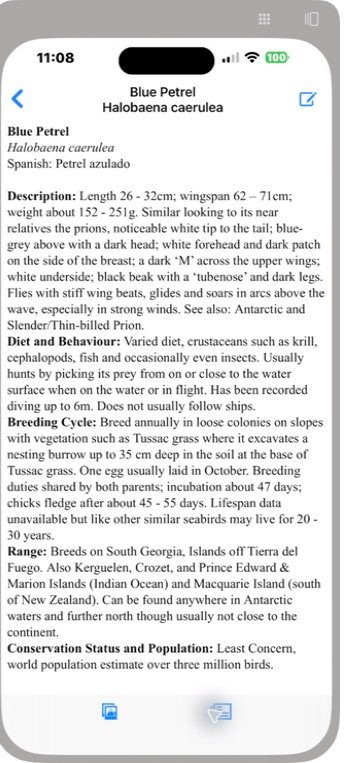
Blue Petrel
Halobaena caeruleaA small blue-grey petrel with a dark eye patch, white forehead, white underparts, and a bold dark M across the upperwings.Field marks
- Length about 26-32 cm, wingspan about 62-71 cm, and weight about 152-251 g in app detail
- Blue-grey above with a dark head and noticeable white tail tip
- White forehead, dark patch on the side of the breast, and white underside
- Black beak with a tubenose and dark legs
Guide facts
- App detail notes varied diet including crustaceans such as krill, cephalopods, fish, and occasionally insects
- Hunts by picking prey from or near the water surface when on the water or in flight
- Has been recorded diving up to about 6 m
- Does not usually follow ships


Petrels and Shearwaters
App section: Petrels, Prions, Shearwaters etc.App detail capturedprimary: captured / app-captureadditional: pending / pending-app-capture
Detail: structuredSource: app-screenshotRights: licensed-app-content
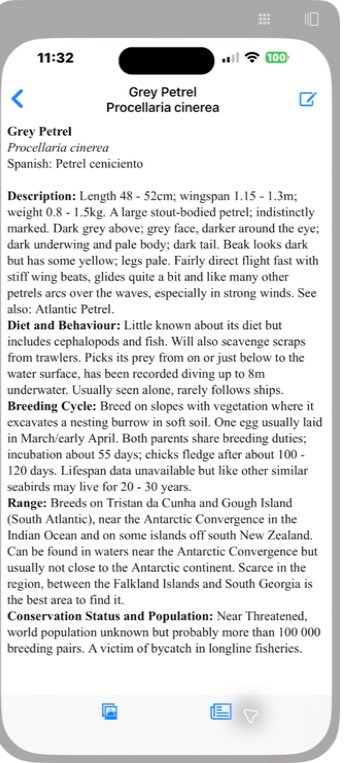
Grey Petrel
Procellaria cinereaA large stout-bodied petrel with dark grey upperparts, grey face, white underwing, pale body, and fast direct flight with stiff wingbeats.Field marks
- Length about 48-52 cm, wingspan about 1.15-1.3 m, and weight about 0.8-1.5 kg in app detail
- Dark grey above with grey face and darker area around the eye
- Dark underwing and pale body
- Dark tail and dark bill with some yellow
Guide facts
- App detail notes fast direct flight with stiff wingbeats and glides
- Will also scavenge scraps from trawlers
- Can dive up to about 8 m underwater
- Usually seen alone and rarely follows ships


Petrels and Shearwaters
App section: Petrels, Prions, Shearwaters etc.App detail capturedprimary: captured / app-captureadditional: pending / pending-app-capture
Detail: structuredSource: app-screenshotRights: licensed-app-content
Kerguelen Petrel
Lugensa brevirostrisA dark gadfly petrel with a white-chinned look, dark bill and legs, and fast stiff-winged flight over rough southern waters.Field marks
- Length about 34 cm, wingspan about 80 cm, and weight about 345-365 g in app detail
- Looks all dark at a distance
- Faint paler patches near the shoulder and wing tips of the underwing
- Dark beak and dark legs
Guide facts
- App detail notes fast stiff wingbeats, glides, and soaring in arcs above the sea
- Often active over waves, especially in strong winds
- Usually seen alone and does not usually follow ships
- App detail points guides to compare with Sooty Shearwater, White-chinned Petrel, and Soft-plumaged Petrel


Petrels and Shearwaters
App section: Petrels, Prions, Shearwaters etc.App detail capturedprimary: captured / app-captureadditional: pending / pending-app-capture
Detail: structuredSource: app-screenshotRights: licensed-app-content
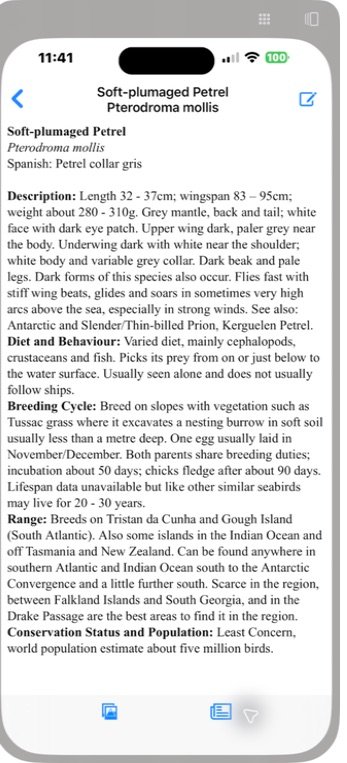
Soft-plumaged Petrel
Pterodroma mollisA grey-mantled gadfly petrel with dark underwings, white face and belly, pale grey collar, and fast high arcs above southern seas.Field marks
- Length about 32-37 cm, wingspan about 83-95 cm, and weight about 280-310 g in app detail
- Grey mantle, back, and tail with white face and dark eye patch
- Upper wing dark and paler grey near the body
- Dark beak and pale legs
Guide facts
- App detail notes fast stiff wingbeats, glides, and very high arcs above the sea
- Picks prey from on or just below the water surface
- Usually seen alone and does not usually follow ships
- Scarce in the region, with the Falkland Islands, South Georgia, and Drake Passage noted as best areas


Petrels and Shearwaters
App section: Petrels, Prions, Shearwaters etc.App detail capturedprimary: captured / app-captureadditional: pending / pending-app-capture
Detail: structuredSource: app-screenshotRights: licensed-app-content
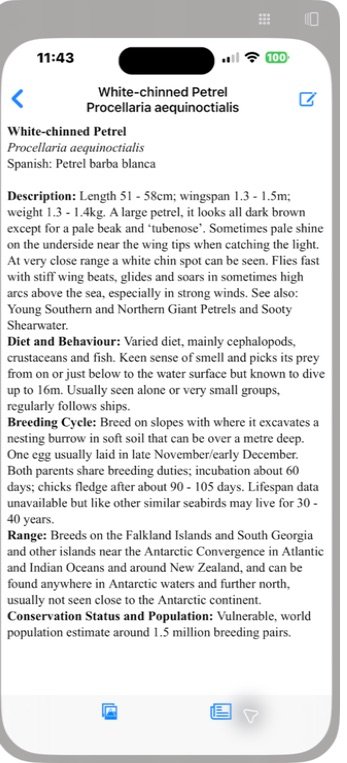
White-chinned Petrel
Procellaria aequinoctialisA very large dark brown petrel with a pale bill, sometimes pale underwing shine, and a close-range white chin spot.Field marks
- Length about 51-58 cm, wingspan about 1.3-1.5 m, and weight about 1.3-1.4 kg in app detail
- Large petrel that looks all dark brown except for a pale beak and tubenose
- Sometimes pale shine on underside near the wing tips when catching the light
- White chin spot can be seen at very close range
Guide facts
- App detail notes a keen sense of smell
- Picks prey from on or just below the water surface
- Can dive up to about 16 m
- Usually seen alone or in very small groups and regularly follows ships


Petrels and Shearwaters
App section: Petrels, Prions, Shearwaters etc.App detail capturedprimary: captured / app-captureadditional: pending / pending-app-capture
Detail: structuredSource: app-screenshotRights: licensed-app-content
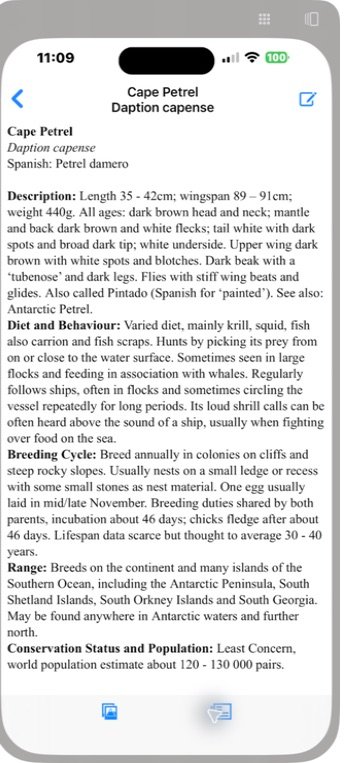
Cape Petrel
Daption capenseA boldly patterned black, brown, and white petrel, often called Pintado, that commonly follows ships around Antarctic and subantarctic waters.Field marks
- Length about 35-42 cm, wingspan about 89-91 cm, and weight about 440 g in app detail
- Dark brown head and neck, with dark brown mantle/back and white flecks
- Tail white with dark spots and broad dark tip
- White underside and upperwing dark brown with white spots and blotches
Guide facts
- App detail notes a varied diet, mainly krill, squid, fish, carrion, and fish scraps
- Often follows ships in flocks and may circle the vessel for long periods
- Hunts by picking prey from or close to the water surface
- Can be heard above the sound of a ship, usually when fighting over food on the sea


Diving Petrels
App section: Petrels, Prions, Shearwaters etc.App detail capturedprimary: captured / app-captureadditional: pending / pending-app-capture
Detail: structuredSource: app-screenshotRights: licensed-app-content
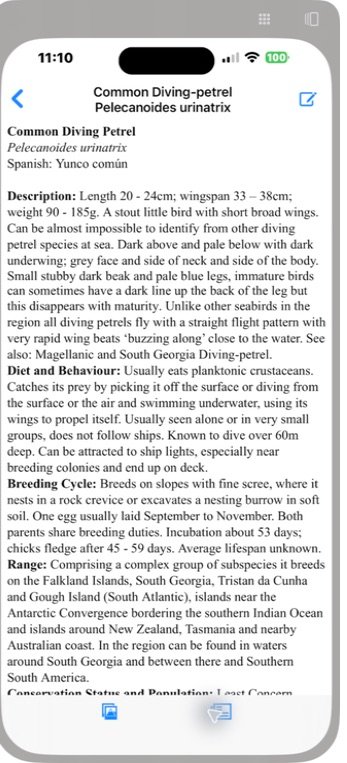
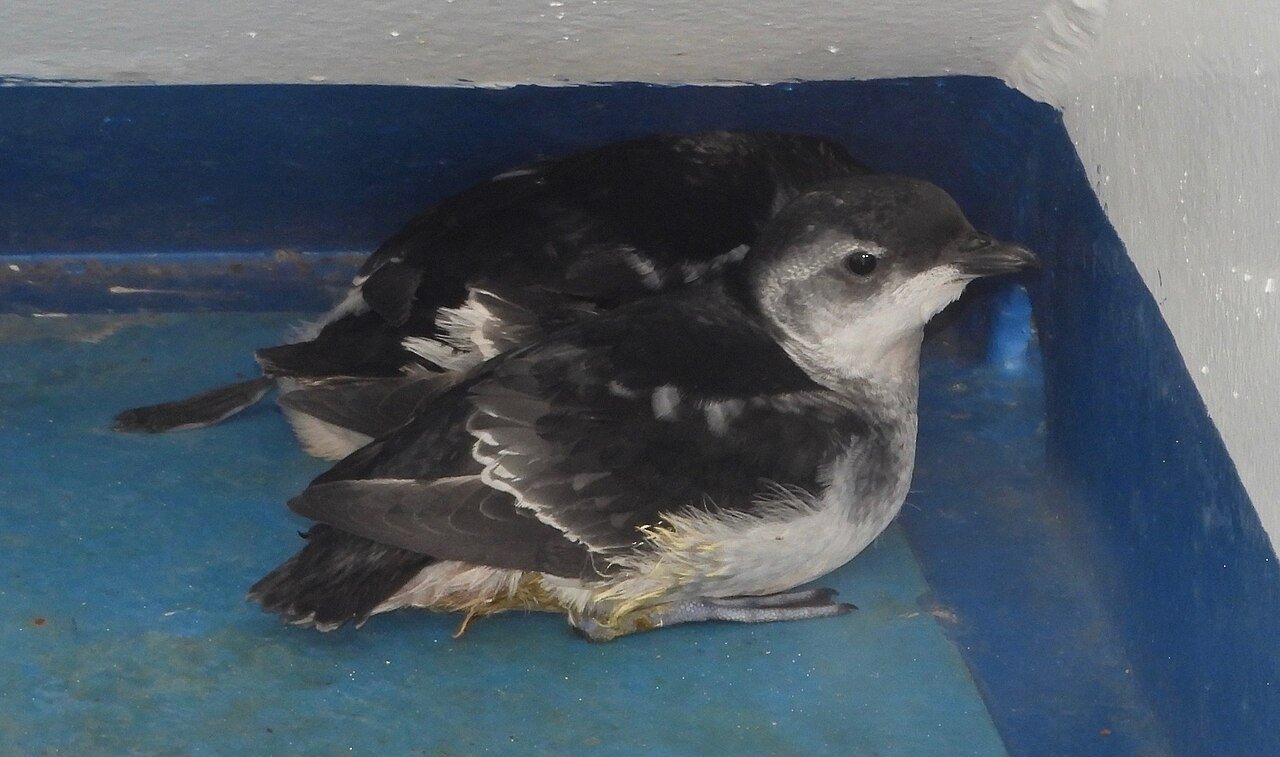
Common Diving-petrel
Pelecanoides urinatrixA small stout diving petrel with short broad wings, dark upperparts, pale underparts, and fast whirring flight low over the sea.Field marks
- Length about 20-24 cm, wingspan about 33-38 cm, and weight about 90-185 g in app detail
- Stout little bird with short broad wings
- Dark above and pale below with dark underwing
- Small stubby dark beak, pale blue legs, and immature birds may show a dark line up the back of the leg
Guide facts
- App detail notes that diving petrels can be difficult to identify at sea
- Unlike other seabirds in the region, all diving petrels fly with a straight flight pattern and very rapid wingbeats
- Usually eats planktonic crustaceans
- Does not follow ships, but can be attracted to ship lights near breeding colonies

Diving Petrels
App section: Petrels, Prions, Shearwaters etc.App detail capturedprimary: captured / app-captureadditional: pending / pending-app-capture
Detail: structuredSource: app-screenshotRights: licensed-app-content
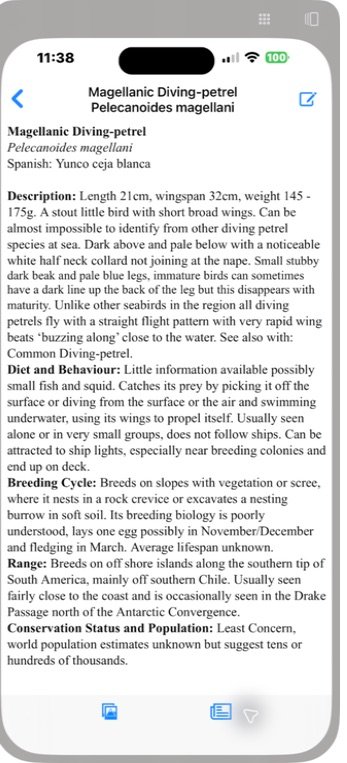
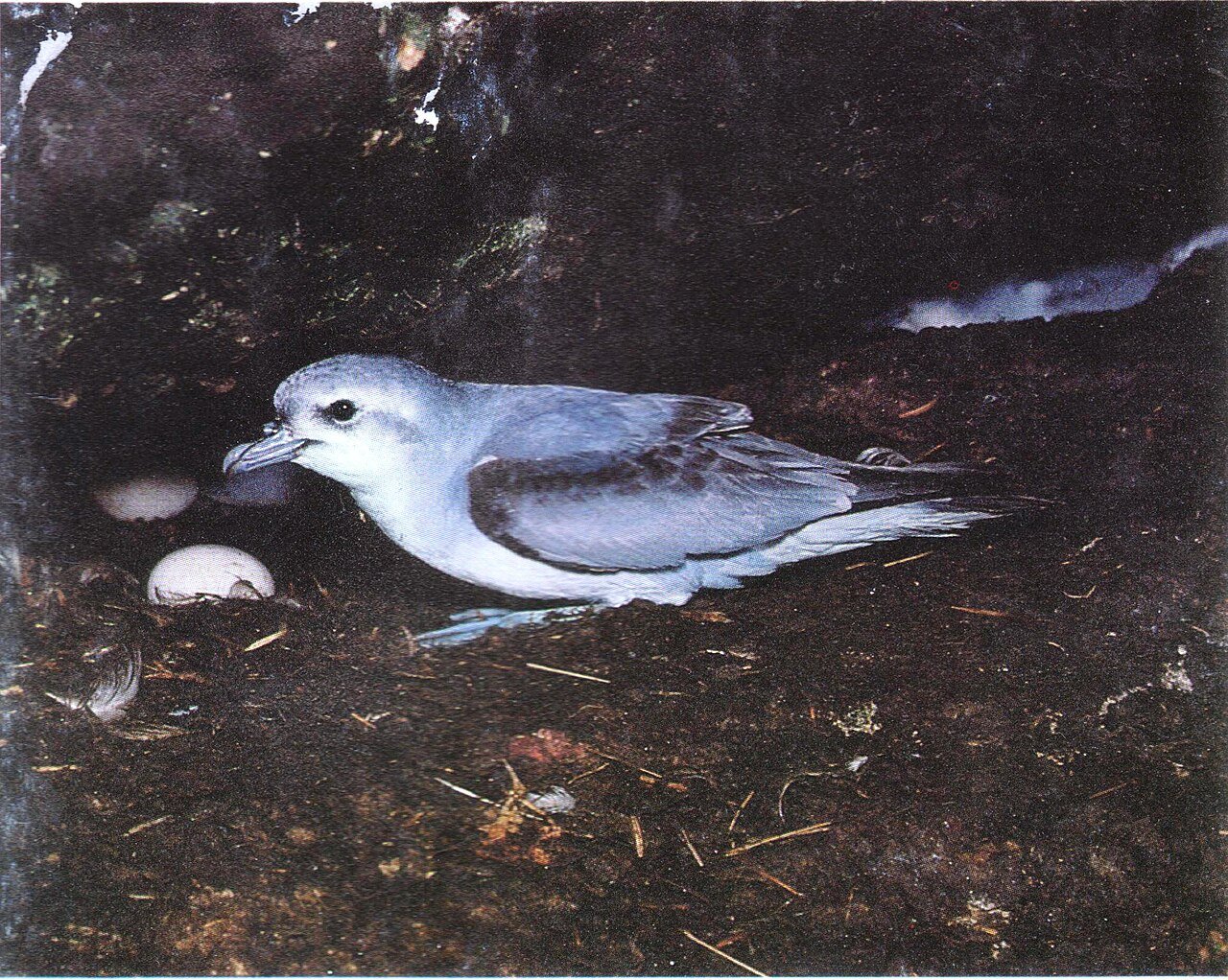
Magellanic Diving-petrel
Pelecanoides magellaniA stout little diving petrel with short broad wings, dark upperparts, pale underparts, white half-neck collar, and rapid straight flight low over the water.Field marks
- Length about 21 cm, wingspan about 32 cm, and weight about 145-175 g in app detail
- Dark above and pale below with a noticeable white half-neck collar not joining at the nape
- Small stubby dark beak and pale blue legs
- Immature birds can sometimes show a dark line up the back of the leg
Guide facts
- App detail notes diving petrels can be almost impossible to identify from other diving petrel species at sea
- Unlike other seabirds in the region, all diving petrels fly with a straight flight pattern and very rapid wingbeats close to the water
- Usually seen alone or in very small groups and does not follow ships
- Can be attracted to ship lights, especially near breeding colonies

Petrels and Shearwaters
App section: Petrels, Prions, Shearwaters etc.App detail capturedprimary: captured / app-captureadditional: pending / pending-app-capture
Detail: structuredSource: app-screenshotRights: licensed-app-content
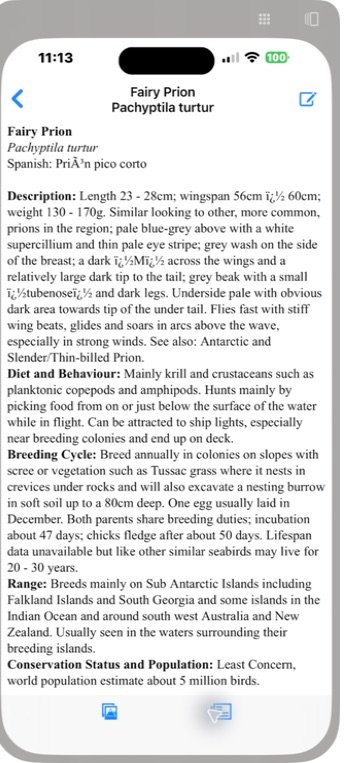
Fairy Prion
Pachyptila turturA small pale blue-grey prion with a dark eye stripe, white supercilium, dark upperwing M, and fast stiff-winged flight over southern waters.Field marks
- Length about 23-28 cm, wingspan about 56-60 cm, and weight about 130-170 g in app detail
- Pale blue-grey above with a white supercilium and thin pale eye stripe
- Grey wash on the side of the breast and a dark M across the wings
- Relatively large dark tail tip, grey beak with a small tubenose, and dark legs
Guide facts
- App detail notes a diet mainly of krill and planktonic crustaceans such as copepods and amphipods
- Hunts mainly by picking food from on or just below the surface of the water while in flight
- Can be attracted to ship lights, especially near breeding colonies
- Breeds annually in colonies on slopes with scree or vegetation such as Tussac grass

Petrels and Shearwaters
App section: Petrels, Prions, Shearwaters etc.App detail capturedprimary: captured / app-captureadditional: pending / pending-app-capture
Detail: structuredSource: app-screenshotRights: licensed-app-content
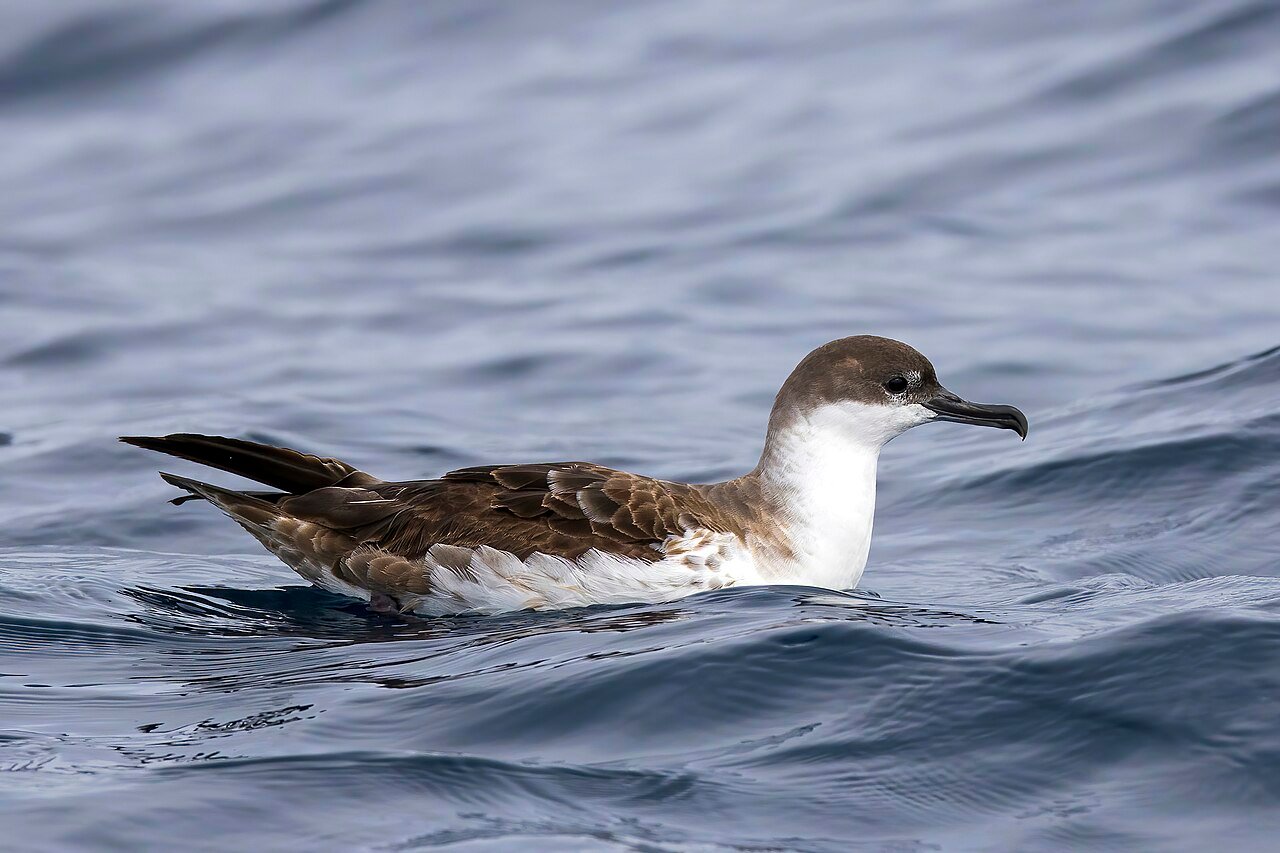
Great Shearwater
Ardenna gravisA large shearwater with a dark cap, pale collar, scaly brown upperparts, pale underwing, and classic arcing shearwater flight.Field marks
- Length about 44-50 cm, wingspan about 1.0-1.2 m, and weight about 700-900 g in app detail
- Dark cap and indistinct pale collar
- Scaly brown mantle, back, and wings with darker tones toward the tips
- Tail black with a variable white crescent at the base, pale underwing with dark edges, pale belly, and dark undertail
Guide facts
- App detail notes a varied diet, mainly fish, cephalopods, crustaceans, and fish scraps from trawlers
- Usually picks prey from on or just below the water surface
- Can dive up to about 19 m underwater using wings and feet
- Can be seen alone or in flocks, does not usually follow ships for long periods

Storm Petrels
App section: Petrels, Prions, Shearwaters etc.App detail capturedprimary: captured / app-captureadditional: pending / pending-app-capture
Detail: structuredSource: app-screenshotRights: licensed-app-content
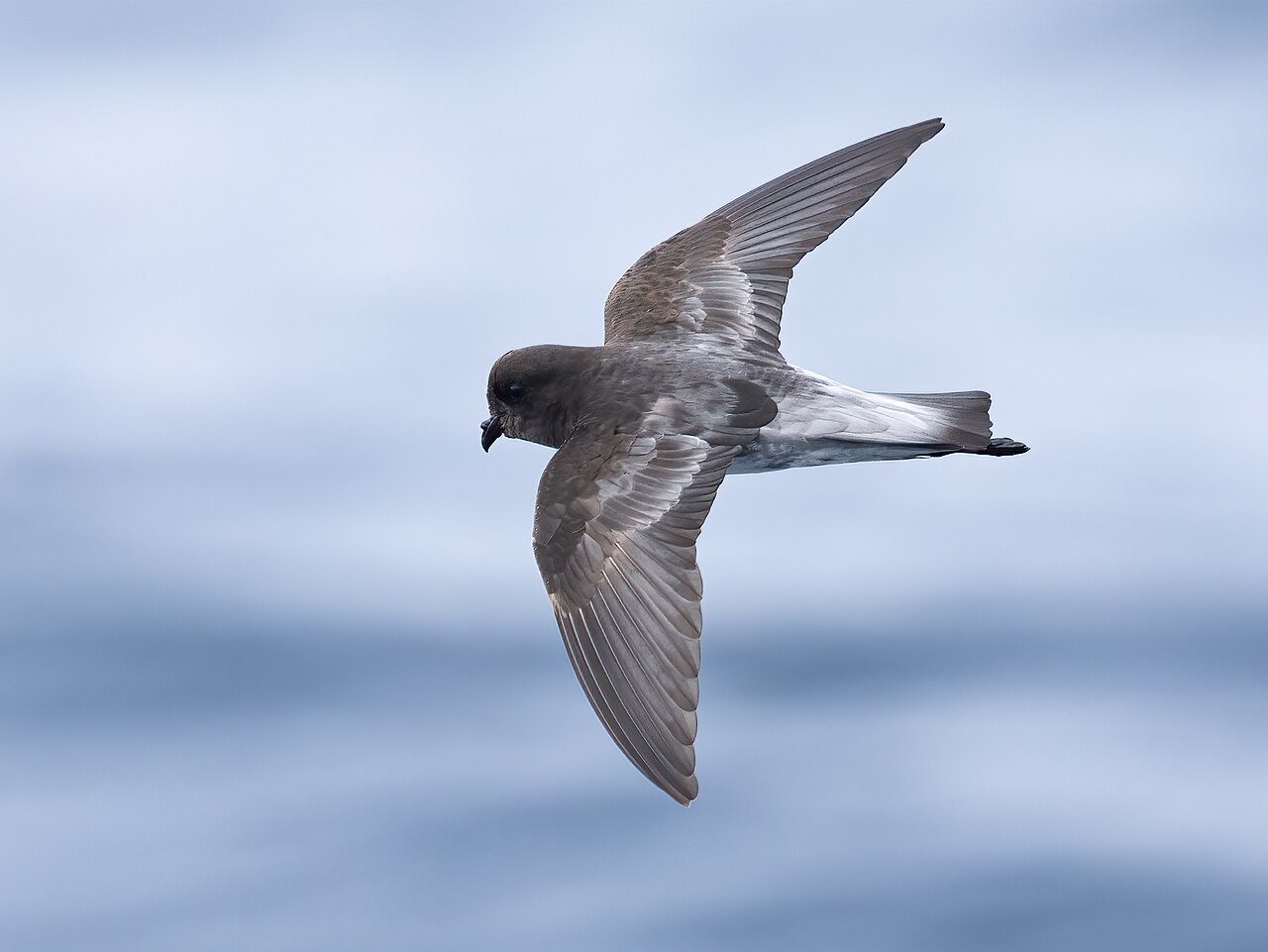
Grey-backed Storm-petrel
Garrodia nereisOne of the smallest birds in the region, a dark storm-petrel with grey rump, grey tail, pale underwing, and erratic dancing flight over the water.Field marks
- Length about 16-19 cm, wingspan about 39 cm, and weight about 21-44 g in app detail
- Upperparts dark with variable indistinct pale wing bar
- Grey rump and grey tail with dark tip
- Underwing white with dark leading edge, undertail and belly white, head/throat/upper breast dark
Guide facts
- App detail notes a varied diet, with planktonic crustaceans especially young barnacles, fish, and squid
- Often dances over the water with legs outstretched and feet pattering on the surface
- Can be seen alone or in small flocks
- Does not usually follow ships


Petrels and Shearwaters
App section: Petrels, Prions, Shearwaters etc.App detail capturedprimary: captured / app-captureadditional: pending / pending-app-capture
Detail: structuredSource: app-screenshotRights: licensed-app-content
Northern Giant Petrel
Macronectes halliA huge brown giant petrel with mottled body plumage, pale pink-yellow bill with pink/red tip, and strong stiff-winged flight around ships and colonies.Field marks
- Length about 80-95 cm, wingspan about 1.5-2.1 m, and weight about 3.8-5.0 kg in app detail
- Adult mottled grey-brown body, wings, and tail
- Pale pink-yellow beak with a deep pink/red tip and a large tubenose
- Immatures begin all dark brown and gradually attain adult plumage over several years
Guide facts
- App detail notes a varied diet and calls the species one of the vultures of the Antarctic
- Often follows ships for long periods and may come within touching distance of a ship
- Unlike other petrels, giant petrels can walk on land and often walk with wings outstretched
- Males usually eat carrion, eggs, and chicks of other birds as well as attacking adult birds, while females mainly hunt fish, squid, and krill


Petrels and Shearwaters
App section: Petrels, Prions, Shearwaters etc.App detail capturedprimary: captured / app-captureadditional: pending / pending-app-capture
Detail: structuredSource: app-screenshotRights: licensed-app-content
Snow Petrel
Pagodroma niveaAn all-white Antarctic petrel with relatively long narrow wings, black bill, dark legs, and stiff-winged flight often near ice.Field marks
- Length about 30-40 cm, wingspan about 75-95 cm, and weight about 200-380 g in app detail
- All ages snow white
- Relatively long narrow wings
- Black beak with a tubenose and dark legs
Guide facts
- App detail notes a varied diet, mainly krill, squid, fish, carrion, and fish scraps
- Hunts by picking prey from on or close to the water surface
- Often seen close to ice and icebergs
- The app notes two subspecies may be recognized: Lesser Snow Petrel and Greater Snow Petrel


Petrels and Shearwaters
App section: Petrels, Prions, Shearwaters etc.App detail capturedprimary: captured / app-captureadditional: pending / pending-app-capture
Detail: structuredSource: app-screenshotRights: licensed-app-content
Sooty Shearwater
Ardenna griseaA dark chocolate-brown shearwater with silvery underwing lining, fast stiff-winged flight, and long arcing glides over strong southern-ocean winds.Field marks
- Length about 40-50 cm, wingspan about 0.95-1.1 m, and weight about 600-900 g in app detail
- All dark sooty brown with silvery lining to the underwing
- Dark beak and dark legs
- Typical shearwater flight with fast stiff wingbeats and glides
Guide facts
- App detail notes a varied diet, mainly fish, cephalopods, and crustaceans
- Picks prey from on or below the water surface
- Can dive up to about 67 m underwater using wings and feet
- Can be seen alone or in flocks, sometimes containing thousands of birds, but does not usually follow ships


Diving Petrels
App section: Petrels, Prions, Shearwaters etc.App detail capturedprimary: captured / app-captureadditional: pending / pending-app-capture
Detail: structuredSource: app-screenshotRights: licensed-app-content
South Georgia Diving Petrel
Pelecanoides georgicusA compact black-and-white diving petrel with a broad white wing bar, black upperparts, and fast low flight close to the water.Field marks
- Length about 20 cm, wingspan about 32 cm, and weight about 90-150 g in app detail
- Little bird with short broad wings
- Dark above and pale below with grey face and side of neck
- Shows thin white lines on the upper wing where the wings meet the back
Guide facts
- App detail notes varied diet, usually planktonic crustaceans such as krill plus small fish and squid
- Catches prey by picking it off the surface or diving from the surface or air
- Usually seen alone or in very small groups and does not follow ships
- Known to dive over 40 m and can be attracted to ship lights, especially near breeding colonies


Petrels and Shearwaters
App section: Petrels, Prions, Shearwaters etc.App detail capturedprimary: captured / app-captureadditional: pending / pending-app-capture
Detail: structuredSource: app-screenshotRights: licensed-app-content
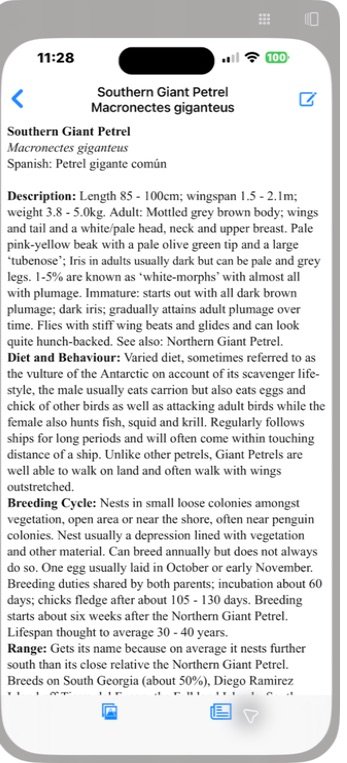
Southern Giant Petrel
Macronectes giganteusA huge grey-brown giant petrel with white head and upper breast, pale pink-yellow bill, and hunch-backed stiff-winged flight around ships and colonies.Field marks
- Length about 85-100 cm, wingspan about 1.5-2.1 m, and weight about 3.8-5.0 kg in app detail
- Adult mottled grey-brown body, wings, and tail with white or pale head, neck, and upper breast
- Pale pink-yellow beak with pale olive-green tip and a large tubenose
- Immatures start all dark brown and gradually attain adult plumage over time
Guide facts
- App detail describes a varied diet and calls giant petrels the vultures of the Antarctic
- Regularly follows ships for long periods and can come within touching distance of a ship
- Unlike other petrels, giant petrels can walk on land and often walk with wings outstretched
- Males usually eat carrion, eggs, and chicks, while females hunt fish, squid, and krill


Albatrosses
App section: AlbatrossesStructured starter recordprimary: starter / public-source
Detail: needs-structured-reviewSource: app-screenshotRights: pending-review
Black-browed Albatross
Thalassarche melanophrisA small southern-ocean albatross recognised by its dark eyebrow, pale head and contrasting underwing pattern.Field marks
- Adult: pale head and body, dark upperparts and a conspicuous eyebrow
- Dark underwing margins surround a broad pale central panel
- Yellow-orange bill; younger birds have a darker bill tip and greyer neck
Guide facts
- Alternates gliding with firm wingbeats
- Can approach vessels; the source guide cautions that prolonged ship-following is not routine

Albatrosses
App section: AlbatrossesStructured starter recordprimary: starter / public-source
Detail: needs-structured-reviewSource: public-sourceRights: public-source-placeholder
Grey-headed Albatross
Thalassarche chrysostomaA southern-ocean mollymawk with a darker head pattern and a bright bill stripe.Field marks
- Grey head and neck
- Black bill with yellow ridge
- White rump
- Dark upperwings
Guide facts
- Often compared with black-browed albatross
- Strong bird for teaching subtle bill and head-pattern differences
- Breeds on remote subantarctic islands

Albatrosses
App section: AlbatrossesStructured starter recordprimary: starter / public-source
Detail: needs-structured-reviewSource: public-sourceRights: public-source-placeholder
Light-mantled Albatross
Phoebetria palpebrataA graceful dark albatross with a pale mantle and long, narrow-winged flight style.Field marks
- Pale grey mantle
- Dark body
- White crescent behind eye
- Long tapered wings
Guide facts
- Beautiful species for explaining dynamic soaring
- Often seen as elegant, arcing silhouettes
- Pairs can perform dramatic aerial displays near colonies

Albatrosses
App section: AlbatrossesStructured starter recordprimary: starter / public-source
Detail: needs-structured-reviewSource: public-sourceRights: public-source-placeholder
Northern Royal Albatross
Diomedea sanfordiA very large albatross with massive wings and mostly white upperwing surfaces in adults.Field marks
- Huge wingspan
- Mostly white upperwings
- Dark cutting edge to bill
- Clean white body
Guide facts
- Good large-albatross comparison with wandering and southern royal
- Less commonly encountered than some mollymawks
- Size and upperwing pattern are key ID cues

Albatrosses
App section: AlbatrossesStructured starter recordprimary: starter / public-source
Detail: needs-structured-reviewSource: public-sourceRights: public-source-placeholder
Sooty Albatross
Phoebetria fuscaA dark albatross with a slim build, long wings, and pale eye-ring.Field marks
- Uniform sooty-brown body
- Long narrow wings
- Pale eye-ring
- Wedge-shaped tail
Guide facts
- A strong contrast species for light-mantled albatross
- Often appears more uniformly dark
- Useful for advanced seabird ID sessions

Albatrosses
App section: AlbatrossesStructured starter recordprimary: starter / public-source
Detail: needs-structured-reviewSource: public-sourceRights: public-source-placeholder
Southern Royal Albatross
Diomedea epomophoraOne of the largest albatrosses, with broad wings and a grand, steady flight profile.Field marks
- Very large size
- White upperwings in adults
- Black edging on wings
- Pinkish bill
Guide facts
- Good for explaining wingspan and energy-saving flight
- Compare with wandering albatross in mixed large-albatross conditions
- Usually a memorable deck-watch sighting

Albatrosses
App section: AlbatrossesStructured starter recordprimary: starter / public-source
Detail: needs-structured-reviewSource: public-sourceRights: public-source-placeholder
Wandering Albatross
Diomedea exulansA huge southern-ocean albatross famous for its enormous wingspan and effortless soaring.Field marks
- Immense wingspan
- White body
- Variable dark upperwing markings
- Large pink bill
Guide facts
- A marquee Drake Passage species
- Excellent for teaching dynamic soaring
- Age affects plumage, so not every bird looks the same

Grebes
App section: GrebesStructured starter recordprimary: starter / public-source
Detail: needs-structured-reviewSource: public-sourceRights: public-source-placeholder
Southern Silvery Grebe
Podiceps occipitalisA small wetland grebe of southern South America and nearby islands.Field marks
- Compact grebe shape
- Silvery cheek pattern
- Freshwater habitat
- Low profile on water
Guide facts
- Most relevant around Falklands and southern South America
- Good reminder that the guide library includes pre- and post-Antarctic ports
- Often needs binoculars for confident ID

Grebes
App section: GrebesStructured starter recordprimary: starter / public-source
Detail: needs-structured-reviewSource: public-sourceRights: public-source-placeholder
White-tufted/Falkland Grebe
Rollandia rollandA southern South American grebe with distinctive white facial tufts in breeding plumage.Field marks
- White facial tufts
- Dark head
- Small diving waterbird
- Freshwater or sheltered wetland habitat
Guide facts
- Useful Falklands species for quieter freshwater stops
- Name varies between white-tufted and Rolland's grebe
- Often compared with silvery grebe

Gulls, Terns and Skuas
App section: Gulls, Terns and SkuasStructured starter recordprimary: starter / public-source
Detail: needs-structured-reviewSource: public-sourceRights: public-source-placeholder
Brown Skua
Stercorarius antarcticusA powerful southern skua seen around colonies, beaches, and coastal feeding areas.Field marks
- Large brown skua
- Heavy build
- White wing flashes
- Direct, assertive flight
Guide facts
- Good species for discussing colony ecology
- May interact with penguin and seabird colonies
- Guides should manage guest spacing around nesting birds
Penguins
App section: PenguinsApp detail capturedprimary: captured / app-captureadditional: pending / pending-app-capture
Detail: structuredSource: app-screenshotRights: licensed-app-content
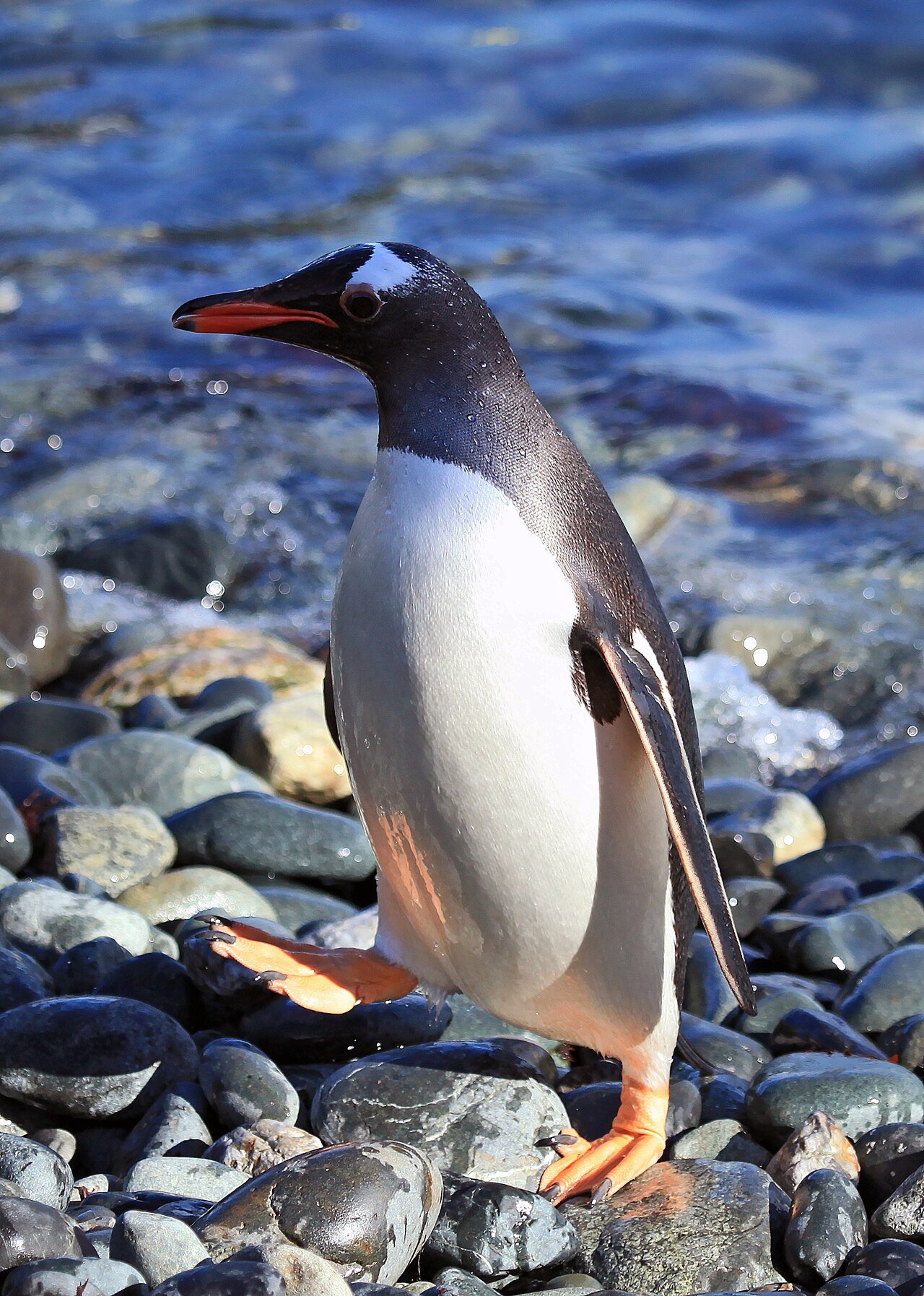
Gentoo Penguin
Pygoscelis papuaA large Pygoscelis penguin with orange-red bill, white head patches joined by a white line, and strong swimming performance.Field marks
- Length about 75-90 cm and weight about 4.5-8.5 kg in app detail
- Third largest penguin and the only penguin with white patches on top of the head
- Dark beak with orange-red sides; feet vary from pale red-orange to almost yellow
- App detail notes dark grey and white with some orange/red on the beak
Guide facts
- App detail notes a varied diet, mainly fish and crustaceans, especially krill
- Average dive is less than 100 m but can be up to 200 m
- Usually does not travel far from the colony to hunt
- Considered the fastest swimming penguin, capable of speeds over 20 mph / 32 kph


Penguins
App section: PenguinsApp detail capturedprimary: captured / app-captureadditional: pending / pending-app-capture
Detail: structuredSource: app-screenshotRights: licensed-app-content
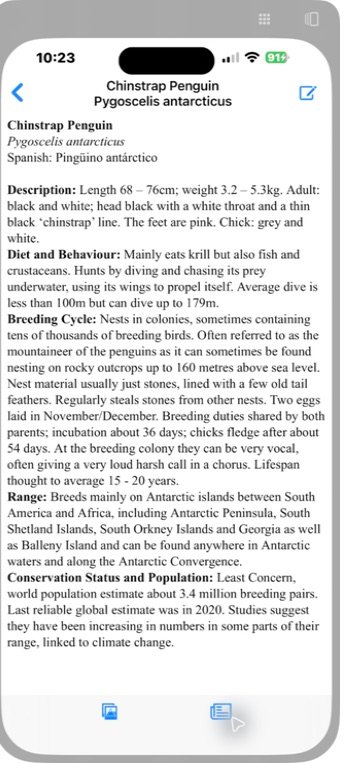
Chinstrap Penguin
Pygoscelis antarcticusA black-and-white Pygoscelis penguin named for its thin black chinstrap line across a white throat and chin.Field marks
- Length about 68-76 cm and weight about 3.2-5.3 kg in app detail
- Adult black and white with black head and white throat
- Thin black chinstrap line is the key field mark
- Feet are pink; chick is grey and white
Guide facts
- App detail notes a diet mainly of krill with fish and crustaceans
- Average dive is less than 100 m but can be up to 179 m
- Usually steals stones from other nests and can nest on rocky outcrops to about 160 m above sea level
- Breeding colony can be very vocal with loud harsh calls in a chorus

Penguins
App section: PenguinsApp detail capturedprimary: captured / app-captureadditional: pending / pending-app-capture
Detail: structuredSource: app-screenshotRights: licensed-app-content
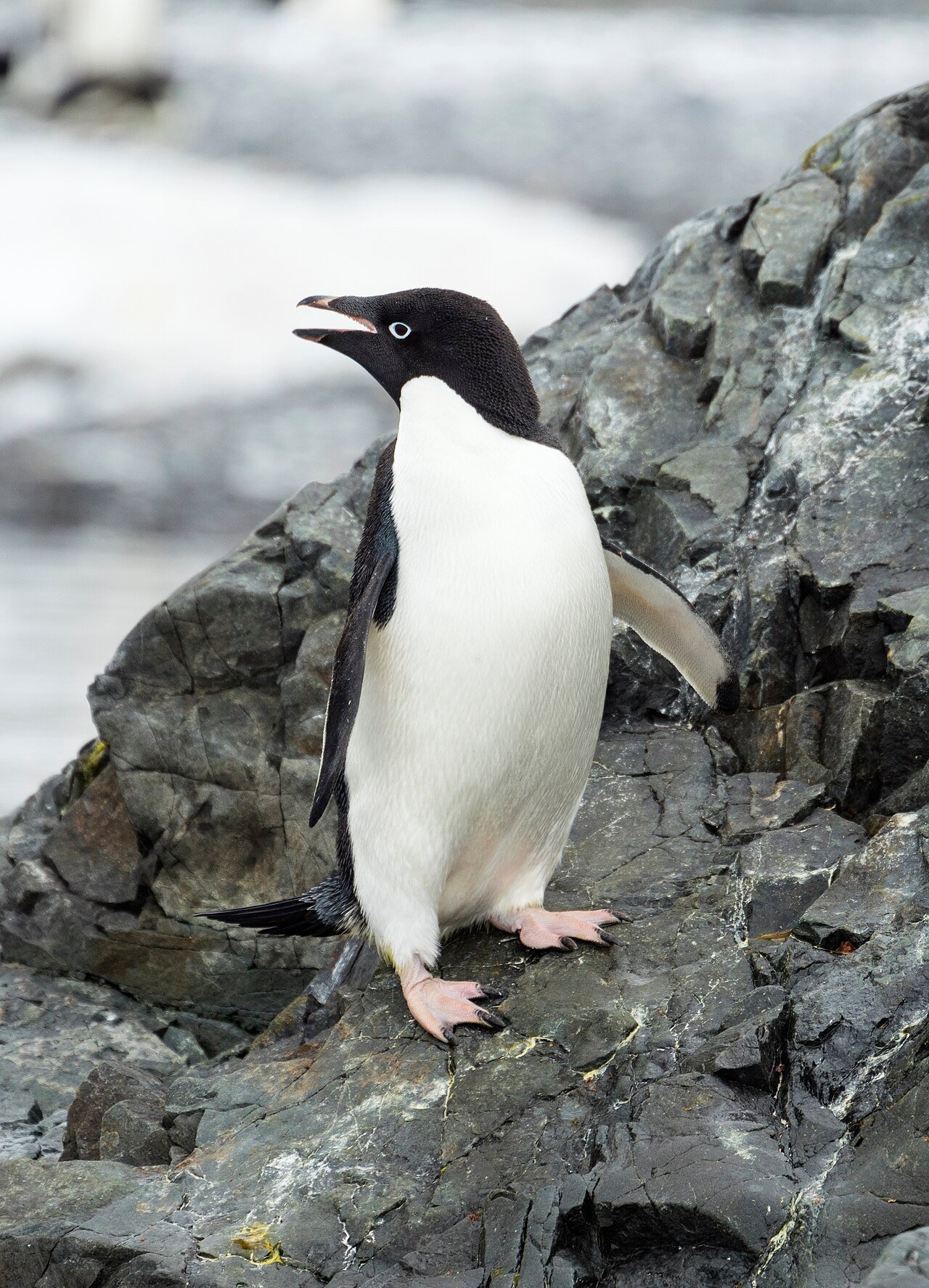
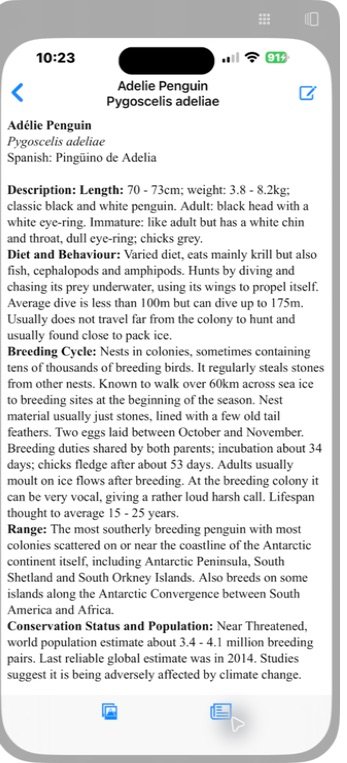
Adelie Penguin
Pygoscelis adeliaeA classic black-and-white Antarctic penguin with a black head, white eye ring, and dense colony nesting around the Antarctic coastline.Field marks
- Length about 70-73 cm and weight about 3.8-8.2 kg in app detail
- Adult has black head with white eye ring
- Chicks are grey and adults are classic black-and-white penguins
- Immature birds look adult-like but with white chin and throat and dull eye ring
Guide facts
- App detail notes a varied diet, mainly krill with fish, cephalopods, and amphipods
- Average dive is less than 100 m but can be up to 175 m
- Nests in colonies and regularly steals stones from other nests
- Can walk over 60 km across sea ice to breeding sites at the beginning of the season


Penguins
App section: PenguinsApp detail capturedprimary: captured / app-captureadditional: pending / pending-app-capture
Detail: structuredSource: app-screenshotRights: licensed-app-content
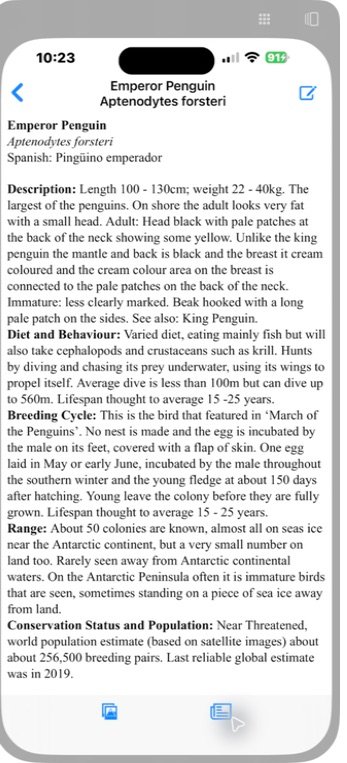
Emperor Penguin
Aptenodytes forsteriThe largest penguin, mostly an Antarctic sea-ice breeder, with pale yellow neck patches and a strong resemblance to King Penguin.Field marks
- Length about 100-130 cm and weight about 22-40 kg in app detail
- Largest penguin; adult looks very fat on shore with small head
- Head black with pale patches at the back of the neck showing some yellow
- Immature birds are less clearly marked; beak is hooked with a long pale side patch
Guide facts
- App detail notes varied diet of mainly fish plus cephalopods and crustaceans such as krill
- Average dive is less than 100 m but can be up to 560 m
- Male incubates the single egg on his feet under a flap of skin through the southern winter
- On the Antarctic Peninsula, sightings are often immature birds or adults on sea ice away from land


Penguins
App section: PenguinsApp detail capturedprimary: captured / app-captureadditional: pending / pending-app-capture
Detail: structuredSource: app-screenshotRights: licensed-app-content
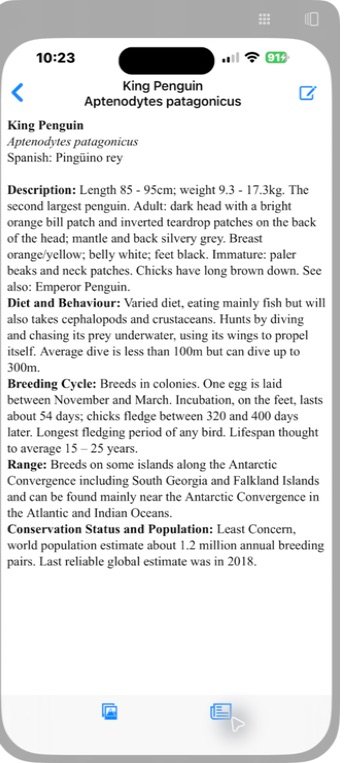
King Penguin
Aptenodytes patagonicusThe second largest penguin, with bright orange bill patching, tear-drop neck patches, and large subantarctic colonies.Field marks
- Length about 85-95 cm and weight about 9.3-17.3 kg in app detail
- Adult has dark head with bright orange bill patch
- Inverted teardrop patches on the back of the head, mantle, and back are silvery grey
- Breast is orange/yellow; belly white; feet black
Guide facts
- App detail notes a varied diet, mainly fish, with cephalopods and crustaceans
- Average dive is less than 100 m but can be up to 300 m
- One egg is laid between November and March; long fledging period can be 320-400 days
- Large populations occur around South Georgia and the Falkland Islands

Penguins
App section: PenguinsApp detail capturedprimary: captured / app-captureadditional: pending / pending-app-capture
Detail: structuredSource: app-screenshotRights: licensed-app-content
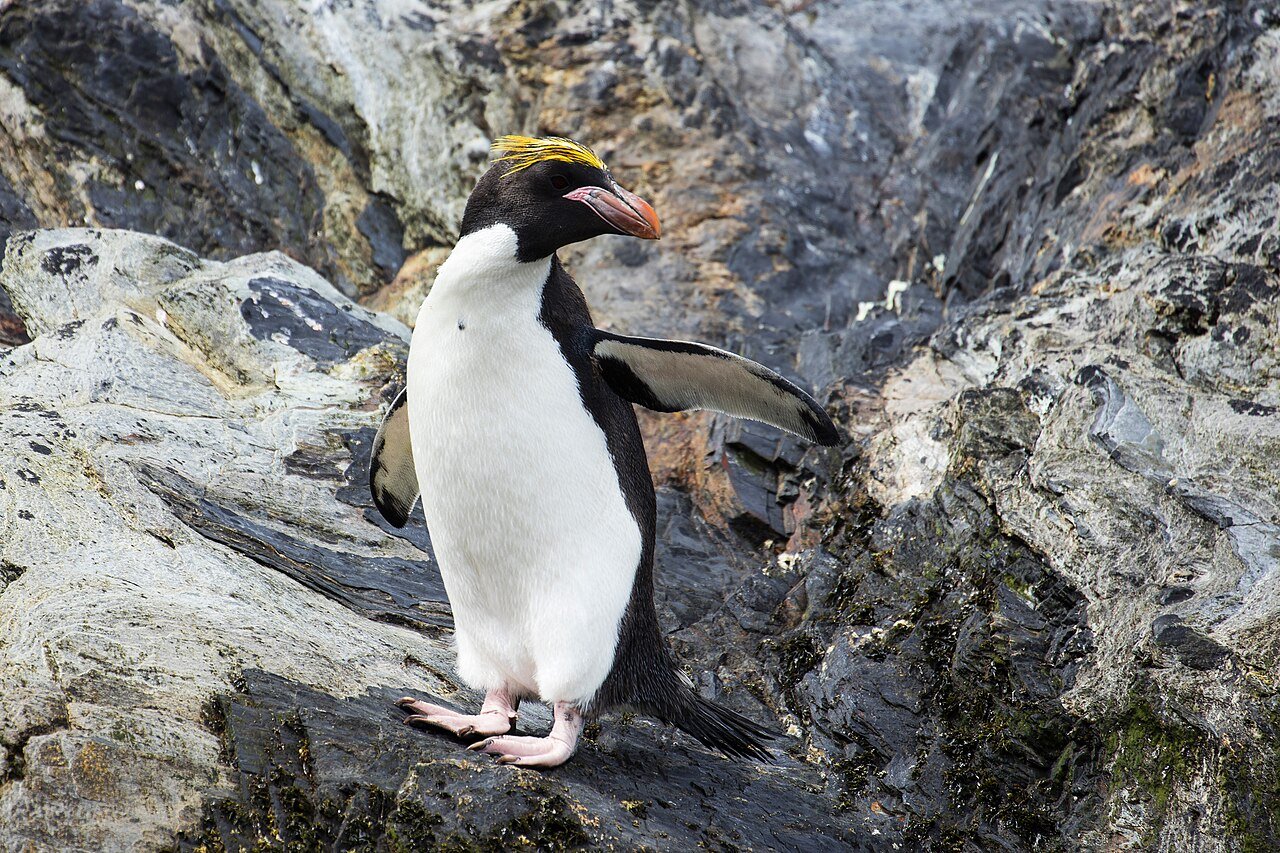
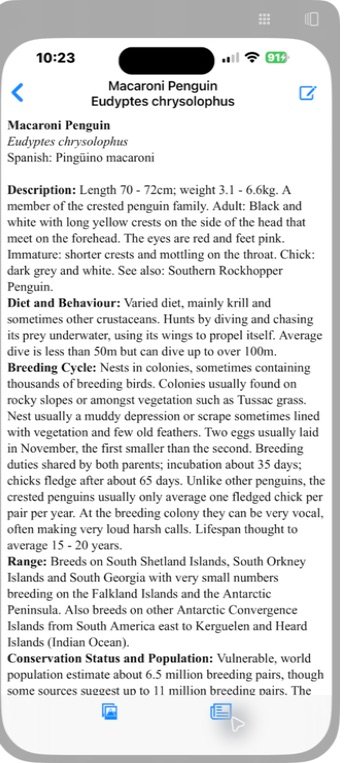
Macaroni Penguin
Eudyptes chrysolophusA crested penguin with black-and-white body, long yellow side crests meeting on the forehead, red feet, and pinkish bill.Field marks
- Length about 70-72 cm and weight about 3.1-6.6 kg in app detail
- Black and white adult with long yellow crests on the side of the head that meet on the forehead
- Eyes are red and feet pink
- Immature birds have shorter crests and mottling on the throat
Guide facts
- App detail notes varied diet, mainly krill and sometimes other crustaceans
- Average dive is less than 50 m but can be up to 100 m
- Nests in colonies, often on rocky slopes or among vegetation such as tussac grass
- Usually lays two eggs in November/December; the first is smaller than the second


Penguins
App section: PenguinsApp detail capturedprimary: captured / app-captureadditional: pending / pending-app-capture
Detail: structuredSource: app-screenshotRights: licensed-app-content
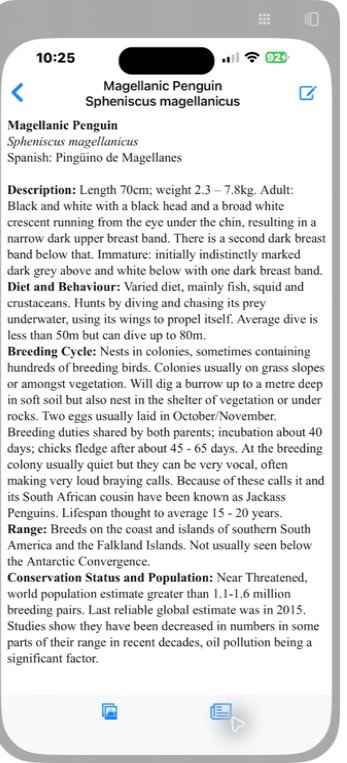
Magellanic Penguin
Spheniscus magellanicusA black-and-white banded penguin of southern South America with a crescent behind the eye and two dark breast bands.Field marks
- Length about 70 cm and weight about 2.3-7.8 kg in app detail
- Adult has black and white pattern with black head and broad white crescent from behind the eye to the upper breast band
- Two dark breast bands are present; immature birds are more indistinctly marked
- Dark grey above and white below with one dark breast band on younger birds
Guide facts
- App detail notes varied diet, mainly fish, squid, and crustaceans
- Average dive is less than 50 m but can be up to 80 m
- Colonies occur on grass slopes or among vegetation, with burrows up to a metre deep in soft soil
- Vocal calls at the colony can sound like a braying donkey


Penguins
App section: PenguinsApp detail capturedprimary: captured / app-captureadditional: pending / pending-app-capture
Detail: structuredSource: app-screenshotRights: licensed-app-content
Southern Rockhopper Penguin
Eudyptes chrysocomeA crested penguin with yellow head plumes, red eyes, pink feet, and loud cliff-colony breeding behavior around the Falklands.Field marks
- Length about 45-58 cm and weight about 2.0-3.8 kg in app detail
- Member of the crested penguin family
- Black and white adult with yellow crests on the side of the head
- Eyes are red and feet pink; immature birds only have crest bands and mottling on the throat
Guide facts
- App detail notes varied diet of fish, cephalopods, and crustaceans
- Average dive is less than 20 m but can be up to 45 m
- Colonies are usually on cliff-tops or scree and can mix with Black-browed Albatrosses
- App detail notes Southern Rockhopper breeds mainly in the Falkland Islands and islands around Cape Horn


Seals
App section: SealsApp detail capturedprimary: captured / app-captureadditional: pending / pending-app-capture
Detail: structuredSource: app-screenshotRights: licensed-app-content
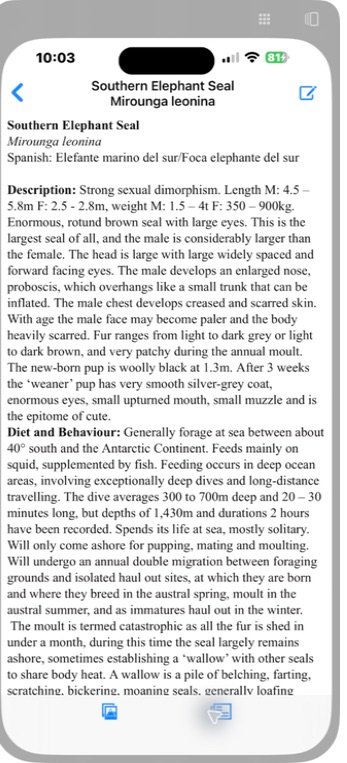
Southern Elephant Seal
Mirounga leoninaA huge, strongly dimorphic southern seal and the largest seal species, often encountered ashore for pupping, mating, molting, or resting.Field marks
- Male about 4.5-5.8 m and female about 2.5-2.8 m in app detail
- Adult male has an enlarged nose/proboscis that hangs over the mouth
- Very large rounded brown seal with large forward-facing eyes
- Male chest develops creased and scarred skin; fur ranges from light to dark grey or light to dark brown
Guide facts
- App detail notes females are mainly squid feeders supplemented by fish
- Deep-ocean foragers with very deep, long-distance travel; app detail notes average dives around 300-700 m and 20-30 minutes
- Come ashore for pupping, mating, molting, and annual resting or haul-out periods
- Wallow behavior includes belching, farting, scratching, bickering, moaning, and generally loafing

Seals
App section: SealsApp detail capturedprimary: captured / app-captureadditional: pending / pending-app-capture
Detail: structuredSource: app-screenshotRights: licensed-app-content
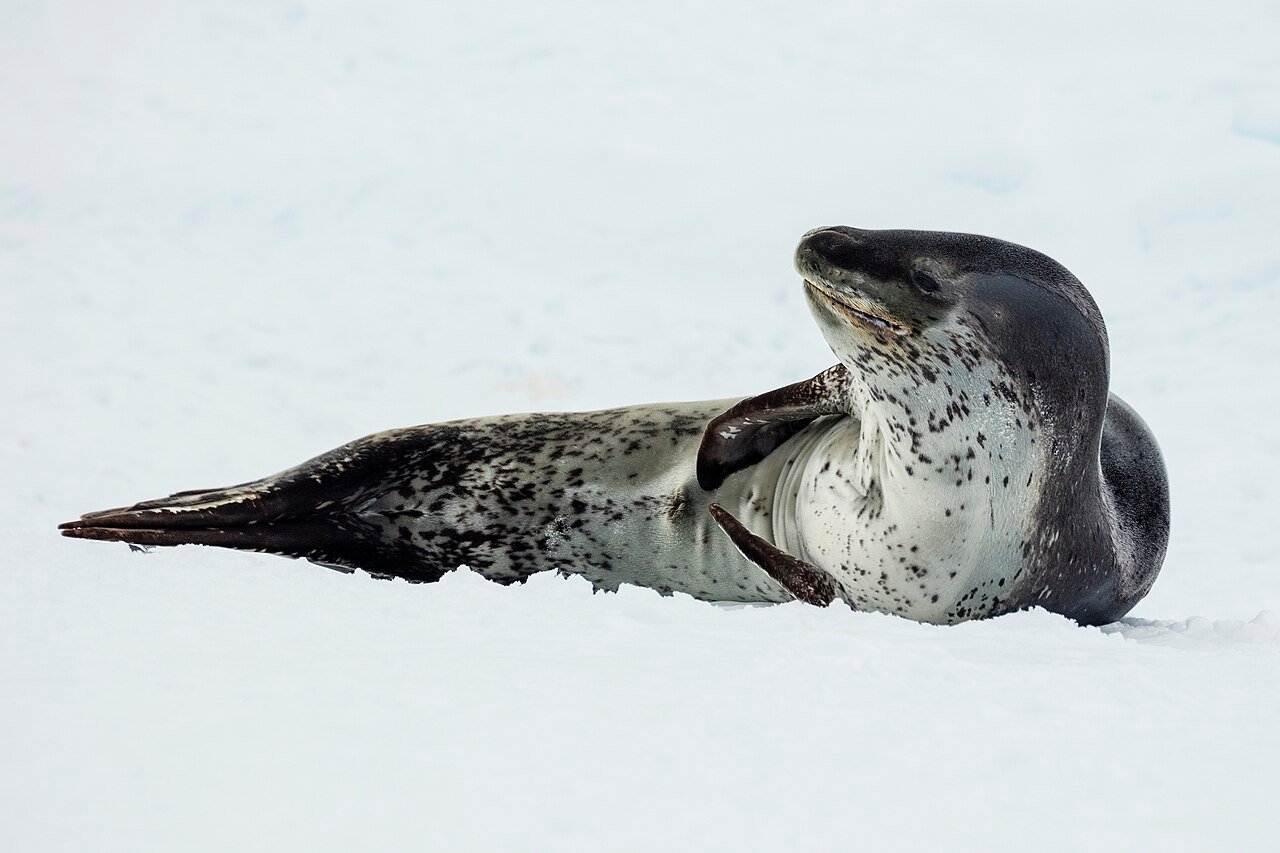
Leopard Seal
Hydrurga leptonyxA large predatory Antarctic seal with a reptilian head profile, spotted coat, long neck, and powerful fore-flippers.Field marks
- Males about 2.8-3.3 m and females about 2.9-3.6 m in app detail
- Large, slender, muscular body with top-heavy grey seal shape
- Large reptilian head, large shoulders, short clear whiskers, and grey spotting
- Female is larger but hard to distinguish at sea
Guide facts
- App detail notes a broad prey range: krill, fish, squid, penguins, seabirds, juvenile seals, Southern Elephant Seal, and fur seals
- Large prey can be skinned by shaking it at the surface while holding it in the teeth
- Often hauls out on sea ice or small icebergs and can be territorial/aggressive toward small boats
- Moults between January and February; mating is believed to occur in water


Toothed Whales and Dolphins
App section: Toothed Whales and DolphinsApp detail capturedprimary: captured / app-captureadditional: pending / pending-app-capture
Detail: structuredSource: app-screenshotRights: licensed-app-content
Orca
Orcinus orcaA large, stocky toothed whale with variable Antarctic ecotypes, rounded head, white saddle patch, and distinctive white eye patch.Field marks
- Length about 5-8 m and weight about 2-9 t in app detail
- Large stocky grey or black body with prominent rounded head
- Variable oval white eye patch behind the eye and grey saddle behind the dorsal fin
- Male dorsal fin can reach about 2 m tall while female dorsal fin is smaller and falcate
Guide facts
- App detail describes Antarctic Type A, Type D, Large Type B, Small Type B, and Type C forms
- Diet can include single-celled algae coating/discolouring the skin in southern waters
- Some ecotypes show grey rather than black-and-white patterning because of diatoms on the skin
- Use ecotype interpretation carefully because Antarctic killer whale morphology is complex


Toothed Whales and Dolphins
App section: Toothed Whales and DolphinsApp detail capturedprimary: captured / app-captureadditional: pending / pending-app-capture
Detail: structuredSource: app-screenshotRights: licensed-app-content
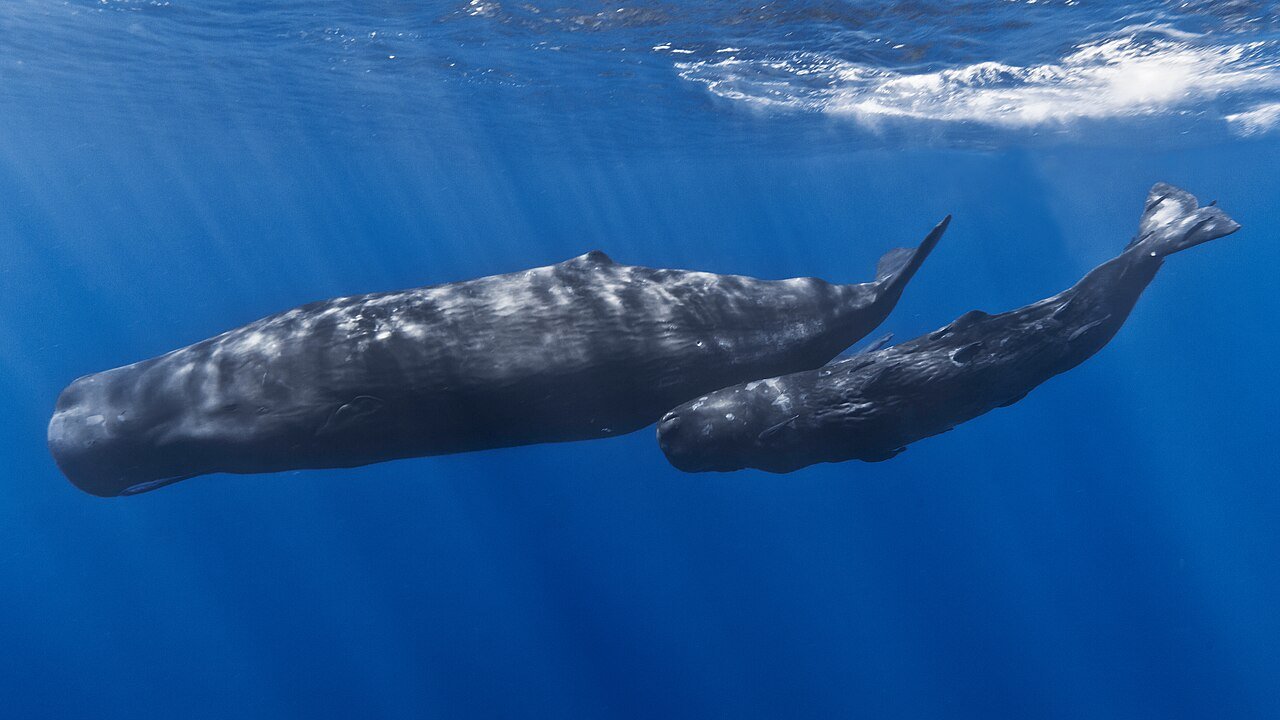
Sperm Whale
Physeter macrocephalusA strongly sexually dimorphic deep-diving toothed whale with a huge blunt head, wrinkled skin, and distinctive angled blow.Field marks
- Male about 15-20.5 m and female about 11-12 m in app detail
- Large elongate grey to brown whale with a prominent flat block-like head
- Inconspicuous hump-like triangular dorsal fin followed by smooth-edged flukes
- Asymmetrical head creates a distinctive side-angled blow
Guide facts
- App detail calls it a famous predator of large squid, cephalopods, and small benthic rays
- Adult males can dive over 2 hours and about 3000 m
- Males are often solitary outside breeding while females and juveniles stay in close groups
- App detail describes the spermaceti organ helping control buoyancy during deep dives


Toothed Whales and Dolphins
App section: Toothed Whales and DolphinsApp detail capturedprimary: captured / app-captureadditional: pending / pending-app-capture
Detail: structuredSource: app-screenshotRights: licensed-app-content
Arnoux's Beaked Whale
Berardius arnuxiiA large southern beaked whale with a long beak, prominent forehead bulge, small far-set dorsal fin, and often pale-scratched body.Field marks
- Length about 8-12 m and weight about 7-11 t in app detail
- Large long dark grey-brown whale with prominent pale scratches
- Long beak and prominent forehead bulge
- Small slanted dorsal fin set far down the back; blunt rounded flippers
Guide facts
- App detail notes squid and probably bottom/pelagic fish as prey
- Very adept divers, adapted to life under or around ice where breathing holes are far apart
- Can dive well beyond 7 km between breaths according to app detail
- Known for aerial displays, repeated full-body breaches, and occasional groups up to about 80 animals


Toothed Whales and Dolphins
App section: Toothed Whales and DolphinsApp detail capturedprimary: captured / app-captureadditional: pending / pending-app-capture
Detail: structuredSource: app-screenshotRights: licensed-app-content
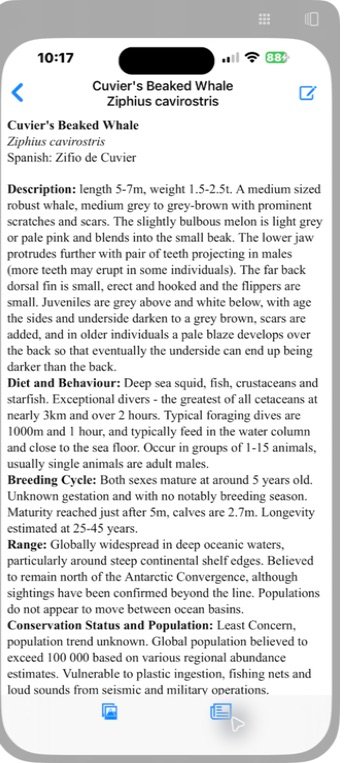
Cuvier's Beaked Whale
Ziphius cavirostrisA deep-diving beaked whale with a robust body, pale head tones in adults, and small posterior dorsal fin.Field marks
- Robust beaked whale with compact head and short beak
- Small dorsal fin set well back on the body
- Adult males can show pale or whitish head and scarring
- Often inconspicuous at sea except for low surfacing profile
Guide facts
- App record captured as part of the Toothed Whales and Dolphins group
- Best interpreted as a deep-diving squid specialist
- Usually seen briefly at the surface between long dives
- Good comparison species for Arnoux's, strap-toothed, and southern bottlenose whales


Toothed Whales and Dolphins
App section: Toothed Whales and DolphinsApp detail capturedprimary: captured / app-captureadditional: pending / pending-app-capture
Detail: structuredSource: app-screenshotRights: licensed-app-content
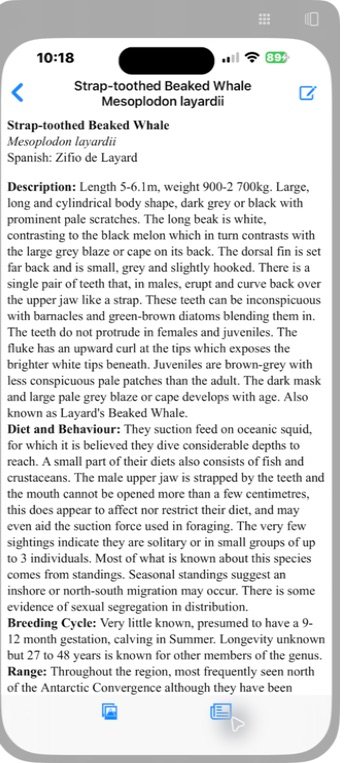
Strap-toothed Beaked Whale
Mesoplodon layardiiA large cylindrical beaked whale with pale scratches, a strong dark mask in adults, and distinctive strap-like male teeth.Field marks
- Length about 5-6.1 m and weight about 900-2700 kg in app detail
- Large long cylindrical dark grey or black body with prominent pale scratches
- Long beak is white, contrasting with black melon and pale grey chest
- In males, erupting lower-jaw teeth curve over the upper jaw like a strap
Guide facts
- App detail notes suction feeding on oceanic squid beyond the shelf edge, with some fish and crustaceans
- Very few sightings indicate they are solitary or in small groups up to three
- Seasonal strandings suggest inshore or north-south migration may occur
- App detail notes very little is known about the breeding cycle


Toothed Whales and Dolphins
App section: Toothed Whales and DolphinsApp detail capturedprimary: captured / app-captureadditional: pending / pending-app-capture
Detail: structuredSource: app-screenshotRights: licensed-app-content
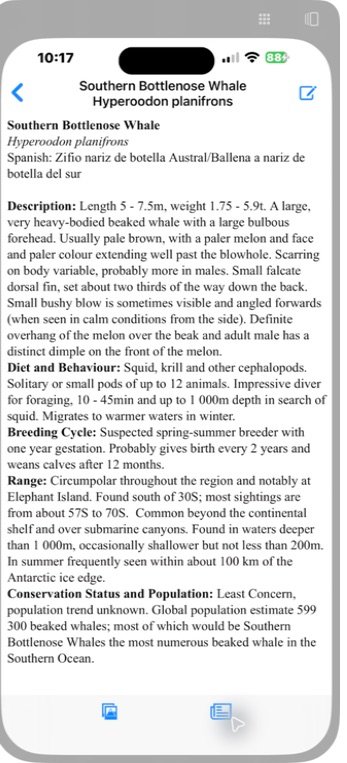
Southern Bottlenose Whale
Hyperoodon planifronsA southern beaked whale with a bulbous forehead, short beak, and small falcate dorsal fin, usually interpreted as a deep-water squid hunter.Field marks
- Large beaked whale with bulbous forehead and short beak
- Small dorsal fin set far back on the body
- Grey-brown body can show scarring and pale marks
- Profile can be confused with other southern beaked whales in quick views
Guide facts
- App record captured from the Toothed Whales and Dolphins group
- Useful species for explaining deep-diving beaked whale ecology
- Often associated with offshore and deep-water habitat
- Compare carefully with Arnoux's and other beaked whales during interpretation

Toothed Whales and Dolphins
App section: Toothed Whales and DolphinsApp detail capturedprimary: captured / app-captureadditional: pending / pending-app-capture
Detail: structuredSource: app-screenshotRights: licensed-app-content
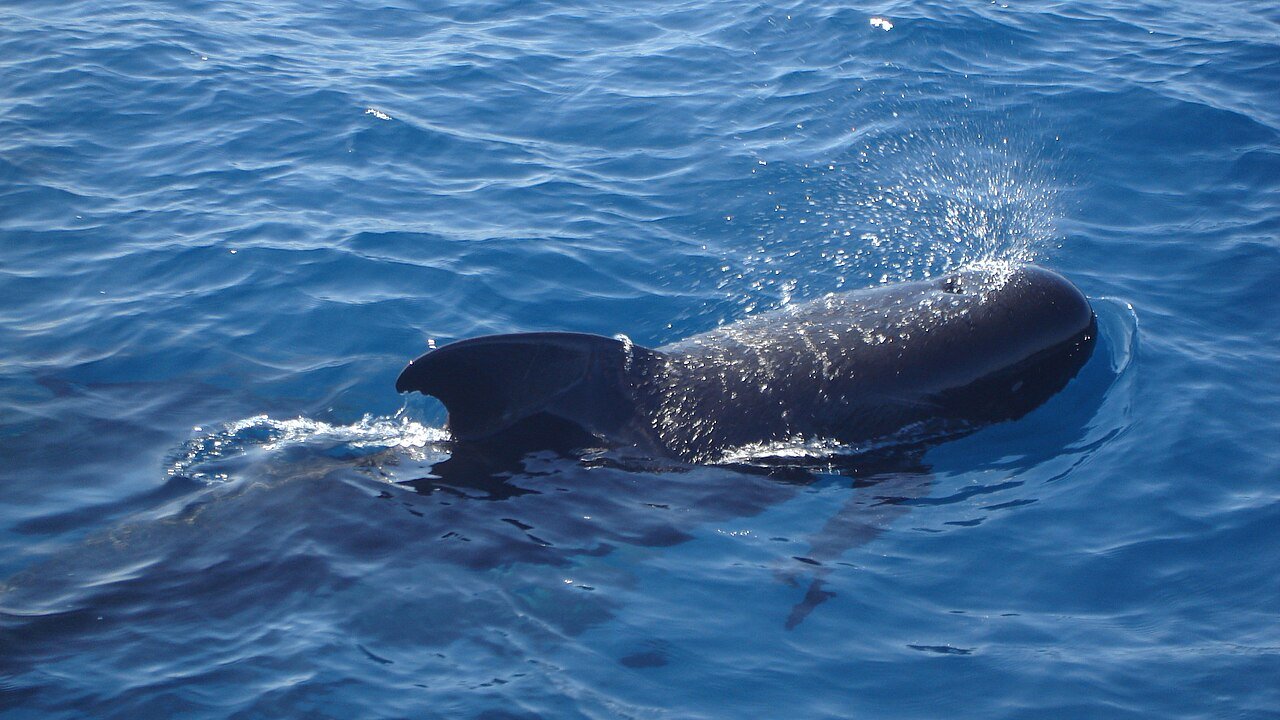
Long-finned Pilot Whale
Globicephala melasA social dark toothed whale with a rounded bulbous head, long sickle-shaped flippers, and group-travel behavior.Field marks
- Dark stocky whale with rounded forehead and no distinct beak
- Long narrow flippers give the species its common name
- Low, curved dorsal fin set forward on the back
- Often encountered in social groups rather than alone
Guide facts
- App detail captured for the full Toothed Whales and Dolphins import
- Good species for discussing social structure and mass-stranding behavior
- Often associated with squid prey and deeper water
- Can be compared with orca and large dolphins by head shape and dorsal fin form


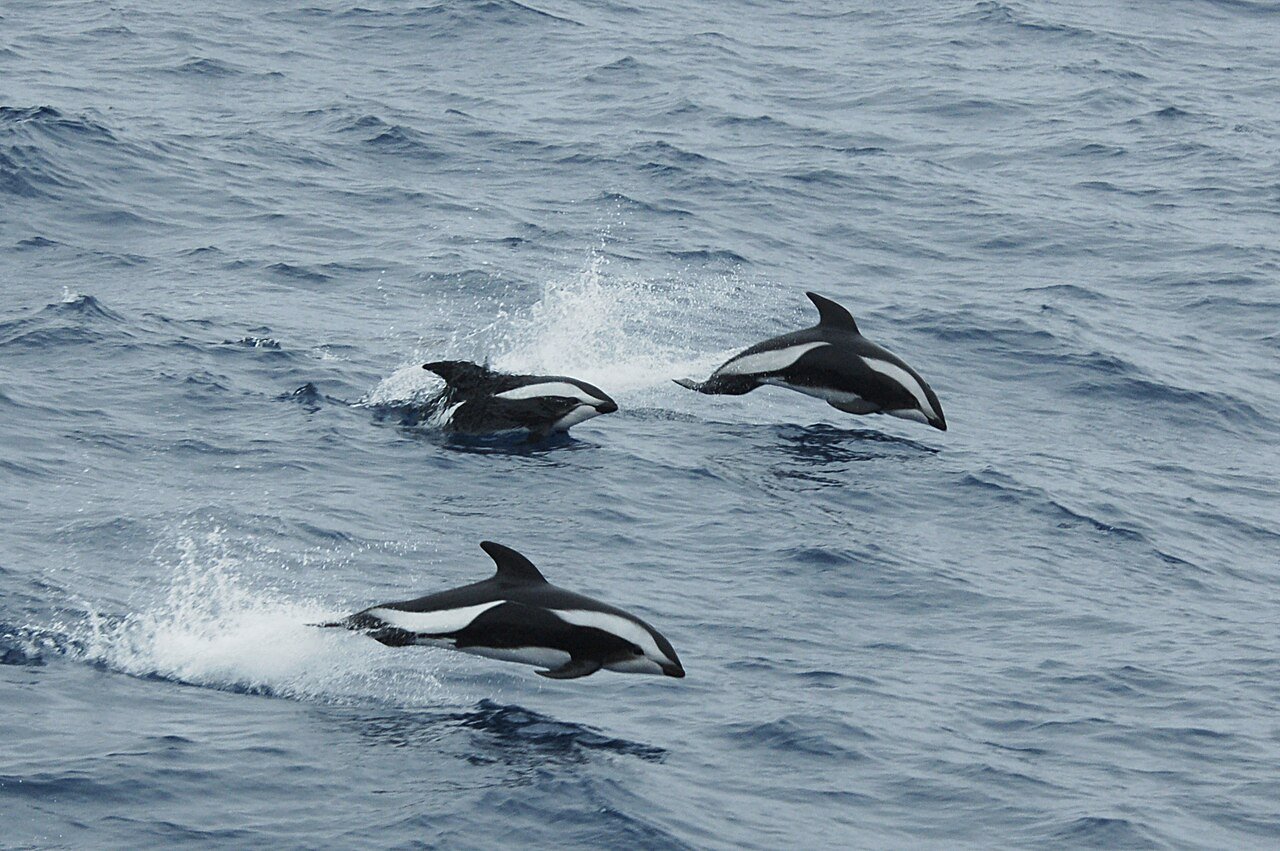
Toothed Whales and Dolphins
App section: Toothed Whales and DolphinsApp detail capturedprimary: captured / app-captureadditional: pending / pending-app-capture
Detail: structuredSource: app-screenshotRights: licensed-app-content
Hourglass Dolphin
Lagenorhynchus crucigerA small, fast southern ocean dolphin with bold black-and-white hourglass patterning and energetic bow-riding behavior.Field marks
- Small compact dolphin with sharply contrasting black-and-white pattern
- White side patches form the hourglass shape
- Dark back, dark flippers, and prominent dorsal fin
- Often seen moving quickly in rough southern seas
Guide facts
- App detail captured in the Toothed Whales and Dolphins group
- One of the most distinctive dolphin IDs in Antarctic and subantarctic waters
- Useful for Drake Passage interpretation and watchkeeping
- Often appears in active groups and can bow-ride vessels

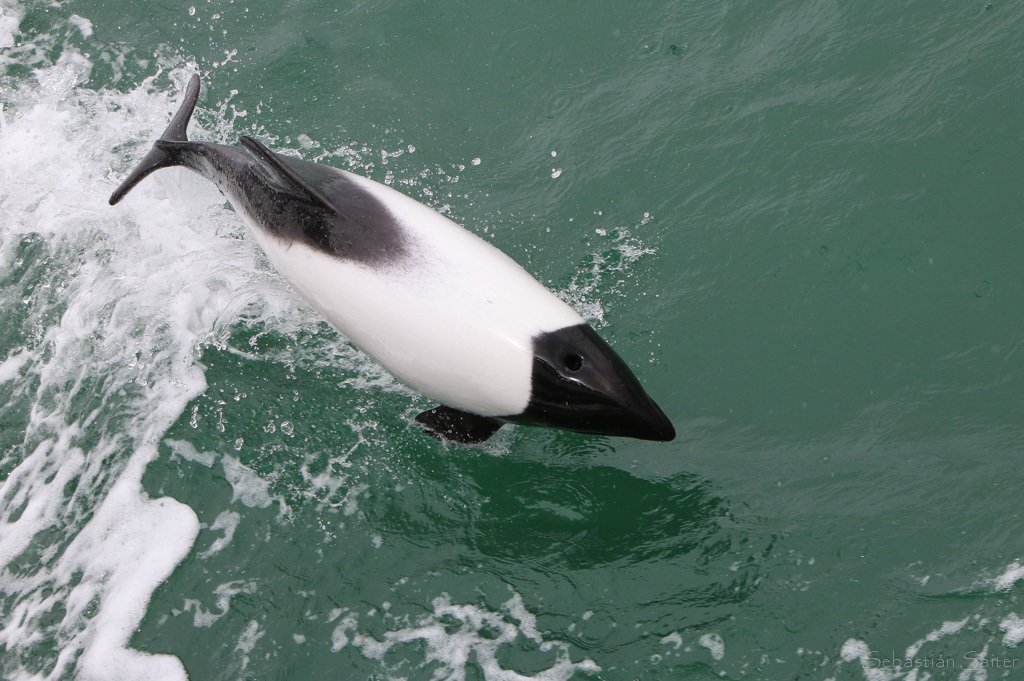
Toothed Whales and Dolphins
App section: Toothed Whales and DolphinsApp detail capturedprimary: captured / app-captureadditional: pending / pending-app-capture
Detail: structuredSource: app-screenshotRights: licensed-app-content
Commerson's Dolphin
Cephalorhynchus commersoniiA small black-and-white dolphin of southern South America, often seen in coastal waters around the Falklands and Beagle Channel.Field marks
- Small dolphin with bold black-and-white body pattern
- Rounded head with little or no obvious beak
- Dark flippers, tail, and dorsal fin contrast with white body areas
- Often active close to shore or around vessels
Guide facts
- App detail captured from the full Toothed Whales and Dolphins list
- A strong regional indicator for Falklands and Ushuaia/Beagle Channel itineraries
- Good comparison species for Peale's and dusky dolphins
- Energetic surfacing behavior makes it useful for guest ID practice

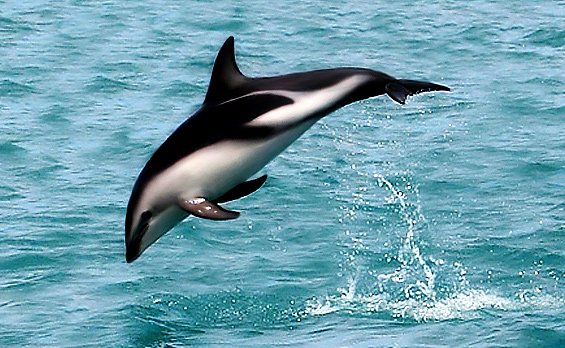
Toothed Whales and Dolphins
App section: Toothed Whales and DolphinsApp detail capturedprimary: captured / app-captureadditional: pending / pending-app-capture
Detail: structuredSource: app-screenshotRights: licensed-app-content
Dusky Dolphin
Lagenorhynchus obscurusA compact southern dolphin with a dark back, pale sides, and agile group behavior in cool temperate to subantarctic waters.Field marks
- Small dolphin with dark back and pale side pattern
- Short beak and falcate dorsal fin
- Often confused with other Lagenorhynchus dolphins in quick views
- Frequently seen in active groups
Guide facts
- App detail captured in the Toothed Whales and Dolphins group
- Use with Peale's Dolphin comparisons in southern South American waters
- Known for agile leaping and group feeding behavior
- Helpful species for explaining regional dolphin diversity before or after Antarctic crossings
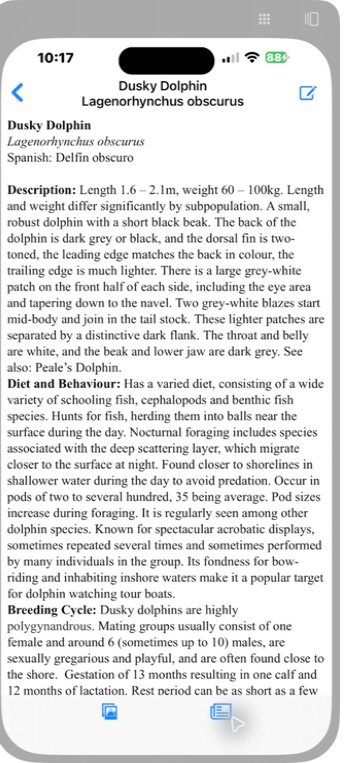

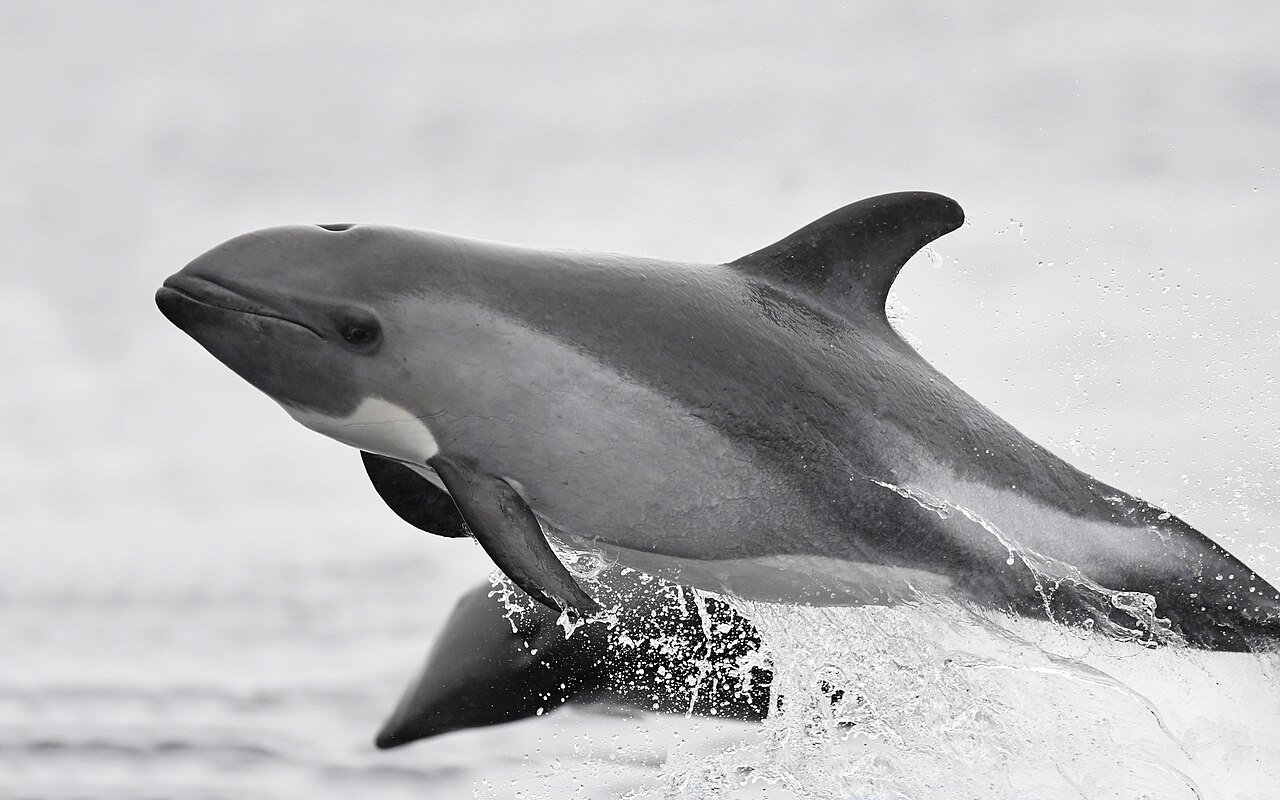
Toothed Whales and Dolphins
App section: Toothed Whales and DolphinsApp detail capturedprimary: captured / app-captureadditional: pending / pending-app-capture
Detail: structuredSource: app-screenshotRights: licensed-app-content
Peale's Dolphin
Lagenorhynchus australisA small robust dolphin with dark head and pale flank patches, common around southern South American coastal waters.Field marks
- Length about 2-2.2 m and weight about 100-115 kg in app detail
- Dark head and pale flank patches with largely grey-black head and back
- Prominent grey-white patch starts behind the eye and tapers to mid-body
- Tall stocky body with relatively large falcate dorsal fin and pointed flipper
Guide facts
- App detail notes benthic fish, squid, octopuses, and crustaceans as prey
- Travels in small pods between five and twenty individuals
- Often cruises close to shore and can enter bursts of breaching
- Often associated with tidal rips at fjord and channel entrances


Toothed Whales and Dolphins
App section: Toothed Whales and DolphinsApp detail capturedprimary: captured / app-captureadditional: pending / pending-app-capture
Detail: structuredSource: app-screenshotRights: licensed-app-content
Southern Right Whale Dolphin
Lissodelphis peroniiA slender southern dolphin with strong black-and-white contrast and no dorsal fin, named for its right-whale-like back profile.Field marks
- Slender dolphin with no dorsal fin
- Dark upperparts and clean white lower body pattern
- Smooth back profile can be distinctive in good views
- Often seen offshore in southern temperate to subantarctic waters
Guide facts
- App detail captured as part of the Toothed Whales and Dolphins import
- No dorsal fin is the key quick field mark
- Can be difficult to detect in rough seas because of the low profile
- Useful comparison with Hourglass Dolphin and other offshore dolphins
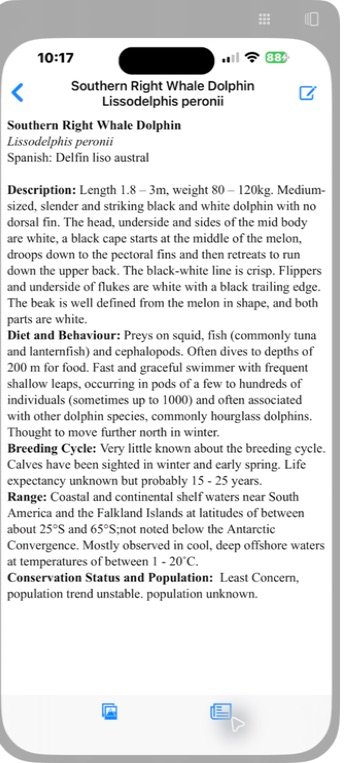


Toothed Whales and Dolphins
App section: Toothed Whales and DolphinsApp detail capturedprimary: captured / app-captureadditional: pending / pending-app-capture
Detail: structuredSource: app-screenshotRights: licensed-app-content
Spectacled Porpoise
Phocoena dioptricaA rarely seen southern porpoise with compact form, dark-and-white contrast, and distinctive eye markings.Field marks
- Small compact porpoise rather than a long-beaked dolphin
- Dark upperparts and pale lower body contrast
- Distinctive markings around the eye give the species its name
- Low, brief surfacing profile can make sightings difficult
Guide facts
- App detail captured from the Toothed Whales and Dolphins list
- Often best treated as a rare possibility in Falklands and Beagle Channel interpretation
- Useful for explaining the difference between porpoises and dolphins
- Can be hard to confirm without photos because sightings may be brief

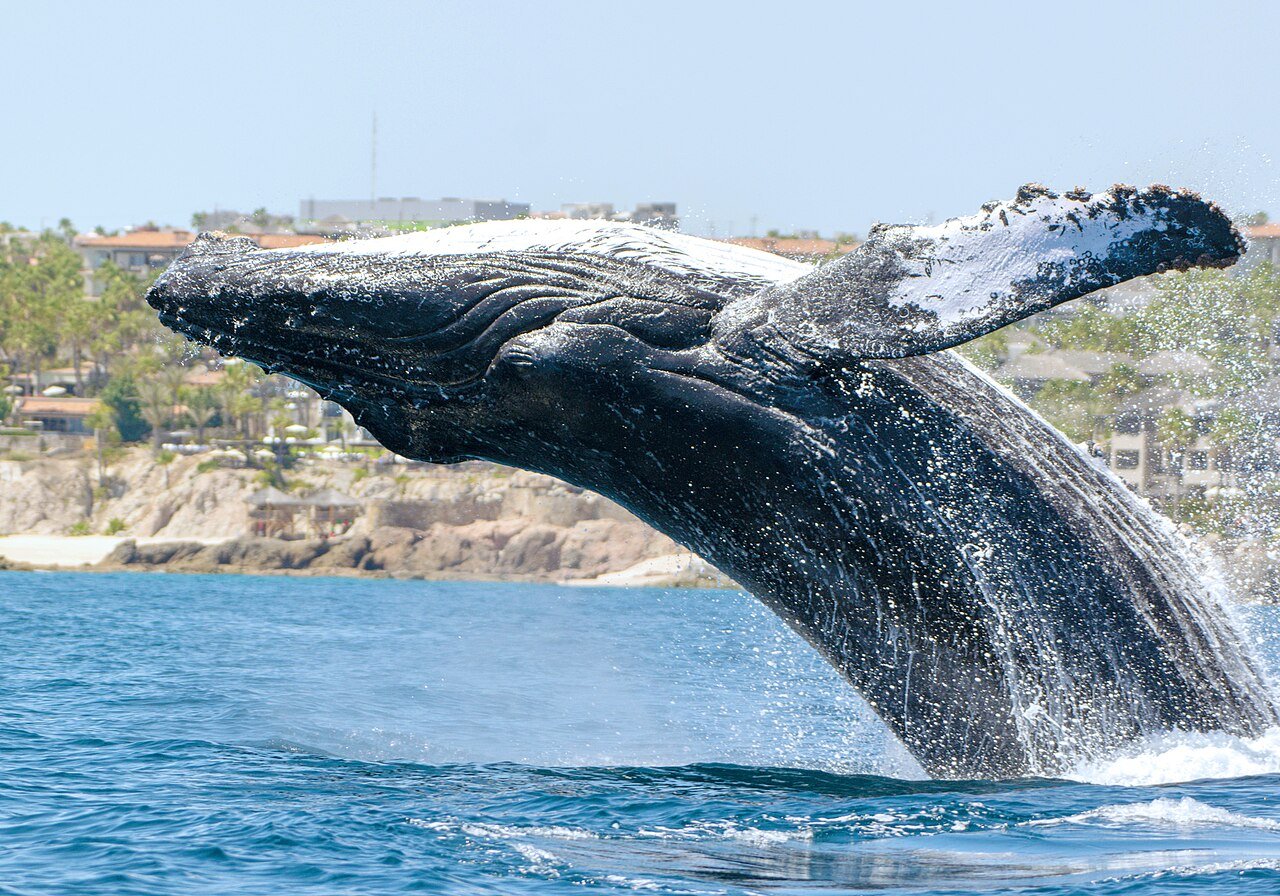
Baleen Whales
App section: Baleen WhalesApp detail capturedprimary: captured / app-captureadditional: pending / pending-app-capture
Detail: structuredSource: app-screenshotRights: licensed-app-content
Humpback Whale
Megaptera novaeangliaeA large spindle-shaped baleen whale with long thin flippers, a humped dorsal fin, and highly recognizable flukes.Field marks
- Very long thin flippers and marked hump before the dorsal fin
- Dark grey to black above and white below
- Knobs on the rostrum and splashguard in front of the blowhole
- Raised flukes with distinctive black-and-white underside patterns useful for photo ID
Guide facts
- App detail notes males are about 13-14 m and females 15-16 m
- In the Southern Hemisphere, they filter feed mainly during austral summer in Antarctic and subantarctic waters
- Diet consists almost exclusively of euphausiids/krill, though fish and other plankton species are also taken
- Complex feeding behavior can include bubble-netting, lunges, pectoral fin use, and coordinated group feeding


Baleen Whales
App section: Baleen WhalesApp detail capturedprimary: captured / app-captureadditional: pending / pending-app-capture
Detail: structuredSource: app-screenshotRights: licensed-app-content
Antarctic Minke Whale
Balaenoptera bonaerensisA small, sleek Antarctic rorqual with a pointed snout, subtle grey patterning, and a fast, inconspicuous surfacing style around ice-edge feeding areas.Field marks
- Length about 6-9 m and weight about 6-9 t in app detail
- Small, sleek, spindle-shaped grey rorqual with sharp pointed snout
- Dark grey-brown above with white upper lip lining and dark lower lip lining
- Small dorsal fin set far back; flippers can be indistinctly two-toned dark and pale grey
Guide facts
- App detail notes peak feeding around the ice edge and early morning activity
- Filter feeds on zooplankton, mainly krill, with baleen adapted for rapid lunge-feeding
- Often fast moving, alone, or in small groups, with erratic surfacing patterns
- Important prey for Type-A Orca and migrates north to breed in austral winter

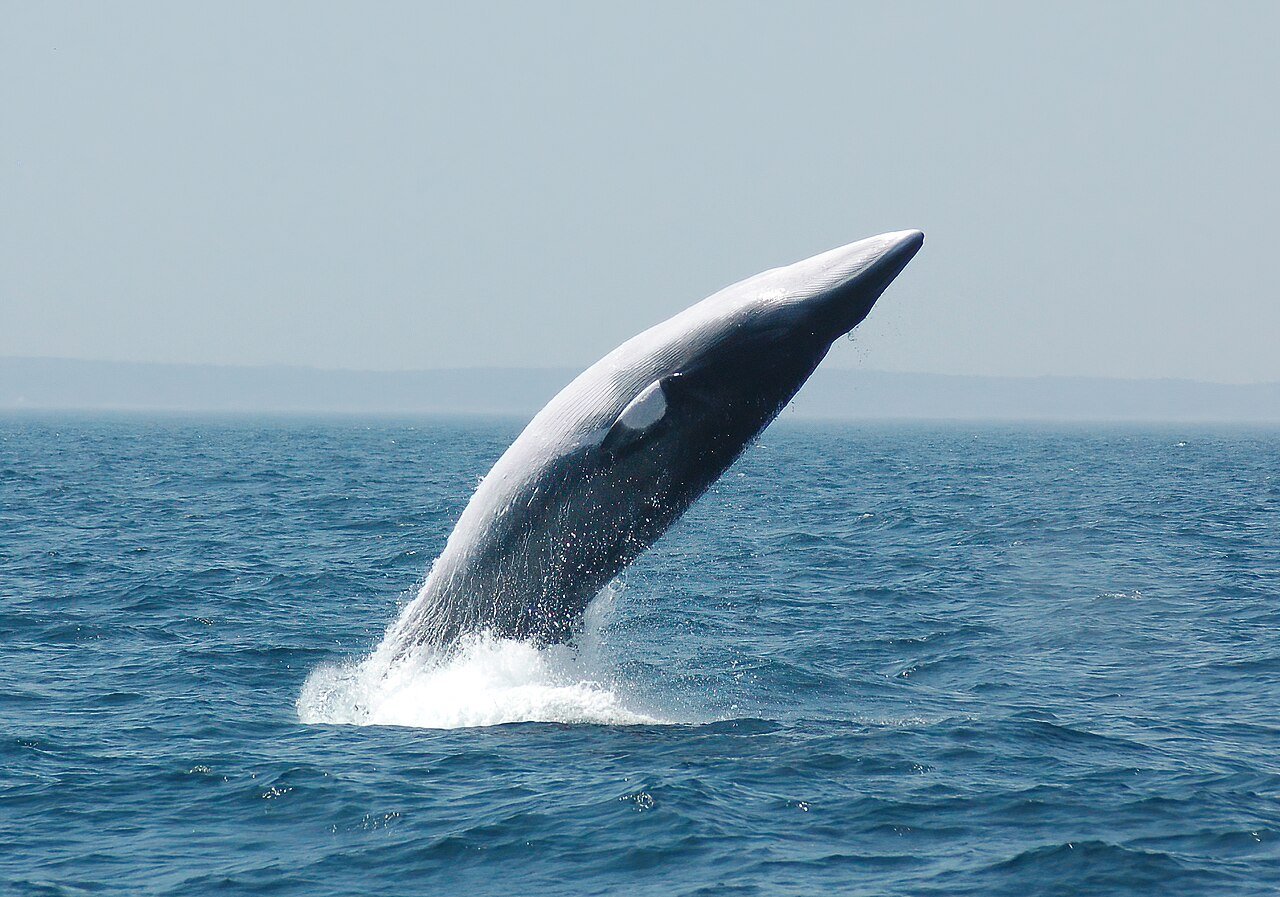
Baleen Whales
App section: Baleen WhalesApp detail capturedprimary: captured / app-captureadditional: pending / pending-app-capture
Detail: structuredSource: app-screenshotRights: licensed-app-content
Common (Dwarf) Minke Whale
Balaenoptera acutorostrataA small southern minke form, often identified by pale shoulder patches, a light grey crescent, and an inconspicuous blow.Field marks
- Length about 6.8 m and weight about 6.8 t in app detail
- Small, sleek, spindle-shaped grey rorqual with a sharp pointed snout
- Dark grey-brown above with light grey crescent or wave-shaped shoulder patch
- Small paddle-shaped flippers with white patches; small dorsal fin sits quite far back
Guide facts
- App detail notes prey is primarily myctophid fish
- Feeding habits are not well known but likely include lunging into shoals near the surface
- Fast moving and usually alone or in small groups; seldom shows flukes
- Known in some areas for odorous blows and may be seen singly, in pairs, or small groups up to about eight


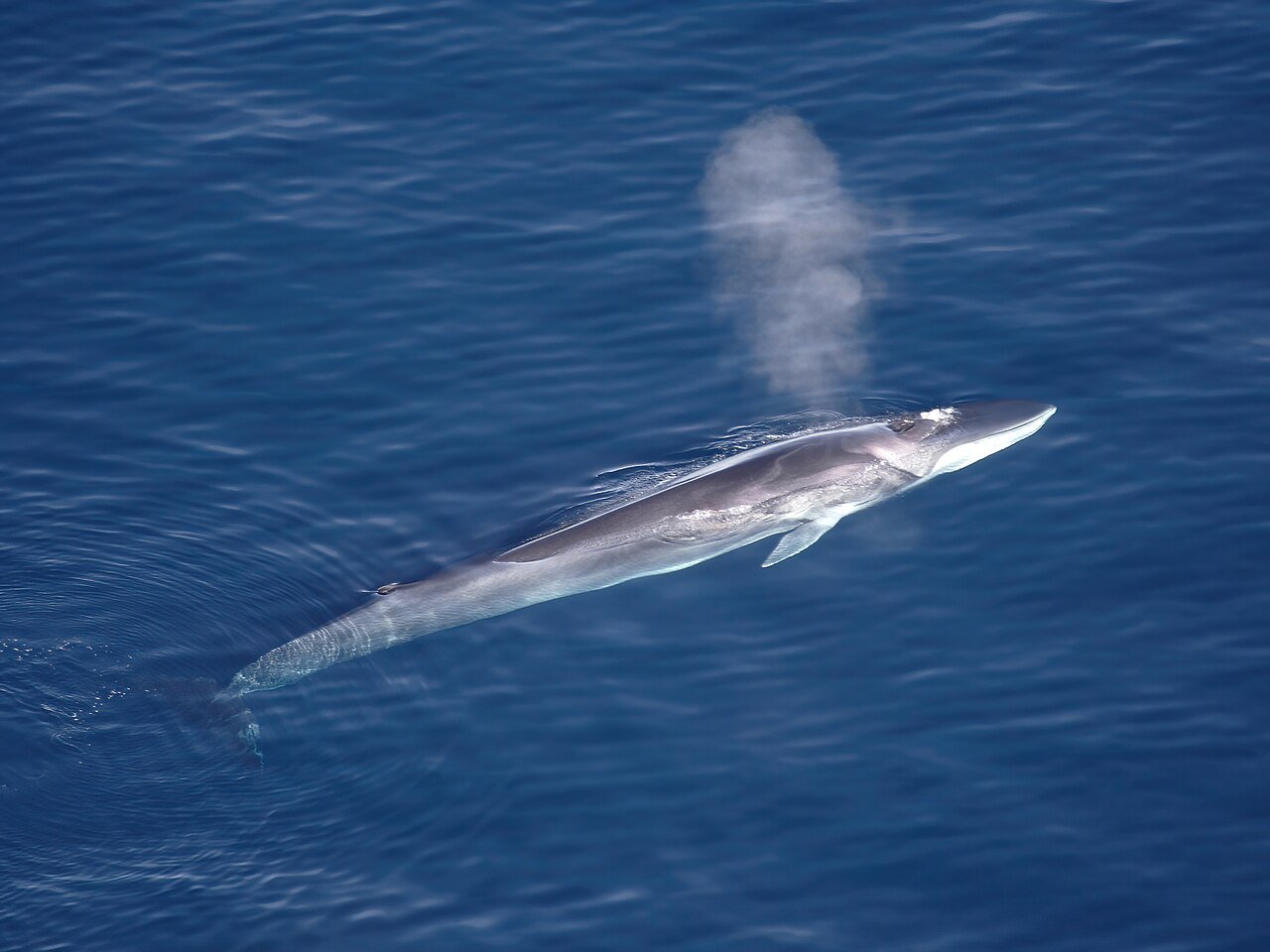
Baleen Whales
App section: Baleen WhalesApp detail capturedprimary: captured / app-captureadditional: pending / pending-app-capture
Detail: structuredSource: app-screenshotRights: licensed-app-content
Fin Whale
Balaenoptera physalusA long, slender dark rorqual with a hooked dorsal fin, asymmetric head coloration, and a tall columnar blow.Field marks
- Length about 18-26 m and weight about 40-74 t in app detail
- Long slender dark grey whale with hooked dorsal fin set two thirds down the back
- Small dorsal fin slopes and points distinctly backwards
- Right side of head, throat, and baleen are pale grey to white while the left side is dark
Guide facts
- App detail notes it is specifically a krill eater with krill making up to 99% of the diet
- Usually lunges on its side at the surface and may feed alone or in groups of 6-10
- Often lives in groups of 6-10, with groups increasing to about 100 during foraging
- Tail stock arches before dives and flukes are typically not shown
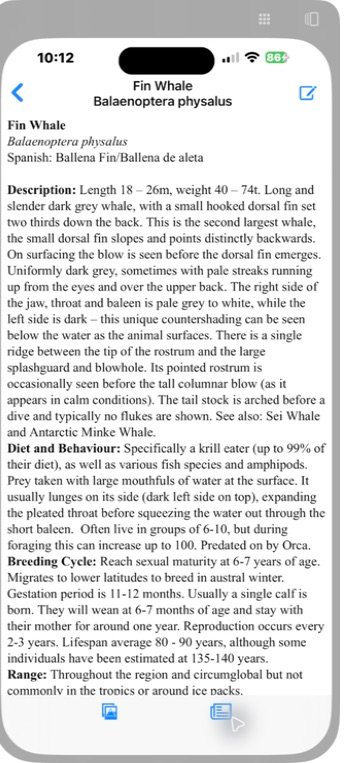

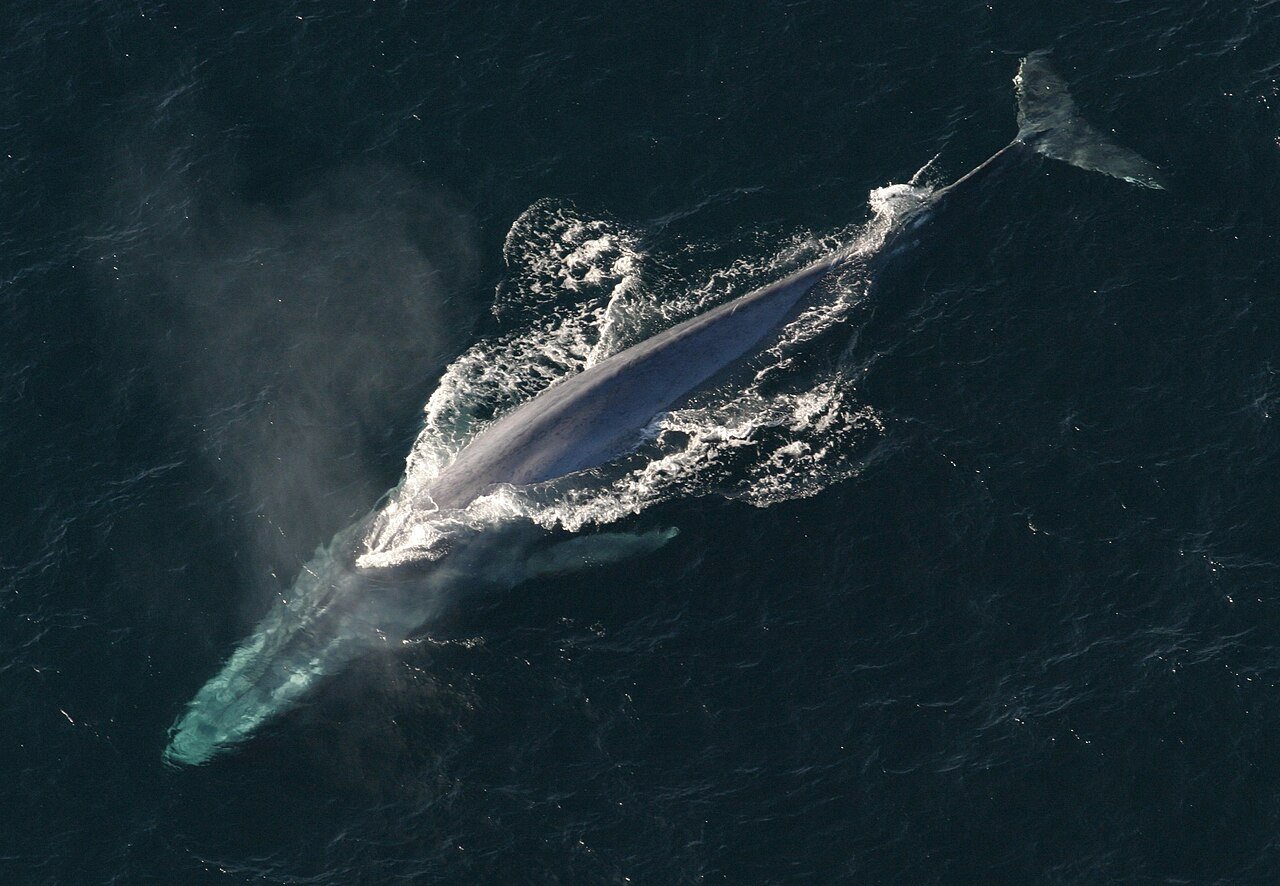
Baleen Whales
App section: Baleen WhalesApp detail capturedprimary: captured / app-captureadditional: pending / pending-app-capture
Detail: structuredSource: app-screenshotRights: licensed-app-content
Blue Whale
Balaenoptera musculusAn enormous mottled blue-grey rorqual with a high splashguard, long back, tiny far-set dorsal fin, and towering blow.Field marks
- Length about 22-30 m and weight about 60-180 t in app detail
- Enormous, slender, mottled blue-grey whale with tall prominent blow
- High profile splashguard, long back, and tiny dorsal fin set very far back
- Broad, stocky flippers and black flukes with pointed tips
Guide facts
- App detail notes blue whales primarily eat krill but may occasionally feed on small copepods
- Feeds on both the surface and at depths up to about 300 m
- Usually solitary or in pairs, though larger groups can form while feeding
- May reach about 50 km/h and produces very loud low-frequency sounds that can travel hundreds of kilometres


Baleen Whales
App section: Baleen WhalesApp detail capturedprimary: captured / app-captureadditional: pending / pending-app-capture
Detail: structuredSource: app-screenshotRights: licensed-app-content
Sei Whale
Balaenoptera borealisA very long, slender rorqual with a pointed snout, prominent falcate dorsal fin, and dark lower jaw useful for separating it from fin whales.Field marks
- Length about 15-22 m and weight about 15-28 t in app detail
- Very long slender grey whale with a pointed snout
- Distinct falcate dorsal fin set two-thirds down the back
- Dark lower jaw on the right-hand side helps separate it from fin whales
Guide facts
- App detail notes feeding can average about 900 kg of food per day
- Consumes zooplankton, copepods, and amphipods at lower latitudes, with krill replacing them south of the Antarctic Convergence
- Usually skim-feeds just below the surface and often travels or feeds in groups of five to ten
- Rarely lunges, may only blow once or twice in succession, and does not arch its peduncle before diving


Baleen Whales
App section: Baleen WhalesApp detail capturedprimary: captured / app-captureadditional: pending / pending-app-capture
Detail: structuredSource: app-screenshotRights: licensed-app-content
Southern Right Whale
Eubalaena australisA huge robust dark whale with no dorsal fin, raised head callosities, arched mouthline, and a broad V-shaped blow.Field marks
- Length about 12-15 m and weight about 25-55 t in app detail
- Huge robust dark grey-brown whale with no dorsal fin
- Raised rough skin callosities around the head and jaws
- Very long fine baleen plates and broad black flippers with pointed tips
Guide facts
- App detail notes a plankton diet including copepods, krill, and pteropods
- Continuous slow ram-feeding can happen alone or in groups
- Usually raises the rostrum slowly at the surface and may breach, flipper-slap, or tail-lob
- Migrates north to warmer waters in austral winter, with breeding groups along coastlines


Storm Petrels
App section: Petrels, Prions, Shearwaters etc.App detail capturedprimary: captured / app-captureadditional: pending / pending-app-capture
Detail: structuredSource: app-screenshotRights: licensed-app-content
Black-bellied Storm-petrel
Fregetta tropicaA small black-and-white storm-petrel with a white rump, dark belly stripe, and quick pattering flight over the sea surface.Field marks
- Small storm-petrel, about 20 cm long with a roughly 46 cm wingspan
- Upperparts dark with variable indistinct brown wing bar
- White rump and dark tail
- Underwing white with dark leading edge; black belly stripe down the middle
Guide facts
- Often picks prey from on or just below the water surface while pattering with legs and feet outstretched
- Usually erratic in flight pattern and does not usually follow ships, but can be attracted to ship lights
- Breeds in colonies or alone on vegetated slopes or scree, using rock crevices or soft-soil burrows
- App detail notes conservation status as Least Concern


Seals
App section: SealsApp detail capturedprimary: captured / app-captureadditional: pending / pending-app-capture
Detail: structuredSource: app-screenshotRights: licensed-app-content
Antarctic Fur Seal
Arctocephalus gazellaA strongly sexually dimorphic fur seal that feeds mainly at night and is now highly abundant around South Georgia.Field marks
- Male much larger than female, with dark brown or grey seal shape and heavier neck
- Female grey to brown-grey with lighter underside
- Short pointed muzzle, visible whiskers, and long ear pinnae
- Long strong fore-flippers allow an upright sitting posture ashore
Guide facts
- App detail notes males may hold harems of around 20 breeding partners in a season
- Diet varies by season and locality and includes krill, fish, cephalopods, copepods, and sometimes penguins
- Moves effectively on land with strong fore-flippers and can be assertive around breeding beaches
- App detail notes about 95% of the population breeds at South Georgia

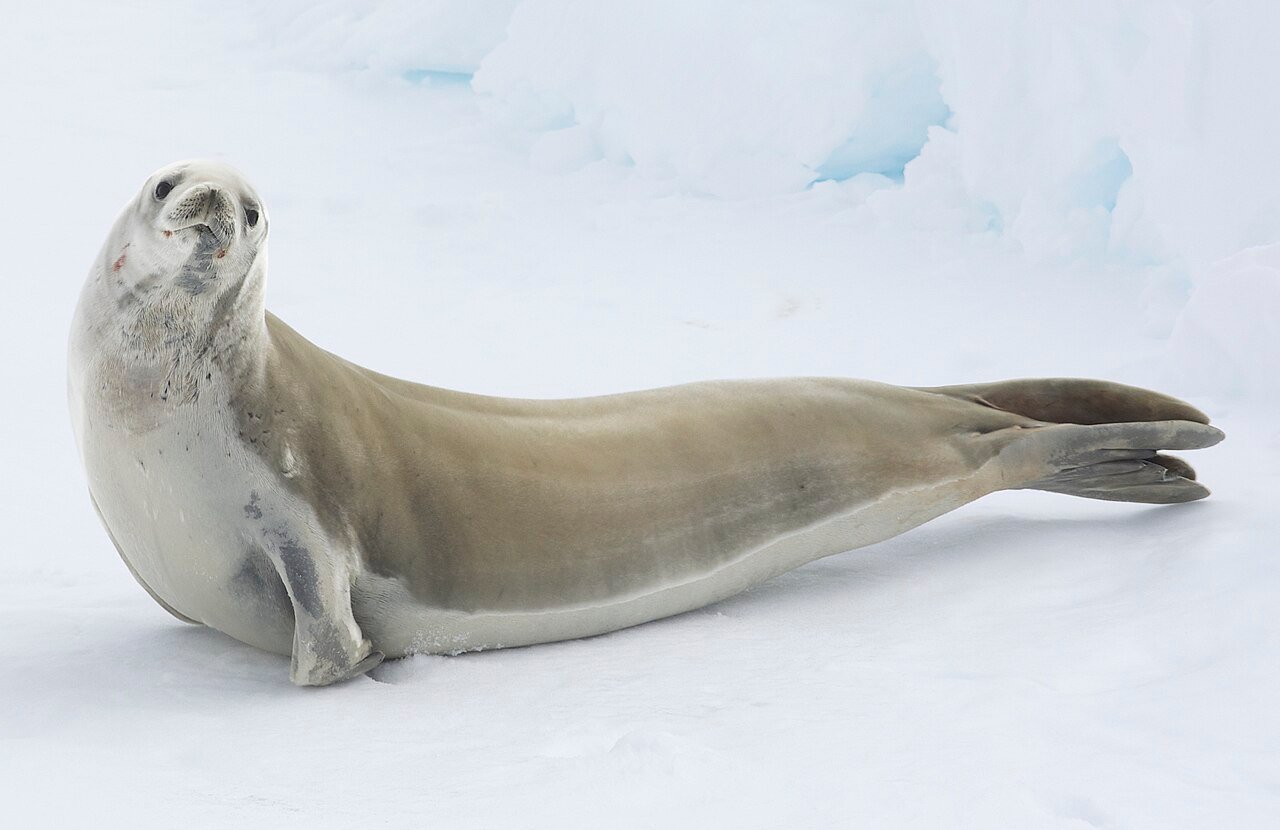
Seals
App section: SealsApp detail capturedprimary: captured / app-captureadditional: pending / pending-app-capture
Detail: structuredSource: app-screenshotRights: licensed-app-content
Crabeater Seal
Lobodon carcinophagaA medium-sized Antarctic seal specialized for krill feeding, often seen on ice or swimming near ice edges.Field marks
- Medium-sized seal, about 2.2-2.6 m and 180-300 kg in app detail
- Light-coloured seal with dog-like muzzle
- Large eyes, upturned nose, concave forehead, and long front incisors/short whiskers
- Fur can be silver-grey to cream with spots or side rings
Guide facts
- App detail notes unique sieve-like tooth structure for predation on krill
- Feeds primarily on Antarctic krill, with some fish and squid
- Often hauls out during the day, usually on ice, and may forage at night
- Scarring from Leopard Seal attacks can be visible on many individuals
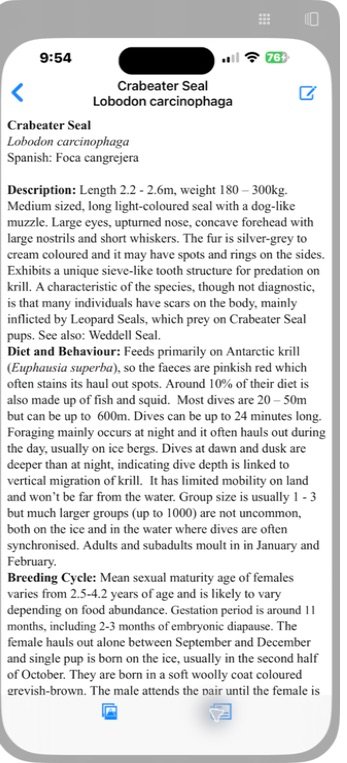


Seals
App section: SealsApp detail capturedprimary: captured / app-captureadditional: pending / pending-app-capture
Detail: structuredSource: app-screenshotRights: licensed-app-content
Weddell Seal
Leptonychotes weddelliiA large, long-spotted or mottled grey Antarctic seal with a smooth body shape, short muzzle, and expressive face.Field marks
- Length about 2.5-3.5 m and weight about 400-500 kg in app detail
- Large grey seal with smooth body contour and pretty cat-like face
- Small head, close-set eyes, small muzzle, short upturned mouth, and long whiskers
- Grey-brown back and silver-white front with variable spotting and mottling
Guide facts
- App detail notes Weddell Seals primarily feed on fish, especially Antarctic cod
- Specialized around fast ice, breathing holes, and under-ice access
- Can be highly vocal with noises heard through sea ice
- Often seen hauled out alone or in loose groups and is relatively docile on ice


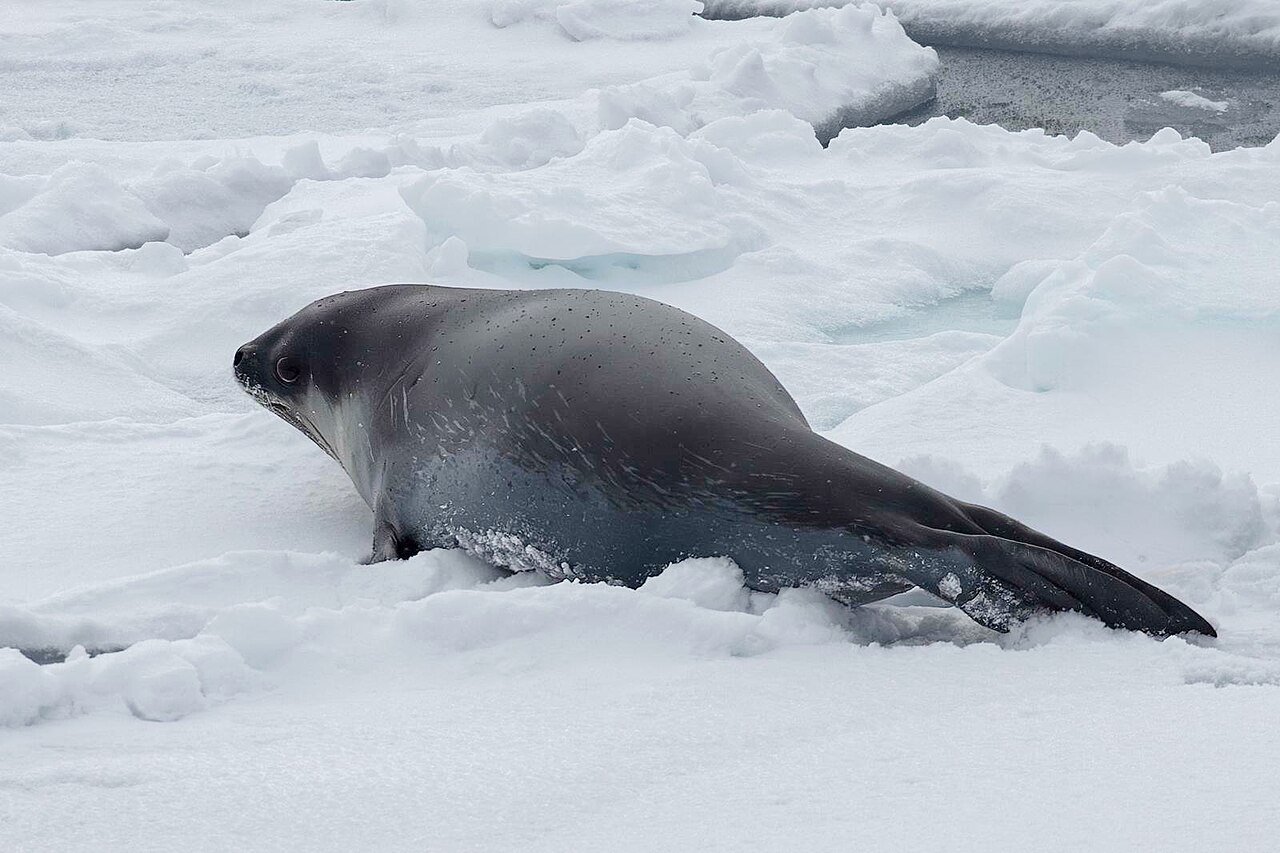
Seals
App section: SealsApp detail capturedprimary: captured / app-captureadditional: pending / pending-app-capture
Detail: structuredSource: app-screenshotRights: licensed-app-content
Ross Seal
Ommatophoca rossiiA small, rarely encountered Antarctic seal with a compact body, large eyes, and distinctive throat markings.Field marks
- Length about 1.7-2.5 m and weight about 129-216 kg in app detail
- Small dark brown seal with a small head and large eyes
- Paler silver-white underside and dark streaks from neck to mouth and eyes
- Short flippers, thick neck, and distinctive laryngeal air sacs that inflate when vocalising
Guide facts
- App detail notes diet is thought to be mostly squid with lesser fish and small krill
- Extremely aquatic and often solitary, spending most of the year at sea
- Recorded dives can be deep and long, with average dives in app detail around 108 m
- Known for vocalisations that can sound like sirens or twits when heard underwater or around ice
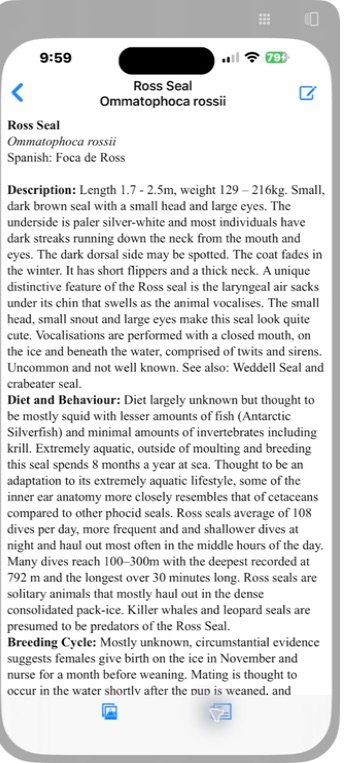


Seals
App section: SealsApp detail capturedprimary: captured / app-captureadditional: pending / pending-app-capture
Detail: structuredSource: app-screenshotRights: licensed-app-content
South American Fur Seal
Arctocephalus australisA medium-sized fur seal of southern South America, sexually dimorphic and agile ashore with long fore-flippers.Field marks
- Male about 2.0 m and female about 1.4 m in app detail
- Medium-sized furry dark brown or grey seal with grey or tan grizzled markings
- Short pointed muzzle, long pale whiskers, and long ear pinnae
- Male has a concave forehead, upward-pointing muzzle, and thick scruffy mane; female is brown to grey-black above with paler underside
Guide facts
- App detail notes they are nocturnal hunters that primarily feed on lobster krill, fish, and occasionally squid
- Foraging dives are usually between 50-600 m deep
- Often travel in rafts at the surface and can porpoise or leap clear of the water during rapid movement
- Breeding colonies are generally established along rocky coasts between October and January
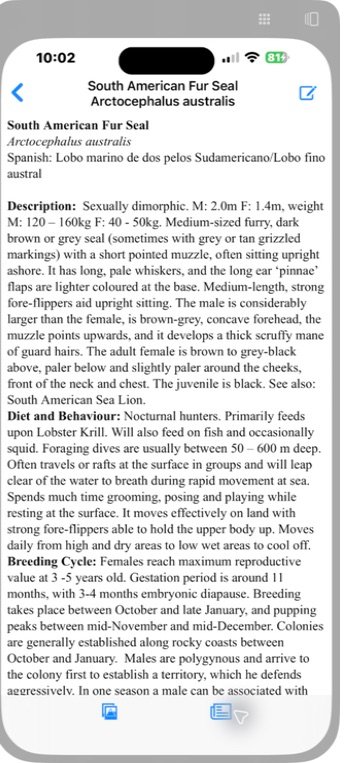


Seals
App section: SealsApp detail capturedprimary: captured / app-captureadditional: pending / pending-app-capture
Detail: structuredSource: app-screenshotRights: licensed-app-content
South American Sea Lion
Otaria flavescensA large, heavy-bodied otariid with strong sexual dimorphism, a blunt muzzle, long fore-flippers, and coastal haul-out behavior.Field marks
- Male about 2.1-2.6 m and female about 1.5-2 m in app detail
- Large heavy-bodied furry brown seal with upturned muzzle and large fore-flippers
- Male is larger with a thick mane on neck and chest hair
- Pup is black and adult females are coarse dark brown with lighter golden-brown tones
Guide facts
- App detail notes a generalist diet of fish, cephalopods, crustaceans, gastropods, and occasionally penguins or young seals
- Foraging dives average about 61 m and 3 minutes, but short dives to 240 m are possible
- Frequently rafts in groups and can travel long distances, including Falkland Islands to South American coastlines
- Highly polygynous; males defend territories after reaching maturity later than females


Storm Petrels
Storm Petrels
App section: Petrels, Prions, Shearwaters etc.App capture pendingprimary: pending / pending-app-capture
Detail: not-startedSource: migration-scaffoldRights: pending-review
Wilson's Storm Petrel
Oceanites oceanicusA storm petrels record from the Antarctic Wildlife Guide migration scaffold, ready for source-app animal text, app photos, conservation status, regional notes, and guide-only interpretation details.Field marks
- Photo and app-detail capture pending
- Confirm field marks against licensed source content
- Attach comparison species notes during review
Guide facts
- Migrated as a coverage slot for the scoped animal import
- Needs species-detail screen capture and guide review
- Can already be filtered by category and operating region
Storm Petrels
Storm Petrels
App section: Petrels, Prions, Shearwaters etc.App search unresolvedprimary: pending / pending-app-capture
Detail: not-startedSource: migration-scaffoldRights: pending-review
White-bellied Storm Petrel
Fregetta grallariaA storm petrels record from the app-evidenced migration scaffold. Search attempts did not expose a matching detail page, so this row needs list-state verification before importing text or photos.Field marks
- App search returned Not Found
- Verify the species from the full section list before importing
- Do not attach substitute public-source field marks until app presence is confirmed
Guide facts
- Search evidence is saved in the migration folder
- Needs manual list-state verification in the app
- Keep pending until a detail page or corrected species name is confirmed
Grebes
Grebes
App section: GrebesApp capture pendingprimary: pending / pending-app-capture
Detail: not-startedSource: migration-scaffoldRights: pending-review
Great Grebe
Podiceps majorA grebes record from the Antarctic Wildlife Guide migration scaffold, ready for source-app animal text, app photos, conservation status, regional notes, and guide-only interpretation details.Field marks
- Photo and app-detail capture pending
- Confirm field marks against licensed source content
- Attach comparison species notes during review
Guide facts
- Migrated as a coverage slot for the scoped animal import
- Needs species-detail screen capture and guide review
- Can already be filtered by category and operating region
Cormorants and Shags
Cormorants and Shags
App section: Cormorants and ShagsApp capture pendingprimary: pending / pending-app-capture
Detail: not-startedSource: migration-scaffoldRights: pending-review
Imperial Shag
Leucocarbo atricepsA cormorants and shags record from the Antarctic Wildlife Guide migration scaffold, ready for source-app animal text, app photos, conservation status, regional notes, and guide-only interpretation details.Field marks
- Photo and app-detail capture pending
- Confirm field marks against licensed source content
- Attach comparison species notes during review
Guide facts
- Migrated as a coverage slot for the scoped animal import
- Needs species-detail screen capture and guide review
- Can already be filtered by category and operating region
Cormorants and Shags
Cormorants and Shags
App section: Cormorants and ShagsApp capture pendingprimary: pending / pending-app-capture
Detail: not-startedSource: migration-scaffoldRights: pending-review
South Georgia Shag
Leucocarbo georgianusA cormorants and shags record from the Antarctic Wildlife Guide migration scaffold, ready for source-app animal text, app photos, conservation status, regional notes, and guide-only interpretation details.Field marks
- Photo and app-detail capture pending
- Confirm field marks against licensed source content
- Attach comparison species notes during review
Guide facts
- Migrated as a coverage slot for the scoped animal import
- Needs species-detail screen capture and guide review
- Can already be filtered by category and operating region
Cormorants and Shags
Cormorants and Shags
App section: Cormorants and ShagsApp capture pendingprimary: pending / pending-app-capture
Detail: not-startedSource: migration-scaffoldRights: pending-review
Antarctic Shag
Leucocarbo bransfieldensisA cormorants and shags record from the Antarctic Wildlife Guide migration scaffold, ready for source-app animal text, app photos, conservation status, regional notes, and guide-only interpretation details.Field marks
- Photo and app-detail capture pending
- Confirm field marks against licensed source content
- Attach comparison species notes during review
Guide facts
- Migrated as a coverage slot for the scoped animal import
- Needs species-detail screen capture and guide review
- Can already be filtered by category and operating region
Ducks and Geese
Ducks and Geese
App section: Ducks and GeeseApp capture pendingprimary: pending / pending-app-capture
Detail: not-startedSource: migration-scaffoldRights: pending-review
Falkland Steamer Duck
Tachyeres brachypterusA ducks and geese record from the Antarctic Wildlife Guide migration scaffold, ready for source-app animal text, app photos, conservation status, regional notes, and guide-only interpretation details.Field marks
- Photo and app-detail capture pending
- Confirm field marks against licensed source content
- Attach comparison species notes during review
Guide facts
- Migrated as a coverage slot for the scoped animal import
- Needs species-detail screen capture and guide review
- Can already be filtered by category and operating region
Ducks and Geese
Ducks and Geese
App section: Ducks and GeeseApp capture pendingprimary: pending / pending-app-capture
Detail: not-startedSource: migration-scaffoldRights: pending-review
Flying Steamer Duck
Tachyeres patachonicusA ducks and geese record from the Antarctic Wildlife Guide migration scaffold, ready for source-app animal text, app photos, conservation status, regional notes, and guide-only interpretation details.Field marks
- Photo and app-detail capture pending
- Confirm field marks against licensed source content
- Attach comparison species notes during review
Guide facts
- Migrated as a coverage slot for the scoped animal import
- Needs species-detail screen capture and guide review
- Can already be filtered by category and operating region
Ducks and Geese
Ducks and Geese
App section: Ducks and GeeseApp capture pendingprimary: pending / pending-app-capture
Detail: not-startedSource: migration-scaffoldRights: pending-review
Upland Goose
Chloephaga pictaA ducks and geese record from the Antarctic Wildlife Guide migration scaffold, ready for source-app animal text, app photos, conservation status, regional notes, and guide-only interpretation details.Field marks
- Photo and app-detail capture pending
- Confirm field marks against licensed source content
- Attach comparison species notes during review
Guide facts
- Migrated as a coverage slot for the scoped animal import
- Needs species-detail screen capture and guide review
- Can already be filtered by category and operating region
Ducks and Geese
Ducks and Geese
App section: Ducks and GeeseApp capture pendingprimary: pending / pending-app-capture
Detail: not-startedSource: migration-scaffoldRights: pending-review
Kelp Goose
Chloephaga hybridaA ducks and geese record from the Antarctic Wildlife Guide migration scaffold, ready for source-app animal text, app photos, conservation status, regional notes, and guide-only interpretation details.Field marks
- Photo and app-detail capture pending
- Confirm field marks against licensed source content
- Attach comparison species notes during review
Guide facts
- Migrated as a coverage slot for the scoped animal import
- Needs species-detail screen capture and guide review
- Can already be filtered by category and operating region
Ducks and Geese
Ducks and Geese
App section: Ducks and GeeseApp capture pendingprimary: pending / pending-app-capture
Detail: not-startedSource: migration-scaffoldRights: pending-review
Crested Duck
Lophonetta specularioidesA ducks and geese record from the Antarctic Wildlife Guide migration scaffold, ready for source-app animal text, app photos, conservation status, regional notes, and guide-only interpretation details.Field marks
- Photo and app-detail capture pending
- Confirm field marks against licensed source content
- Attach comparison species notes during review
Guide facts
- Migrated as a coverage slot for the scoped animal import
- Needs species-detail screen capture and guide review
- Can already be filtered by category and operating region
Shorebirds
Shorebirds
App section: ShorebirdsApp capture pendingprimary: pending / pending-app-capture
Detail: not-startedSource: migration-scaffoldRights: pending-review
Magellanic Oystercatcher
Haematopus leucopodusA shorebirds record from the Antarctic Wildlife Guide migration scaffold, ready for source-app animal text, app photos, conservation status, regional notes, and guide-only interpretation details.Field marks
- Photo and app-detail capture pending
- Confirm field marks against licensed source content
- Attach comparison species notes during review
Guide facts
- Migrated as a coverage slot for the scoped animal import
- Needs species-detail screen capture and guide review
- Can already be filtered by category and operating region
Shorebirds
Shorebirds
App section: ShorebirdsApp capture pendingprimary: pending / pending-app-capture
Detail: not-startedSource: migration-scaffoldRights: pending-review
Blackish Oystercatcher
Haematopus aterA shorebirds record from the Antarctic Wildlife Guide migration scaffold, ready for source-app animal text, app photos, conservation status, regional notes, and guide-only interpretation details.Field marks
- Photo and app-detail capture pending
- Confirm field marks against licensed source content
- Attach comparison species notes during review
Guide facts
- Migrated as a coverage slot for the scoped animal import
- Needs species-detail screen capture and guide review
- Can already be filtered by category and operating region
Shorebirds
Shorebirds
App section: ShorebirdsApp capture pendingprimary: pending / pending-app-capture
Detail: not-startedSource: migration-scaffoldRights: pending-review
Two-banded Plover
Charadrius falklandicusA shorebirds record from the Antarctic Wildlife Guide migration scaffold, ready for source-app animal text, app photos, conservation status, regional notes, and guide-only interpretation details.Field marks
- Photo and app-detail capture pending
- Confirm field marks against licensed source content
- Attach comparison species notes during review
Guide facts
- Migrated as a coverage slot for the scoped animal import
- Needs species-detail screen capture and guide review
- Can already be filtered by category and operating region
Shorebirds
Shorebirds
App section: ShorebirdsApp capture pendingprimary: pending / pending-app-capture
Detail: not-startedSource: migration-scaffoldRights: pending-review
Rufous-chested Dotterel
Charadrius modestusA shorebirds record from the Antarctic Wildlife Guide migration scaffold, ready for source-app animal text, app photos, conservation status, regional notes, and guide-only interpretation details.Field marks
- Photo and app-detail capture pending
- Confirm field marks against licensed source content
- Attach comparison species notes during review
Guide facts
- Migrated as a coverage slot for the scoped animal import
- Needs species-detail screen capture and guide review
- Can already be filtered by category and operating region
Ducks and Geese
Ducks and Geese
App section: Ducks and GeeseApp capture pendingprimary: pending / pending-app-capture
Detail: not-startedSource: migration-scaffoldRights: pending-review
South Georgia Pintail
Anas georgica georgicaA ducks and geese record from the Antarctic Wildlife Guide migration scaffold, ready for source-app animal text, app photos, conservation status, regional notes, and guide-only interpretation details.Field marks
- Photo and app-detail capture pending
- Confirm field marks against licensed source content
- Attach comparison species notes during review
Guide facts
- Migrated as a coverage slot for the scoped animal import
- Needs species-detail screen capture and guide review
- Can already be filtered by category and operating region
Land Birds
Land Birds
App section: Land BirdsApp capture pendingprimary: pending / pending-app-capture
Detail: not-startedSource: migration-scaffoldRights: pending-review
South Georgia Pipit
Anthus antarcticusA land birds record from the Antarctic Wildlife Guide migration scaffold, ready for source-app animal text, app photos, conservation status, regional notes, and guide-only interpretation details.Field marks
- Photo and app-detail capture pending
- Confirm field marks against licensed source content
- Attach comparison species notes during review
Guide facts
- Migrated as a coverage slot for the scoped animal import
- Needs species-detail screen capture and guide review
- Can already be filtered by category and operating region
Land Birds
Land Birds
App section: Land BirdsApp capture pendingprimary: pending / pending-app-capture
Detail: not-startedSource: migration-scaffoldRights: pending-review
Tussacbird
Cinclodes antarcticusA land birds record from the Antarctic Wildlife Guide migration scaffold, ready for source-app animal text, app photos, conservation status, regional notes, and guide-only interpretation details.Field marks
- Photo and app-detail capture pending
- Confirm field marks against licensed source content
- Attach comparison species notes during review
Guide facts
- Migrated as a coverage slot for the scoped animal import
- Needs species-detail screen capture and guide review
- Can already be filtered by category and operating region
Land Birds
Land Birds
App section: Land BirdsApp capture pendingprimary: pending / pending-app-capture
Detail: not-startedSource: migration-scaffoldRights: pending-review
Cobb's Wren
Troglodytes cobbiA land birds record from the Antarctic Wildlife Guide migration scaffold, ready for source-app animal text, app photos, conservation status, regional notes, and guide-only interpretation details.Field marks
- Photo and app-detail capture pending
- Confirm field marks against licensed source content
- Attach comparison species notes during review
Guide facts
- Migrated as a coverage slot for the scoped animal import
- Needs species-detail screen capture and guide review
- Can already be filtered by category and operating region
Land Birds
Land Birds
App section: Land BirdsApp capture pendingprimary: pending / pending-app-capture
Detail: not-startedSource: migration-scaffoldRights: pending-review
Dark-faced Ground Tyrant
Muscisaxicola maclovianusA land birds record from the Antarctic Wildlife Guide migration scaffold, ready for source-app animal text, app photos, conservation status, regional notes, and guide-only interpretation details.Field marks
- Photo and app-detail capture pending
- Confirm field marks against licensed source content
- Attach comparison species notes during review
Guide facts
- Migrated as a coverage slot for the scoped animal import
- Needs species-detail screen capture and guide review
- Can already be filtered by category and operating region
Gulls, Terns and Skuas
Gulls, Terns and Skuas
App section: Gulls, Terns and SkuasApp capture pendingprimary: pending / pending-app-capture
Detail: not-startedSource: migration-scaffoldRights: pending-review
Brown-hooded Gull
Chroicocephalus maculipennisA gulls, terns and skuas record from the Antarctic Wildlife Guide migration scaffold, ready for source-app animal text, app photos, conservation status, regional notes, and guide-only interpretation details.Field marks
- Photo and app-detail capture pending
- Confirm field marks against licensed source content
- Attach comparison species notes during review
Guide facts
- Migrated as a coverage slot for the scoped animal import
- Needs species-detail screen capture and guide review
- Can already be filtered by category and operating region
Gulls, Terns and Skuas
Gulls, Terns and Skuas
App section: Gulls, Terns and SkuasApp capture pendingprimary: pending / pending-app-capture
Detail: not-startedSource: migration-scaffoldRights: pending-review
Kelp Gull
Larus dominicanusA gulls, terns and skuas record from the Antarctic Wildlife Guide migration scaffold, ready for source-app animal text, app photos, conservation status, regional notes, and guide-only interpretation details.Field marks
- Photo and app-detail capture pending
- Confirm field marks against licensed source content
- Attach comparison species notes during review
Guide facts
- Migrated as a coverage slot for the scoped animal import
- Needs species-detail screen capture and guide review
- Can already be filtered by category and operating region
Gulls, Terns and Skuas
Gulls, Terns and Skuas
App section: Gulls, Terns and SkuasApp capture pendingprimary: pending / pending-app-capture
Detail: not-startedSource: migration-scaffoldRights: pending-review
Dolphin Gull
Leucophaeus scoresbiiA gulls, terns and skuas record from the Antarctic Wildlife Guide migration scaffold, ready for source-app animal text, app photos, conservation status, regional notes, and guide-only interpretation details.Field marks
- Photo and app-detail capture pending
- Confirm field marks against licensed source content
- Attach comparison species notes during review
Guide facts
- Migrated as a coverage slot for the scoped animal import
- Needs species-detail screen capture and guide review
- Can already be filtered by category and operating region
Gulls, Terns and Skuas
Gulls, Terns and Skuas
App section: Gulls, Terns and SkuasApp capture pendingprimary: pending / pending-app-capture
Detail: not-startedSource: migration-scaffoldRights: pending-review
Antarctic Tern
Sterna vittataA gulls, terns and skuas record from the Antarctic Wildlife Guide migration scaffold, ready for source-app animal text, app photos, conservation status, regional notes, and guide-only interpretation details.Field marks
- Photo and app-detail capture pending
- Confirm field marks against licensed source content
- Attach comparison species notes during review
Guide facts
- Migrated as a coverage slot for the scoped animal import
- Needs species-detail screen capture and guide review
- Can already be filtered by category and operating region
Gulls, Terns and Skuas
Gulls, Terns and Skuas
App section: Gulls, Terns and SkuasApp capture pendingprimary: pending / pending-app-capture
Detail: not-startedSource: migration-scaffoldRights: pending-review
Arctic Tern
Sterna paradisaeaA gulls, terns and skuas record from the Antarctic Wildlife Guide migration scaffold, ready for source-app animal text, app photos, conservation status, regional notes, and guide-only interpretation details.Field marks
- Photo and app-detail capture pending
- Confirm field marks against licensed source content
- Attach comparison species notes during review
Guide facts
- Migrated as a coverage slot for the scoped animal import
- Needs species-detail screen capture and guide review
- Can already be filtered by category and operating region
Gulls, Terns and Skuas
Gulls, Terns and Skuas
App section: Gulls, Terns and SkuasApp capture pendingprimary: pending / pending-app-capture
Detail: not-startedSource: migration-scaffoldRights: pending-review
South American Tern
Sterna hirundinaceaA gulls, terns and skuas record from the Antarctic Wildlife Guide migration scaffold, ready for source-app animal text, app photos, conservation status, regional notes, and guide-only interpretation details.Field marks
- Photo and app-detail capture pending
- Confirm field marks against licensed source content
- Attach comparison species notes during review
Guide facts
- Migrated as a coverage slot for the scoped animal import
- Needs species-detail screen capture and guide review
- Can already be filtered by category and operating region
Gulls, Terns and Skuas
Gulls, Terns and Skuas
App section: Gulls, Terns and SkuasApp capture pendingprimary: pending / pending-app-capture
Detail: not-startedSource: migration-scaffoldRights: pending-review
Chilean Skua
Stercorarius chilensisA gulls, terns and skuas record from the Antarctic Wildlife Guide migration scaffold, ready for source-app animal text, app photos, conservation status, regional notes, and guide-only interpretation details.Field marks
- Photo and app-detail capture pending
- Confirm field marks against licensed source content
- Attach comparison species notes during review
Guide facts
- Migrated as a coverage slot for the scoped animal import
- Needs species-detail screen capture and guide review
- Can already be filtered by category and operating region
Gulls, Terns and Skuas
Gulls, Terns and Skuas
App section: Gulls, Terns and SkuasApp capture pendingprimary: pending / pending-app-capture
Detail: not-startedSource: migration-scaffoldRights: pending-review
South Polar Skua
Stercorarius maccormickiA gulls, terns and skuas record from the Antarctic Wildlife Guide migration scaffold, ready for source-app animal text, app photos, conservation status, regional notes, and guide-only interpretation details.Field marks
- Photo and app-detail capture pending
- Confirm field marks against licensed source content
- Attach comparison species notes during review
Guide facts
- Migrated as a coverage slot for the scoped animal import
- Needs species-detail screen capture and guide review
- Can already be filtered by category and operating region
Shorebirds
Shorebirds
App section: ShorebirdsApp capture pendingprimary: pending / pending-app-capture
Detail: not-startedSource: migration-scaffoldRights: pending-review
Snowy Sheathbill
Chionis albusA shorebirds record from the Antarctic Wildlife Guide migration scaffold, ready for source-app animal text, app photos, conservation status, regional notes, and guide-only interpretation details.Field marks
- Photo and app-detail capture pending
- Confirm field marks against licensed source content
- Attach comparison species notes during review
Guide facts
- Migrated as a coverage slot for the scoped animal import
- Needs species-detail screen capture and guide review
- Can already be filtered by category and operating region
Herons and Ibises
Herons and Ibises
App section: Herons and IbisesApp capture pendingprimary: pending / pending-app-capture
Detail: not-startedSource: migration-scaffoldRights: pending-review
Black-crowned Night Heron
Nycticorax nycticoraxA herons and ibises record from the Antarctic Wildlife Guide migration scaffold, ready for source-app animal text, app photos, conservation status, regional notes, and guide-only interpretation details.Field marks
- Photo and app-detail capture pending
- Confirm field marks against licensed source content
- Attach comparison species notes during review
Guide facts
- Migrated as a coverage slot for the scoped animal import
- Needs species-detail screen capture and guide review
- Can already be filtered by category and operating region
Herons and Ibises
Herons and Ibises
App section: Herons and IbisesApp capture pendingprimary: pending / pending-app-capture
Detail: not-startedSource: migration-scaffoldRights: pending-review
Black-faced Ibis
Theristicus melanopisA herons and ibises record from the Antarctic Wildlife Guide migration scaffold, ready for source-app animal text, app photos, conservation status, regional notes, and guide-only interpretation details.Field marks
- Photo and app-detail capture pending
- Confirm field marks against licensed source content
- Attach comparison species notes during review
Guide facts
- Migrated as a coverage slot for the scoped animal import
- Needs species-detail screen capture and guide review
- Can already be filtered by category and operating region
Kingfishers
Kingfishers
App section: KingfishersApp capture pendingprimary: pending / pending-app-capture
Detail: not-startedSource: migration-scaffoldRights: pending-review
Ringed Kingfisher
Megaceryle torquataA kingfishers record from the Antarctic Wildlife Guide migration scaffold, ready for source-app animal text, app photos, conservation status, regional notes, and guide-only interpretation details.Field marks
- Photo and app-detail capture pending
- Confirm field marks against licensed source content
- Attach comparison species notes during review
Guide facts
- Migrated as a coverage slot for the scoped animal import
- Needs species-detail screen capture and guide review
- Can already be filtered by category and operating region
Owls, Vultures, Hawks and Caracaras
Owls, Vultures, Hawks and Caracaras
App section: Owls, Vultures, Hawks and CaracarasApp capture pendingprimary: pending / pending-app-capture
Detail: not-startedSource: migration-scaffoldRights: pending-review
American Kestrel
Falco sparveriusA owls, vultures, hawks and caracaras record from the Antarctic Wildlife Guide migration scaffold, ready for source-app animal text, app photos, conservation status, regional notes, and guide-only interpretation details.Field marks
- Photo and app-detail capture pending
- Confirm field marks against licensed source content
- Attach comparison species notes during review
Guide facts
- Migrated as a coverage slot for the scoped animal import
- Needs species-detail screen capture and guide review
- Can already be filtered by category and operating region
Owls, Vultures, Hawks and Caracaras
Owls, Vultures, Hawks and Caracaras
App section: Owls, Vultures, Hawks and CaracarasApp capture pendingprimary: pending / pending-app-capture
Detail: not-startedSource: migration-scaffoldRights: pending-review
Andean Condor
Vultur gryphusA owls, vultures, hawks and caracaras record from the Antarctic Wildlife Guide migration scaffold, ready for source-app animal text, app photos, conservation status, regional notes, and guide-only interpretation details.Field marks
- Photo and app-detail capture pending
- Confirm field marks against licensed source content
- Attach comparison species notes during review
Guide facts
- Migrated as a coverage slot for the scoped animal import
- Needs species-detail screen capture and guide review
- Can already be filtered by category and operating region
Owls, Vultures, Hawks and Caracaras
Owls, Vultures, Hawks and Caracaras
App section: Owls, Vultures, Hawks and CaracarasApp capture pendingprimary: pending / pending-app-capture
Detail: not-startedSource: migration-scaffoldRights: pending-review
Austral Pygmy Owl
Glaucidium nanaA owls, vultures, hawks and caracaras record from the Antarctic Wildlife Guide migration scaffold, ready for source-app animal text, app photos, conservation status, regional notes, and guide-only interpretation details.Field marks
- Photo and app-detail capture pending
- Confirm field marks against licensed source content
- Attach comparison species notes during review
Guide facts
- Migrated as a coverage slot for the scoped animal import
- Needs species-detail screen capture and guide review
- Can already be filtered by category and operating region
Owls, Vultures, Hawks and Caracaras
Owls, Vultures, Hawks and Caracaras
App section: Owls, Vultures, Hawks and CaracarasApp capture pendingprimary: pending / pending-app-capture
Detail: not-startedSource: migration-scaffoldRights: pending-review
Black-chested Buzzard-eagle
Geranoaetus melanoleucusA owls, vultures, hawks and caracaras record from the Antarctic Wildlife Guide migration scaffold, ready for source-app animal text, app photos, conservation status, regional notes, and guide-only interpretation details.Field marks
- Photo and app-detail capture pending
- Confirm field marks against licensed source content
- Attach comparison species notes during review
Guide facts
- Migrated as a coverage slot for the scoped animal import
- Needs species-detail screen capture and guide review
- Can already be filtered by category and operating region
Owls, Vultures, Hawks and Caracaras
Owls, Vultures, Hawks and Caracaras
App section: Owls, Vultures, Hawks and CaracarasApp capture pendingprimary: pending / pending-app-capture
Detail: not-startedSource: migration-scaffoldRights: pending-review
Chimango Caracara
Phalcoboenus chimangoA owls, vultures, hawks and caracaras record from the Antarctic Wildlife Guide migration scaffold, ready for source-app animal text, app photos, conservation status, regional notes, and guide-only interpretation details.Field marks
- Photo and app-detail capture pending
- Confirm field marks against licensed source content
- Attach comparison species notes during review
Guide facts
- Migrated as a coverage slot for the scoped animal import
- Needs species-detail screen capture and guide review
- Can already be filtered by category and operating region
Owls, Vultures, Hawks and Caracaras
Owls, Vultures, Hawks and Caracaras
App section: Owls, Vultures, Hawks and CaracarasApp capture pendingprimary: pending / pending-app-capture
Detail: not-startedSource: migration-scaffoldRights: pending-review
Peregrine Falcon
Falco peregrinusA owls, vultures, hawks and caracaras record from the Antarctic Wildlife Guide migration scaffold, ready for source-app animal text, app photos, conservation status, regional notes, and guide-only interpretation details.Field marks
- Photo and app-detail capture pending
- Confirm field marks against licensed source content
- Attach comparison species notes during review
Guide facts
- Migrated as a coverage slot for the scoped animal import
- Needs species-detail screen capture and guide review
- Can already be filtered by category and operating region
Owls, Vultures, Hawks and Caracaras
Owls, Vultures, Hawks and Caracaras
App section: Owls, Vultures, Hawks and CaracarasApp capture pendingprimary: pending / pending-app-capture
Detail: not-startedSource: migration-scaffoldRights: pending-review
Short-eared Owl
Asio flammeusA owls, vultures, hawks and caracaras record from the Antarctic Wildlife Guide migration scaffold, ready for source-app animal text, app photos, conservation status, regional notes, and guide-only interpretation details.Field marks
- Photo and app-detail capture pending
- Confirm field marks against licensed source content
- Attach comparison species notes during review
Guide facts
- Migrated as a coverage slot for the scoped animal import
- Needs species-detail screen capture and guide review
- Can already be filtered by category and operating region
Owls, Vultures, Hawks and Caracaras
Owls, Vultures, Hawks and Caracaras
App section: Owls, Vultures, Hawks and CaracarasApp capture pendingprimary: pending / pending-app-capture
Detail: not-startedSource: migration-scaffoldRights: pending-review
Southern Caracara
Caracara plancusA owls, vultures, hawks and caracaras record from the Antarctic Wildlife Guide migration scaffold, ready for source-app animal text, app photos, conservation status, regional notes, and guide-only interpretation details.Field marks
- Photo and app-detail capture pending
- Confirm field marks against licensed source content
- Attach comparison species notes during review
Guide facts
- Migrated as a coverage slot for the scoped animal import
- Needs species-detail screen capture and guide review
- Can already be filtered by category and operating region
Owls, Vultures, Hawks and Caracaras
Owls, Vultures, Hawks and Caracaras
App section: Owls, Vultures, Hawks and CaracarasApp capture pendingprimary: pending / pending-app-capture
Detail: not-startedSource: migration-scaffoldRights: pending-review
Striated Caracara
Phalcoboenus australisA owls, vultures, hawks and caracaras record from the Antarctic Wildlife Guide migration scaffold, ready for source-app animal text, app photos, conservation status, regional notes, and guide-only interpretation details.Field marks
- Photo and app-detail capture pending
- Confirm field marks against licensed source content
- Attach comparison species notes during review
Guide facts
- Migrated as a coverage slot for the scoped animal import
- Needs species-detail screen capture and guide review
- Can already be filtered by category and operating region
Owls, Vultures, Hawks and Caracaras
Owls, Vultures, Hawks and Caracaras
App section: Owls, Vultures, Hawks and CaracarasApp capture pendingprimary: pending / pending-app-capture
Detail: not-startedSource: migration-scaffoldRights: pending-review
Turkey Vulture
Cathartes auraA owls, vultures, hawks and caracaras record from the Antarctic Wildlife Guide migration scaffold, ready for source-app animal text, app photos, conservation status, regional notes, and guide-only interpretation details.Field marks
- Photo and app-detail capture pending
- Confirm field marks against licensed source content
- Attach comparison species notes during review
Guide facts
- Migrated as a coverage slot for the scoped animal import
- Needs species-detail screen capture and guide review
- Can already be filtered by category and operating region
Owls, Vultures, Hawks and Caracaras
Owls, Vultures, Hawks and Caracaras
App section: Owls, Vultures, Hawks and CaracarasApp capture pendingprimary: pending / pending-app-capture
Detail: not-startedSource: migration-scaffoldRights: pending-review
Variable/Red-backed Hawk
Geranoaetus polyosomaA owls, vultures, hawks and caracaras record from the Antarctic Wildlife Guide migration scaffold, ready for source-app animal text, app photos, conservation status, regional notes, and guide-only interpretation details.Field marks
- Photo and app-detail capture pending
- Confirm field marks against licensed source content
- Attach comparison species notes during review
Guide facts
- Migrated as a coverage slot for the scoped animal import
- Needs species-detail screen capture and guide review
- Can already be filtered by category and operating region
Owls, Vultures, Hawks and Caracaras
Owls, Vultures, Hawks and Caracaras
App section: Owls, Vultures, Hawks and CaracarasApp capture pendingprimary: pending / pending-app-capture
Detail: not-startedSource: migration-scaffoldRights: pending-review
White-throated Caracara
Phalcoboenus albogularisA owls, vultures, hawks and caracaras record from the Antarctic Wildlife Guide migration scaffold, ready for source-app animal text, app photos, conservation status, regional notes, and guide-only interpretation details.Field marks
- Photo and app-detail capture pending
- Confirm field marks against licensed source content
- Attach comparison species notes during review
Guide facts
- Migrated as a coverage slot for the scoped animal import
- Needs species-detail screen capture and guide review
- Can already be filtered by category and operating region
Glossary
Working terms for animal and location interpretation.
These are draft guide-facing terms built from the current animal and location records. The source-app Glossary still needs one phone capture pass before its exact wording can be reconciled.
Animal ID
drafted-from-current-recordsBaleen
Keratin plates used by baleen whales to filter krill and small schooling prey from seawater.Use when explaining why humpback, fin, blue, sei, minke, and southern right whales feed differently from toothed whales.26 animal matches / 26 captured / 0 pending / 1 location filesGuide draft readyOpen Glossary termCurrent baleen whale records and app-section structure.Operations
drafted-from-current-recordsBiosecurity
The cleaning and inspection practices that reduce the risk of moving seeds, soil, pathogens, or organisms between landing sites.Keep near location pages because it affects boot-wash timing, landing flow, and how guides frame guest instructions.3 animal matches / 2 captured / 1 pending / 5 location filesGuide draft readyOpen Glossary termLocation profile operations fields.Location
drafted-from-current-recordsDrake Passage
The open-water transit between southern South America and the Antarctic Peninsula.Use for sea-day deck-watch notes, pelagic bird context, oceanography, and weather-system interpretation.12 animal matches / 5 captured / 7 pending / 5 location filesGuide draft readyOpen Glossary termDrake Passage location profile.Weather
drafted-from-current-recordsKatabatic wind
Cold, dense air flowing downhill from ice or high terrain, sometimes accelerating sharply near coasts and fjords.Use in South Georgia and Antarctic Peninsula operations notes when explaining sudden wind changes or landing contingencies.0 animal matches / 0 captured / 0 pending / 5 location filesGuide draft readyOpen Glossary termLocation weather fields.Animal ID
drafted-from-current-recordsKrill
Small shrimp-like crustaceans that are a major Antarctic food source for many whales, penguins, seals, and seabirds.Use as a cross-link between baleen whales, penguins, seals, petrels, and the broader food-web story.27 animal matches / 27 captured / 0 pending / 1 location filesGuide draft readyOpen Glossary termCurrent animal guide facts.Animal ID
drafted-from-current-recordsPelagic
Living or feeding in open ocean waters away from land.Use for Drake Passage bird and cetacean interpretation, especially albatrosses, petrels, prions, and shearwaters.32 animal matches / 23 captured / 9 pending / 4 location filesGuide draft readyOpen Glossary termDrake Passage and seabird records.Animal ID
drafted-from-current-recordsPinniped
A fin-footed marine mammal group that includes seals, fur seals, and sea lions.Use when contrasting true seals with fur seals and sea lions in field briefings.24 animal matches / 21 captured / 3 pending / 5 location filesGuide draft readyOpen Glossary termSeal and otariid species records.Animal ID
drafted-from-current-recordsRookery
A breeding or nesting colony used by birds or some marine mammals.Use for penguin, seabird, and seal colony interpretation and for explaining wildlife-distance behavior.15 animal matches / 14 captured / 1 pending / 3 location filesGuide draft readyOpen Glossary termPenguin and seal records.Operations
drafted-from-current-recordsZodiac cruise
A small-boat operation where guests remain in Zodiacs for wildlife, ice, coastline, or ship-cruise interpretation.Use on location pages to separate landing-day notes from water-based wildlife viewing and contingency plans.47 animal matches / 1 captured / 46 pending / 5 location filesGuide draft readyOpen Glossary termLocation itinerary and operations fields.Conservation
needs-app-glossary-captureSource-app glossary
The original app glossary menu remains to be captured and reconciled against this working guide glossary.Use as the checklist item for the next phone pass so app-specific term wording can replace or refine these draft terms.2 animal matches / 1 captured / 1 pending / 0 location filesSource wording pendingOpen Glossary termMenu item observed in screenshots/001-app-menu-species-detail.png.Migration plan
How the remaining animal, location, and Glossary work fits in.
The source app says it contains more than 135 species and over 750 images. This page is scoped to the location files, animal records, and Glossary terms we need for the guide; extra app features remain historical evidence unless they help those records.
migration/antarctic-app/batch-import-templates.md for guide-facing import skeletons and migration/antarctic-app/batch-import-plan.json for machine-readable screenshot, app-photo, and source-evidence paths. Spreadsheet checklist: migration/antarctic-app/batch-import-checklist.csv. Current phone session: migration/antarctic-app/current-capture-session.md. Import review gate: migration/antarctic-app/import-review.md and migration/antarctic-app/import-review.json. Completion audit: migration/antarctic-app/completion-audit.md and migration/antarctic-app/completion-audit.json. Phone evidence packet: migration/antarctic-app/phone-evidence-packet.md and migration/antarctic-app/phone-evidence-packet.json. Full remaining-work ledger: migration/antarctic-app/full-migration-ledger.md, migration/antarctic-app/full-migration-ledger.json, and migration/antarctic-app/full-migration-ledger.csv. Structured review workbench: migration/antarctic-app/structured-review-workbench.md, migration/antarctic-app/structured-review-workbench.json, and migration/antarctic-app/structured-review-workbench.csv. Route manifest: migration/antarctic-app/route-manifest.md and migration/antarctic-app/route-manifest.json. Full refresh command: npm run migration:refresh.Completion audit
Current state is intentionally not complete.
Generated audit remains false until locations, animal records, and Glossary terms all have current evidence and imported site records.
Advertised species floorIncomplete
110 / 135+Capture full source-app animal lists and reconcile the remaining advertised species slots.
Known species app detailIncomplete
56 / 110Capture and import every pending, starter, scaffolded, and unresolved animal row.
No-phone cleanupClear
0 / 0No captured records need local-only structured cleanup before the next phone pass.
Location overviewsIncomplete
0 / 5Capture or draft each app location overview and regional content layer.
Glossary source wordingIncomplete
9 / 10Capture the source-app Glossary screen and reconcile exact wording.
Audit next targets
First records to prove in the next phone pass.
Capture search result, photo, and info screens; crop the app photo; copy source evidence; then import app-derived fields.
/interp/american-kestrel-app-photo.jpg/interp/source/american-kestrel-info.pngCapture search result, photo, and info screens; crop the app photo; copy source evidence; then import app-derived fields.
/interp/andean-condor-app-photo.jpg/interp/source/andean-condor-info.pngCapture search result, photo, and info screens; crop the app photo; copy source evidence; then import app-derived fields.
/interp/austral-pygmy-owl-app-photo.jpg/interp/source/austral-pygmy-owl-info.pngmigration/antarctic-app/completion-audit.mdmigration/antarctic-app/completion-audit.jsonmigration/antarctic-app/phone-evidence-packet.mdmigration/antarctic-app/phone-evidence-packet.jsonnpm run migration:refreshnpm run migration:completionnpm run migration:packetNext capture queue
Owls, Vultures, Hawks and Caracaras12 pending / 12 total
- American KestrelFalco sparveriusNeeds app detail/photo
- Andean CondorVultur gryphusNeeds app detail/photo
- Austral Pygmy OwlGlaucidium nanaNeeds app detail/photo
- Black-chested Buzzard-eagleGeranoaetus melanoleucusNeeds app detail/photo
- Chimango CaracaraPhalcoboenus chimangoNeeds app detail/photo
- Peregrine FalconFalco peregrinusNeeds app detail/photo
- Short-eared OwlAsio flammeusNeeds app detail/photo
- Southern CaracaraCaracara plancusNeeds app detail/photo
Gulls, Terns and Skuas9 pending / 9 total
- Antarctic TernSterna vittataNeeds app detail/photo
- Arctic TernSterna paradisaeaNeeds app detail/photo
- Brown-hooded GullChroicocephalus maculipennisNeeds app detail/photo
- Chilean SkuaStercorarius chilensisNeeds app detail/photo
- Dolphin GullLeucophaeus scoresbiiNeeds app detail/photo
- Kelp GullLarus dominicanusNeeds app detail/photo
- South American TernSterna hirundinaceaNeeds app detail/photo
- South Polar SkuaStercorarius maccormickiNeeds app detail/photo
Albatrosses7 pending / 7 total
- Black-browed AlbatrossThalassarche melanophrisStarter record needs app audit
- Grey-headed AlbatrossThalassarche chrysostomaStarter record needs app audit
- Light-mantled AlbatrossPhoebetria palpebrataStarter record needs app audit
- Northern Royal AlbatrossDiomedea sanfordiStarter record needs app audit
- Sooty AlbatrossPhoebetria fuscaStarter record needs app audit
- Southern Royal AlbatrossDiomedea epomophoraStarter record needs app audit
- Wandering AlbatrossDiomedea exulansStarter record needs app audit
Ducks and Geese6 pending / 6 total
- Crested DuckLophonetta specularioidesNeeds app detail/photo
- Falkland Steamer DuckTachyeres brachypterusNeeds app detail/photo
- Flying Steamer DuckTachyeres patachonicusNeeds app detail/photo
- Kelp GooseChloephaga hybridaNeeds app detail/photo
- South Georgia PintailAnas georgica georgicaNeeds app detail/photo
- Upland GooseChloephaga pictaNeeds app detail/photo
Shorebirds5 pending / 5 total
- Blackish OystercatcherHaematopus aterNeeds app detail/photo
- Magellanic OystercatcherHaematopus leucopodusNeeds app detail/photo
- Rufous-chested DotterelCharadrius modestusNeeds app detail/photo
- Snowy SheathbillChionis albusNeeds app detail/photo
- Two-banded PloverCharadrius falklandicusNeeds app detail/photo
Land Birds4 pending / 4 total
- Cobb's WrenTroglodytes cobbiNeeds app detail/photo
- Dark-faced Ground TyrantMuscisaxicola maclovianusNeeds app detail/photo
- South Georgia PipitAnthus antarcticusNeeds app detail/photo
- TussacbirdCinclodes antarcticusNeeds app detail/photo
Cormorants and Shags3 pending / 3 total
- Antarctic ShagLeucocarbo bransfieldensisNeeds app detail/photo
- Imperial ShagLeucocarbo atricepsNeeds app detail/photo
- South Georgia ShagLeucocarbo georgianusNeeds app detail/photo
Grebes3 pending / 3 total
- Great GrebePodiceps majorNeeds app detail/photo
- Southern Silvery GrebePodiceps occipitalisStarter record needs app audit
- White-tufted/Falkland GrebeRollandia rollandStarter record needs app audit
Herons and Ibises2 pending / 2 total
- Black-crowned Night HeronNycticorax nycticoraxNeeds app detail/photo
- Black-faced IbisTheristicus melanopisNeeds app detail/photo
Kingfishers1 pending / 1 total
- Ringed KingfisherMegaceryle torquataNeeds app detail/photo
Petrels, Prions, Shearwaters etc.1 pending / 22 total
- Wilson's Storm PetrelOceanites oceanicusNeeds app detail/photo
Capture asset checklist
Petrels, Prions, Shearwaters etc.2 active checklist rows / 22 total
- Wilson's Storm PetrelOceanites oceanicusneeds-app-detail-and-photophoto: /interp/wilsons-storm-petrel-app-photo.jpgsource: /interp/source/wilsons-storm-petrel-info.pngscreenshot: <next>-wilsons-storm-petrel-search-result.pngscreenshot: <next>-wilsons-storm-petrel-photo.pngscreenshot: <next>-wilsons-storm-petrel-info.png
- White-bellied Storm PetrelFregetta grallarianeeds-list-verificationsource: migration/antarctic-app/screenshots/228-white-bellied-storm-petrel-search-result.pngsource: migration/antarctic-app/screenshots/229-white-bellied-storm-petrel-search-retry.pngscreenshot: <next>-white-bellied-storm-petrel-list-verification.png
Albatrosses7 active checklist rows / 7 total
- Black-browed AlbatrossThalassarche melanophrisstarter-needs-app-auditphoto: /interp/black-browed-albatross-app-photo.jpgsource: /interp/source/black-browed-albatross-info.pngscreenshot: <next>-black-browed-albatross-search-result.pngscreenshot: <next>-black-browed-albatross-photo.pngscreenshot: <next>-black-browed-albatross-info.png
- Grey-headed AlbatrossThalassarche chrysostomastarter-needs-app-auditphoto: /interp/grey-headed-albatross-app-photo.jpgsource: /interp/source/grey-headed-albatross-info.pngscreenshot: <next>-grey-headed-albatross-search-result.pngscreenshot: <next>-grey-headed-albatross-photo.pngscreenshot: <next>-grey-headed-albatross-info.png
- Light-mantled AlbatrossPhoebetria palpebratastarter-needs-app-auditphoto: /interp/light-mantled-albatross-app-photo.jpgsource: /interp/source/light-mantled-albatross-info.pngscreenshot: <next>-light-mantled-albatross-search-result.pngscreenshot: <next>-light-mantled-albatross-photo.pngscreenshot: <next>-light-mantled-albatross-info.png
- Northern Royal AlbatrossDiomedea sanfordistarter-needs-app-auditphoto: /interp/northern-royal-albatross-app-photo.jpgsource: /interp/source/northern-royal-albatross-info.pngscreenshot: <next>-northern-royal-albatross-search-result.pngscreenshot: <next>-northern-royal-albatross-photo.pngscreenshot: <next>-northern-royal-albatross-info.png
- Sooty AlbatrossPhoebetria fuscastarter-needs-app-auditphoto: /interp/sooty-albatross-app-photo.jpgsource: /interp/source/sooty-albatross-info.pngscreenshot: <next>-sooty-albatross-search-result.pngscreenshot: <next>-sooty-albatross-photo.pngscreenshot: <next>-sooty-albatross-info.png
- Southern Royal AlbatrossDiomedea epomophorastarter-needs-app-auditphoto: /interp/southern-royal-albatross-app-photo.jpgsource: /interp/source/southern-royal-albatross-info.pngscreenshot: <next>-southern-royal-albatross-search-result.pngscreenshot: <next>-southern-royal-albatross-photo.pngscreenshot: <next>-southern-royal-albatross-info.png
- Wandering AlbatrossDiomedea exulansstarter-needs-app-auditphoto: /interp/wandering-albatross-app-photo.jpgsource: /interp/source/wandering-albatross-info.pngscreenshot: <next>-wandering-albatross-search-result.pngscreenshot: <next>-wandering-albatross-photo.pngscreenshot: <next>-wandering-albatross-info.png
Grebes3 active checklist rows / 3 total
- Great GrebePodiceps majorneeds-app-detail-and-photophoto: /interp/great-grebe-app-photo.jpgsource: /interp/source/great-grebe-info.pngscreenshot: <next>-great-grebe-search-result.pngscreenshot: <next>-great-grebe-photo.pngscreenshot: <next>-great-grebe-info.png
- Southern Silvery GrebePodiceps occipitalisstarter-needs-app-auditphoto: /interp/southern-silvery-grebe-app-photo.jpgsource: /interp/source/southern-silvery-grebe-info.pngscreenshot: <next>-southern-silvery-grebe-search-result.pngscreenshot: <next>-southern-silvery-grebe-photo.pngscreenshot: <next>-southern-silvery-grebe-info.png
- White-tufted/Falkland GrebeRollandia rollandstarter-needs-app-auditphoto: /interp/white-tufted-falkland-grebe-app-photo.jpgsource: /interp/source/white-tufted-falkland-grebe-info.pngscreenshot: <next>-white-tufted-falkland-grebe-search-result.pngscreenshot: <next>-white-tufted-falkland-grebe-photo.pngscreenshot: <next>-white-tufted-falkland-grebe-info.png
Gulls, Terns and Skuas9 active checklist rows / 9 total
- Antarctic TernSterna vittataneeds-app-detail-and-photophoto: /interp/antarctic-tern-app-photo.jpgsource: /interp/source/antarctic-tern-info.pngscreenshot: <next>-antarctic-tern-search-result.pngscreenshot: <next>-antarctic-tern-photo.pngscreenshot: <next>-antarctic-tern-info.png
- Arctic TernSterna paradisaeaneeds-app-detail-and-photophoto: /interp/arctic-tern-app-photo.jpgsource: /interp/source/arctic-tern-info.pngscreenshot: <next>-arctic-tern-search-result.pngscreenshot: <next>-arctic-tern-photo.pngscreenshot: <next>-arctic-tern-info.png
- Brown-hooded GullChroicocephalus maculipennisneeds-app-detail-and-photophoto: /interp/brown-hooded-gull-app-photo.jpgsource: /interp/source/brown-hooded-gull-info.pngscreenshot: <next>-brown-hooded-gull-search-result.pngscreenshot: <next>-brown-hooded-gull-photo.pngscreenshot: <next>-brown-hooded-gull-info.png
- Chilean SkuaStercorarius chilensisneeds-app-detail-and-photophoto: /interp/chilean-skua-app-photo.jpgsource: /interp/source/chilean-skua-info.pngscreenshot: <next>-chilean-skua-search-result.pngscreenshot: <next>-chilean-skua-photo.pngscreenshot: <next>-chilean-skua-info.png
- Dolphin GullLeucophaeus scoresbiineeds-app-detail-and-photophoto: /interp/dolphin-gull-app-photo.jpgsource: /interp/source/dolphin-gull-info.pngscreenshot: <next>-dolphin-gull-search-result.pngscreenshot: <next>-dolphin-gull-photo.pngscreenshot: <next>-dolphin-gull-info.png
- Kelp GullLarus dominicanusneeds-app-detail-and-photophoto: /interp/kelp-gull-app-photo.jpgsource: /interp/source/kelp-gull-info.pngscreenshot: <next>-kelp-gull-search-result.pngscreenshot: <next>-kelp-gull-photo.pngscreenshot: <next>-kelp-gull-info.png
- South American TernSterna hirundinaceaneeds-app-detail-and-photophoto: /interp/south-american-tern-app-photo.jpgsource: /interp/source/south-american-tern-info.pngscreenshot: <next>-south-american-tern-search-result.pngscreenshot: <next>-south-american-tern-photo.pngscreenshot: <next>-south-american-tern-info.png
- South Polar SkuaStercorarius maccormickineeds-app-detail-and-photophoto: /interp/south-polar-skua-app-photo.jpgsource: /interp/source/south-polar-skua-info.pngscreenshot: <next>-south-polar-skua-search-result.pngscreenshot: <next>-south-polar-skua-photo.pngscreenshot: <next>-south-polar-skua-info.png
- Brown SkuaStercorarius antarcticusstarter-needs-app-auditphoto: /interp/brown-skua-app-photo.jpgsource: /interp/source/brown-skua-info.pngscreenshot: <next>-brown-skua-search-result.pngscreenshot: <next>-brown-skua-photo.pngscreenshot: <next>-brown-skua-info.png
Cormorants and Shags3 active checklist rows / 3 total
- Antarctic ShagLeucocarbo bransfieldensisneeds-app-detail-and-photophoto: /interp/antarctic-shag-app-photo.jpgsource: /interp/source/antarctic-shag-info.pngscreenshot: <next>-antarctic-shag-search-result.pngscreenshot: <next>-antarctic-shag-photo.pngscreenshot: <next>-antarctic-shag-info.png
- Imperial ShagLeucocarbo atricepsneeds-app-detail-and-photophoto: /interp/imperial-shag-app-photo.jpgsource: /interp/source/imperial-shag-info.pngscreenshot: <next>-imperial-shag-search-result.pngscreenshot: <next>-imperial-shag-photo.pngscreenshot: <next>-imperial-shag-info.png
- South Georgia ShagLeucocarbo georgianusneeds-app-detail-and-photophoto: /interp/south-georgia-shag-app-photo.jpgsource: /interp/source/south-georgia-shag-info.pngscreenshot: <next>-south-georgia-shag-search-result.pngscreenshot: <next>-south-georgia-shag-photo.pngscreenshot: <next>-south-georgia-shag-info.png
Ducks and Geese6 active checklist rows / 6 total
- Crested DuckLophonetta specularioidesneeds-app-detail-and-photophoto: /interp/crested-duck-app-photo.jpgsource: /interp/source/crested-duck-info.pngscreenshot: <next>-crested-duck-search-result.pngscreenshot: <next>-crested-duck-photo.pngscreenshot: <next>-crested-duck-info.png
- Falkland Steamer DuckTachyeres brachypterusneeds-app-detail-and-photophoto: /interp/falkland-steamer-duck-app-photo.jpgsource: /interp/source/falkland-steamer-duck-info.pngscreenshot: <next>-falkland-steamer-duck-search-result.pngscreenshot: <next>-falkland-steamer-duck-photo.pngscreenshot: <next>-falkland-steamer-duck-info.png
- Flying Steamer DuckTachyeres patachonicusneeds-app-detail-and-photophoto: /interp/flying-steamer-duck-app-photo.jpgsource: /interp/source/flying-steamer-duck-info.pngscreenshot: <next>-flying-steamer-duck-search-result.pngscreenshot: <next>-flying-steamer-duck-photo.pngscreenshot: <next>-flying-steamer-duck-info.png
- Kelp GooseChloephaga hybridaneeds-app-detail-and-photophoto: /interp/kelp-goose-app-photo.jpgsource: /interp/source/kelp-goose-info.pngscreenshot: <next>-kelp-goose-search-result.pngscreenshot: <next>-kelp-goose-photo.pngscreenshot: <next>-kelp-goose-info.png
- South Georgia PintailAnas georgica georgicaneeds-app-detail-and-photophoto: /interp/south-georgia-pintail-app-photo.jpgsource: /interp/source/south-georgia-pintail-info.pngscreenshot: <next>-south-georgia-pintail-search-result.pngscreenshot: <next>-south-georgia-pintail-photo.pngscreenshot: <next>-south-georgia-pintail-info.png
- Upland GooseChloephaga pictaneeds-app-detail-and-photophoto: /interp/upland-goose-app-photo.jpgsource: /interp/source/upland-goose-info.pngscreenshot: <next>-upland-goose-search-result.pngscreenshot: <next>-upland-goose-photo.pngscreenshot: <next>-upland-goose-info.png
Shorebirds5 active checklist rows / 5 total
- Blackish OystercatcherHaematopus aterneeds-app-detail-and-photophoto: /interp/blackish-oystercatcher-app-photo.jpgsource: /interp/source/blackish-oystercatcher-info.pngscreenshot: <next>-blackish-oystercatcher-search-result.pngscreenshot: <next>-blackish-oystercatcher-photo.pngscreenshot: <next>-blackish-oystercatcher-info.png
- Magellanic OystercatcherHaematopus leucopodusneeds-app-detail-and-photophoto: /interp/magellanic-oystercatcher-app-photo.jpgsource: /interp/source/magellanic-oystercatcher-info.pngscreenshot: <next>-magellanic-oystercatcher-search-result.pngscreenshot: <next>-magellanic-oystercatcher-photo.pngscreenshot: <next>-magellanic-oystercatcher-info.png
- Rufous-chested DotterelCharadrius modestusneeds-app-detail-and-photophoto: /interp/rufous-chested-dotterel-app-photo.jpgsource: /interp/source/rufous-chested-dotterel-info.pngscreenshot: <next>-rufous-chested-dotterel-search-result.pngscreenshot: <next>-rufous-chested-dotterel-photo.pngscreenshot: <next>-rufous-chested-dotterel-info.png
- Snowy SheathbillChionis albusneeds-app-detail-and-photophoto: /interp/snowy-sheathbill-app-photo.jpgsource: /interp/source/snowy-sheathbill-info.pngscreenshot: <next>-snowy-sheathbill-search-result.pngscreenshot: <next>-snowy-sheathbill-photo.pngscreenshot: <next>-snowy-sheathbill-info.png
- Two-banded PloverCharadrius falklandicusneeds-app-detail-and-photophoto: /interp/two-banded-plover-app-photo.jpgsource: /interp/source/two-banded-plover-info.pngscreenshot: <next>-two-banded-plover-search-result.pngscreenshot: <next>-two-banded-plover-photo.pngscreenshot: <next>-two-banded-plover-info.png
Land Birds4 active checklist rows / 4 total
- Cobb's WrenTroglodytes cobbineeds-app-detail-and-photophoto: /interp/cobbs-wren-app-photo.jpgsource: /interp/source/cobbs-wren-info.pngscreenshot: <next>-cobbs-wren-search-result.pngscreenshot: <next>-cobbs-wren-photo.pngscreenshot: <next>-cobbs-wren-info.png
- Dark-faced Ground TyrantMuscisaxicola maclovianusneeds-app-detail-and-photophoto: /interp/dark-faced-ground-tyrant-app-photo.jpgsource: /interp/source/dark-faced-ground-tyrant-info.pngscreenshot: <next>-dark-faced-ground-tyrant-search-result.pngscreenshot: <next>-dark-faced-ground-tyrant-photo.pngscreenshot: <next>-dark-faced-ground-tyrant-info.png
- South Georgia PipitAnthus antarcticusneeds-app-detail-and-photophoto: /interp/south-georgia-pipit-app-photo.jpgsource: /interp/source/south-georgia-pipit-info.pngscreenshot: <next>-south-georgia-pipit-search-result.pngscreenshot: <next>-south-georgia-pipit-photo.pngscreenshot: <next>-south-georgia-pipit-info.png
- TussacbirdCinclodes antarcticusneeds-app-detail-and-photophoto: /interp/tussacbird-app-photo.jpgsource: /interp/source/tussacbird-info.pngscreenshot: <next>-tussacbird-search-result.pngscreenshot: <next>-tussacbird-photo.pngscreenshot: <next>-tussacbird-info.png
Herons and Ibises2 active checklist rows / 2 total
- Black-crowned Night HeronNycticorax nycticoraxneeds-app-detail-and-photophoto: /interp/black-crowned-night-heron-app-photo.jpgsource: /interp/source/black-crowned-night-heron-info.pngscreenshot: <next>-black-crowned-night-heron-search-result.pngscreenshot: <next>-black-crowned-night-heron-photo.pngscreenshot: <next>-black-crowned-night-heron-info.png
- Black-faced IbisTheristicus melanopisneeds-app-detail-and-photophoto: /interp/black-faced-ibis-app-photo.jpgsource: /interp/source/black-faced-ibis-info.pngscreenshot: <next>-black-faced-ibis-search-result.pngscreenshot: <next>-black-faced-ibis-photo.pngscreenshot: <next>-black-faced-ibis-info.png
Kingfishers1 active checklist rows / 1 total
- Ringed KingfisherMegaceryle torquataneeds-app-detail-and-photophoto: /interp/ringed-kingfisher-app-photo.jpgsource: /interp/source/ringed-kingfisher-info.pngscreenshot: <next>-ringed-kingfisher-search-result.pngscreenshot: <next>-ringed-kingfisher-photo.pngscreenshot: <next>-ringed-kingfisher-info.png
Owls, Vultures, Hawks and Caracaras12 active checklist rows / 12 total
- American KestrelFalco sparveriusneeds-app-detail-and-photophoto: /interp/american-kestrel-app-photo.jpgsource: /interp/source/american-kestrel-info.pngscreenshot: <next>-american-kestrel-search-result.pngscreenshot: <next>-american-kestrel-photo.pngscreenshot: <next>-american-kestrel-info.png
- Andean CondorVultur gryphusneeds-app-detail-and-photophoto: /interp/andean-condor-app-photo.jpgsource: /interp/source/andean-condor-info.pngscreenshot: <next>-andean-condor-search-result.pngscreenshot: <next>-andean-condor-photo.pngscreenshot: <next>-andean-condor-info.png
- Austral Pygmy OwlGlaucidium nananeeds-app-detail-and-photophoto: /interp/austral-pygmy-owl-app-photo.jpgsource: /interp/source/austral-pygmy-owl-info.pngscreenshot: <next>-austral-pygmy-owl-search-result.pngscreenshot: <next>-austral-pygmy-owl-photo.pngscreenshot: <next>-austral-pygmy-owl-info.png
- Black-chested Buzzard-eagleGeranoaetus melanoleucusneeds-app-detail-and-photophoto: /interp/black-chested-buzzard-eagle-app-photo.jpgsource: /interp/source/black-chested-buzzard-eagle-info.pngscreenshot: <next>-black-chested-buzzard-eagle-search-result.pngscreenshot: <next>-black-chested-buzzard-eagle-photo.pngscreenshot: <next>-black-chested-buzzard-eagle-info.png
- Chimango CaracaraPhalcoboenus chimangoneeds-app-detail-and-photophoto: /interp/chimango-caracara-app-photo.jpgsource: /interp/source/chimango-caracara-info.pngscreenshot: <next>-chimango-caracara-search-result.pngscreenshot: <next>-chimango-caracara-photo.pngscreenshot: <next>-chimango-caracara-info.png
- Peregrine FalconFalco peregrinusneeds-app-detail-and-photophoto: /interp/peregrine-falcon-app-photo.jpgsource: /interp/source/peregrine-falcon-info.pngscreenshot: <next>-peregrine-falcon-search-result.pngscreenshot: <next>-peregrine-falcon-photo.pngscreenshot: <next>-peregrine-falcon-info.png
- Short-eared OwlAsio flammeusneeds-app-detail-and-photophoto: /interp/short-eared-owl-app-photo.jpgsource: /interp/source/short-eared-owl-info.pngscreenshot: <next>-short-eared-owl-search-result.pngscreenshot: <next>-short-eared-owl-photo.pngscreenshot: <next>-short-eared-owl-info.png
- Southern CaracaraCaracara plancusneeds-app-detail-and-photophoto: /interp/southern-caracara-app-photo.jpgsource: /interp/source/southern-caracara-info.pngscreenshot: <next>-southern-caracara-search-result.pngscreenshot: <next>-southern-caracara-photo.pngscreenshot: <next>-southern-caracara-info.png
- Striated CaracaraPhalcoboenus australisneeds-app-detail-and-photophoto: /interp/striated-caracara-app-photo.jpgsource: /interp/source/striated-caracara-info.pngscreenshot: <next>-striated-caracara-search-result.pngscreenshot: <next>-striated-caracara-photo.pngscreenshot: <next>-striated-caracara-info.png
- Turkey VultureCathartes auraneeds-app-detail-and-photophoto: /interp/turkey-vulture-app-photo.jpgsource: /interp/source/turkey-vulture-info.pngscreenshot: <next>-turkey-vulture-search-result.pngscreenshot: <next>-turkey-vulture-photo.pngscreenshot: <next>-turkey-vulture-info.png
- Variable/Red-backed HawkGeranoaetus polyosomaneeds-app-detail-and-photophoto: /interp/variable-red-backed-hawk-app-photo.jpgsource: /interp/source/variable-red-backed-hawk-info.pngscreenshot: <next>-variable-red-backed-hawk-search-result.pngscreenshot: <next>-variable-red-backed-hawk-photo.pngscreenshot: <next>-variable-red-backed-hawk-info.png
- White-throated CaracaraPhalcoboenus albogularisneeds-app-detail-and-photophoto: /interp/white-throated-caracara-app-photo.jpgsource: /interp/source/white-throated-caracara-info.pngscreenshot: <next>-white-throated-caracara-search-result.pngscreenshot: <next>-white-throated-caracara-photo.pngscreenshot: <next>-white-throated-caracara-info.png
App search review queue
White-bellied Storm Petrelneeds-list-verification
- Petrels, Prions, Shearwaters etc.Fregetta grallariaOpen the full source-app animal section list, confirm whether the species row exists under another name, then capture its detail page or correct/remove the scaffold row.
Undiscovered species discovery slots
Birds list root10 minimum slots
- needs-full-list-captureCapture the complete unfiltered Birds list from top to bottom and reconcile every row against the structured catalog.Full Birds list screenshots / Section header screenshots / Row-by-row catalog reconciliation
Location-filtered lists5 minimum slots
- needs-full-list-captureCycle each Choose Location filter and capture the species rows that only appear under one operating region.Falklands filtered list / South Georgia filtered list / Antarctic Peninsula and Drake Passage filtered list / Beagle Channel filtered list
Advertised species gap reconciliation4 minimum slots
- needs-full-list-captureUse root animal lists and location-filtered animal lists to reconcile the remaining advertised species floor without building Smart Search as a site feature.Root animal list screenshots / Location-filtered animal list screenshots / Row-by-row catalog reconciliation
Section-specific animal lists3 minimum slots
- needs-full-list-captureReconcile section-specific animal lists against the structured catalog and add any rows missing from root or filtered lists.Section list screenshots / Missing-row reconciliation notes / Species detail evidence for any new rows
Non-bird animal lists3 minimum slots
- needs-full-list-captureRe-capture Seals, Toothed Whales and Dolphins, and Baleen Whales from All locations to prove whether hidden rows remain.Full Seals list / Full Toothed Whales and Dolphins list / Full Baleen Whales list