Working fact sheet · 1 sections need source detail
Drawn from the existing guide record (app screenshot). Regional tags are library coverage, not a prediction of sightings. Blank fields remain open for research; imported notes have not been independently re-verified.
Colored points show georeferenced records shared through GBIF. Records can be historical and unevenly sampled; gaps do not establish absence. This is a record map, not a complete range or a guarantee of sightings.
Habitat & range notes
Breeds on South Georgia, Tierra del Fuego islands, Kerguelen, Crozet, Prince Edward, Marion, and Macquarie islands
Can be found anywhere in Antarctic waters and farther north, though usually not close to the continent
No phone capture action is currently queued for this animal.
App photo target
/wildlife-photos/blue-petrel.jpg
Source target
/interp/source/blue-petrel-info.png
Animal information
Field marks and guide-facing detail.
Field Marks
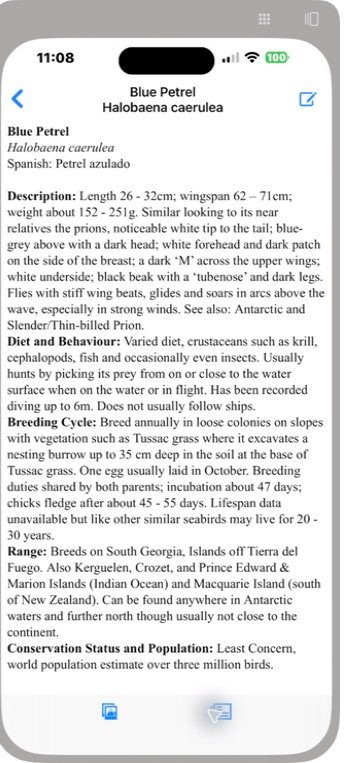
Length about 26-32 cm, wingspan about 62-71 cm, and weight about 152-251 g in app detail
Blue-grey above with a dark head and noticeable white tail tip
White forehead, dark patch on the side of the breast, and white underside
Black beak with a tubenose and dark legs
Guide Facts
App detail notes varied diet including crustaceans such as krill, cephalopods, fish, and occasionally insects
Hunts by picking prey from or near the water surface when on the water or in flight
Has been recorded diving up to about 6 m
Does not usually follow ships
Measurements
Length about 26-32 cmWingspan about 62-71 cmWeight about 152-251 g
Diet
Crustaceans such as krillCephalopodsFishOccasionally insects
Behavior
Fast stiff wingbeatsGlides and soars in arcs above waves, especially in strong windsPicks prey from or near the surface on the water or in flightRecorded diving up to about 6 m
Breeding
Breeds annually in loose colonies on slopes with vegetation such as Tussac grassExcavates a nesting burrow up to about 35 cm deepOne egg is usually laid in OctoberIncubation is about 47 days and chicks fledge after about 45-55 days
Range
Breeds on South Georgia, Tierra del Fuego islands, Kerguelen, Crozet, Prince Edward, Marion, and Macquarie islandsCan be found anywhere in Antarctic waters and farther north, though usually not close to the continent
Comparison Notes
App detail points guides to compare with Antarctic and Slender/Thin-billed Prion
Conservation
Least Concern, with app detail estimating over three million birds
Keratin plates used by baleen whales to filter krill and small schooling prey from seawater.26 animal matches / 26 captured / 0 pending / 1 location filesGuide draft readyOpen Glossary term
Animal ID
drafted-from-current-records
Krill
Small shrimp-like crustaceans that are a major Antarctic food source for many whales, penguins, seals, and seabirds.27 animal matches / 27 captured / 0 pending / 1 location filesGuide draft readyOpen Glossary term
Animal ID
drafted-from-current-records
Pelagic
Living or feeding in open ocean waters away from land.32 animal matches / 23 captured / 9 pending / 4 location filesGuide draft readyOpen Glossary term
Animal ID
drafted-from-current-records
Pinniped
A fin-footed marine mammal group that includes seals, fur seals, and sea lions.24 animal matches / 21 captured / 3 pending / 5 location filesGuide draft readyOpen Glossary term