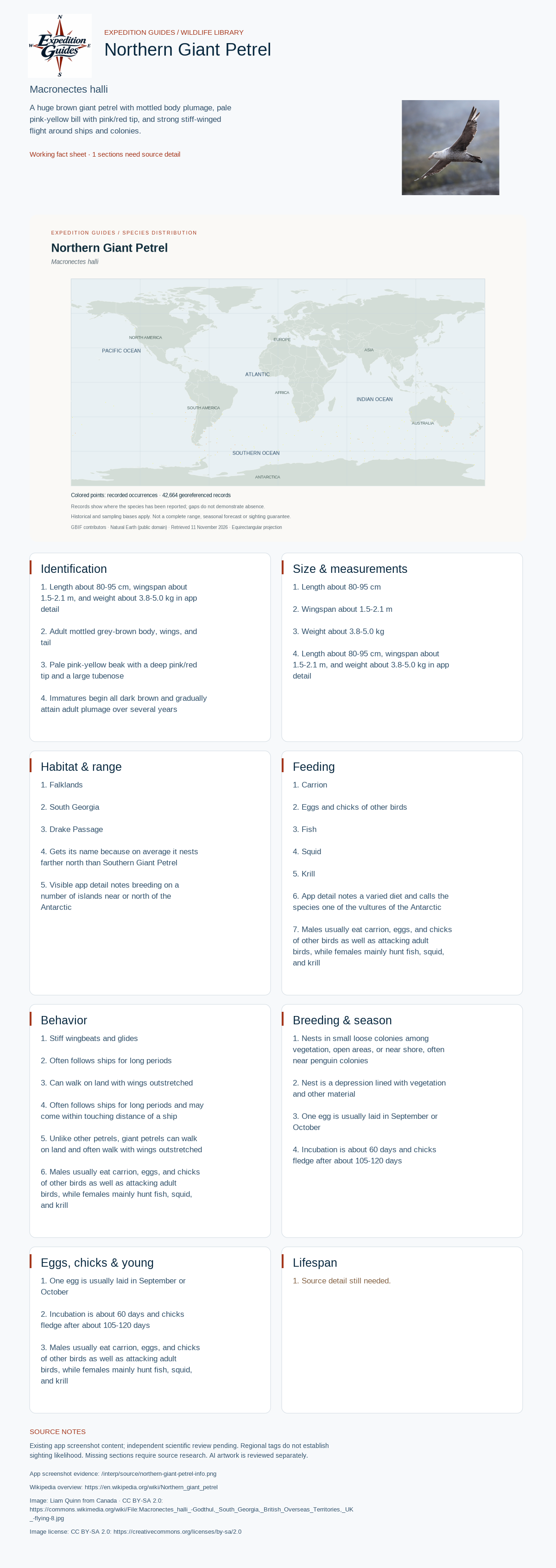
A huge brown giant petrel with mottled body plumage, pale pink-yellow bill with pink/red tip, and strong stiff-winged flight around ships and colonies.
Working fact sheet · 1 sections need source detail
Drawn from the existing guide record (app screenshot). Regional tags are library coverage, not a prediction of sightings. Blank fields remain open for research; imported notes have not been independently re-verified.
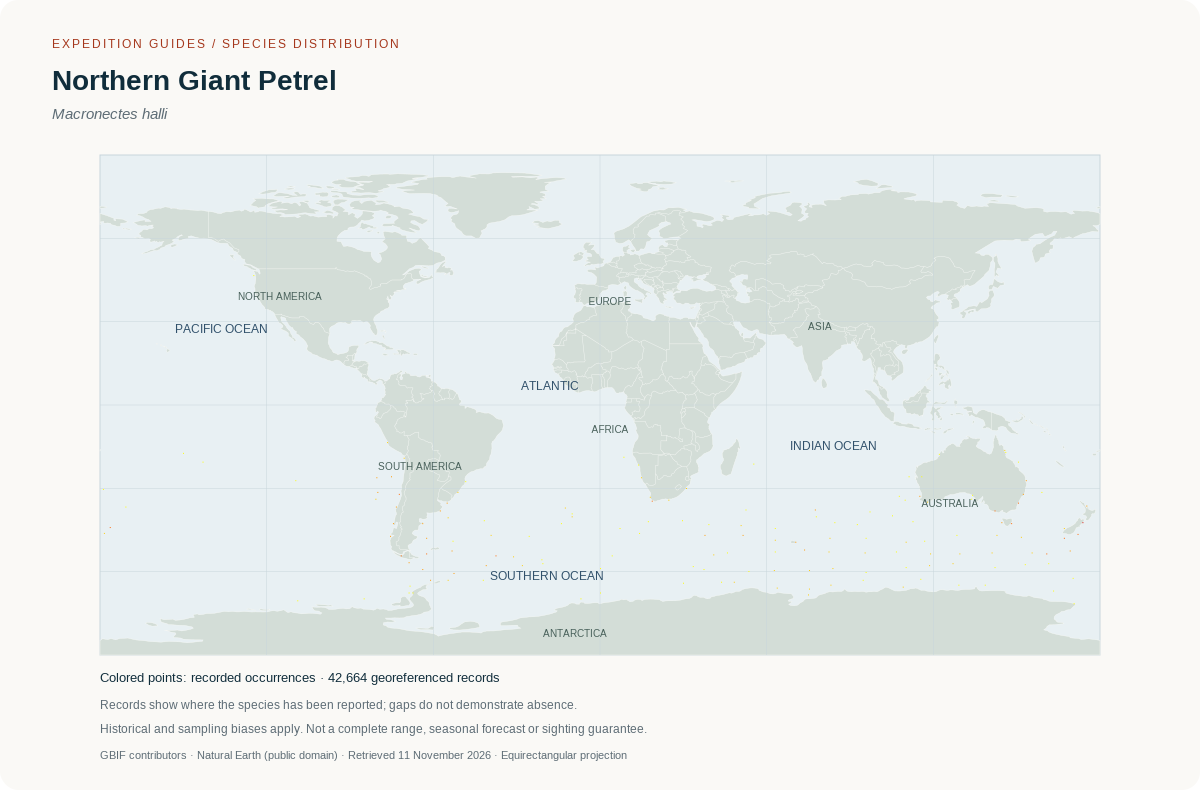
Colored points show georeferenced records shared through GBIF. Records can be historical and unevenly sampled; gaps do not establish absence. This is a record map, not a complete range or a guarantee of sightings.
Habitat & range notes
Gets its name because on average it nests farther north than Southern Giant Petrel
Visible app detail notes breeding on a number of islands near or north of the Antarctic
No phone capture action is currently queued for this animal.
App photo target
/wildlife-photos/northern-giant-petrel.jpg
Source target
/interp/source/northern-giant-petrel-info.png
Animal information
Field marks and guide-facing detail.
Field Marks
Length about 80-95 cm, wingspan about 1.5-2.1 m, and weight about 3.8-5.0 kg in app detail
Adult mottled grey-brown body, wings, and tail
Pale pink-yellow beak with a deep pink/red tip and a large tubenose
Immatures begin all dark brown and gradually attain adult plumage over several years
Guide Facts
App detail notes a varied diet and calls the species one of the vultures of the Antarctic
Often follows ships for long periods and may come within touching distance of a ship
Unlike other petrels, giant petrels can walk on land and often walk with wings outstretched
Males usually eat carrion, eggs, and chicks of other birds as well as attacking adult birds, while females mainly hunt fish, squid, and krill
Measurements
Length about 80-95 cmWingspan about 1.5-2.1 mWeight about 3.8-5.0 kg
Diet
CarrionEggs and chicks of other birdsFishSquidKrill
Behavior
Stiff wingbeats and glidesCan look quite hunch-backedOften follows ships for long periodsCan walk on land with wings outstretched
Breeding
Nests in small loose colonies among vegetation, open areas, or near shore, often near penguin coloniesNest is a depression lined with vegetation and other materialOne egg is usually laid in September or OctoberIncubation is about 60 days and chicks fledge after about 105-120 days
Range
Gets its name because on average it nests farther north than Southern Giant PetrelVisible app detail notes breeding on a number of islands near or north of the Antarctic
Comparison Notes
App detail points guides to compare with Southern Giant Petrel
Conservation
Not fully visible in captured screenshot; needs continuation capture if exact app status is required
Keratin plates used by baleen whales to filter krill and small schooling prey from seawater.26 animal matches / 26 captured / 0 pending / 1 location filesGuide draft readyOpen Glossary term
Animal ID
drafted-from-current-records
Krill
Small shrimp-like crustaceans that are a major Antarctic food source for many whales, penguins, seals, and seabirds.27 animal matches / 27 captured / 0 pending / 1 location filesGuide draft readyOpen Glossary term
Animal ID
drafted-from-current-records
Pelagic
Living or feeding in open ocean waters away from land.32 animal matches / 23 captured / 9 pending / 4 location filesGuide draft readyOpen Glossary term
Animal ID
drafted-from-current-records
Pinniped
A fin-footed marine mammal group that includes seals, fur seals, and sea lions.24 animal matches / 21 captured / 3 pending / 5 location filesGuide draft readyOpen Glossary term