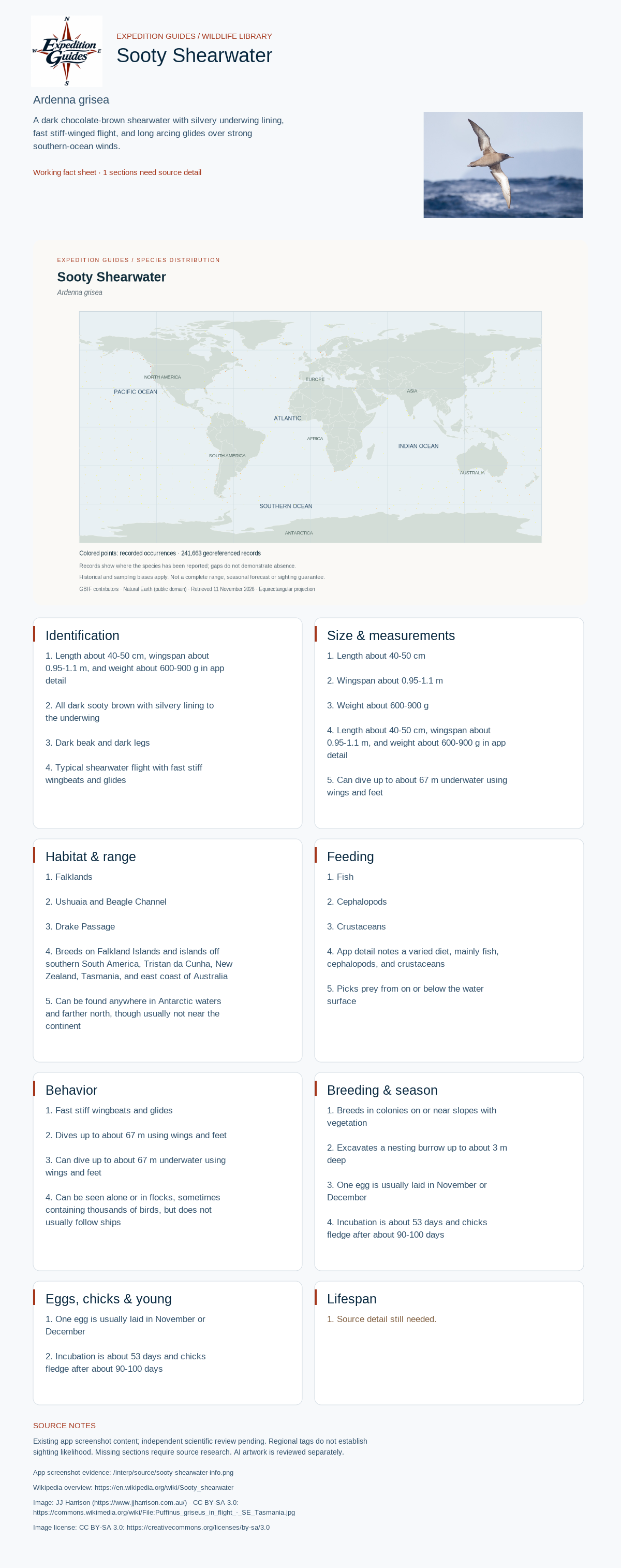
Working fact sheet · 1 sections need source detail
Drawn from the existing guide record (app screenshot). Regional tags are library coverage, not a prediction of sightings. Blank fields remain open for research; imported notes have not been independently re-verified.
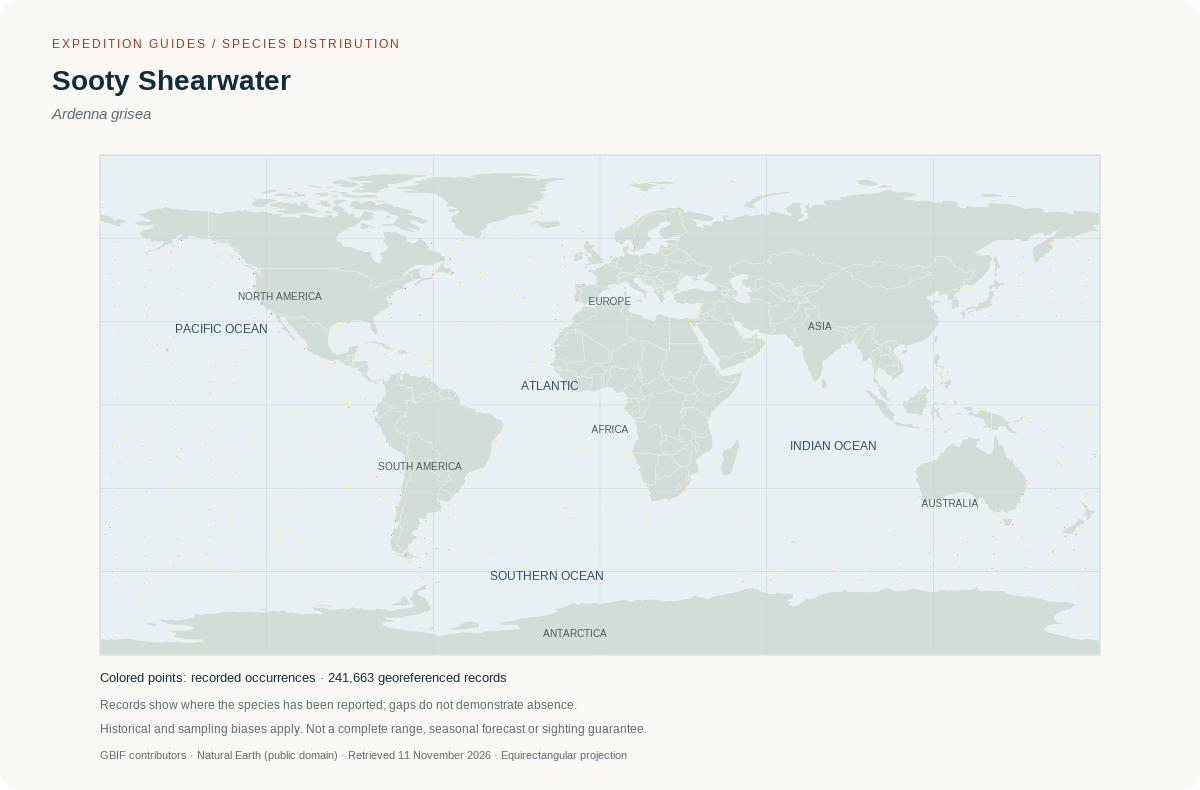
Colored points show georeferenced records shared through GBIF. Records can be historical and unevenly sampled; gaps do not establish absence. This is a record map, not a complete range or a guarantee of sightings.
Habitat & range notes
Breeds on Falkland Islands and islands off southern South America, Tristan da Cunha, New Zealand, Tasmania, and east coast of Australia
Can be found anywhere in Antarctic waters and farther north, though usually not near the continent
Original AI-generated sheet from your ChatGPT artwork session. Its illustrations, maps and embedded facts need separate review and may differ from the source-based fact sheet above.
No phone capture action is currently queued for this animal.
App photo target
/wildlife-photos/sooty-shearwater.jpg
Source target
/interp/source/sooty-shearwater-info.png
Animal information
Field marks and guide-facing detail.
Field Marks
Length about 40-50 cm, wingspan about 0.95-1.1 m, and weight about 600-900 g in app detail
All dark sooty brown with silvery lining to the underwing
Dark beak and dark legs
Typical shearwater flight with fast stiff wingbeats and glides
Guide Facts
App detail notes a varied diet, mainly fish, cephalopods, and crustaceans
Picks prey from on or below the water surface
Can dive up to about 67 m underwater using wings and feet
Can be seen alone or in flocks, sometimes containing thousands of birds, but does not usually follow ships
Measurements
Length about 40-50 cmWingspan about 0.95-1.1 mWeight about 600-900 g
Diet
FishCephalopodsCrustaceans
Behavior
Fast stiff wingbeats and glidesArcs over waves, especially in strong windsDives up to about 67 m using wings and feetCan occur alone or in large flocks
Breeding
Breeds in colonies on or near slopes with vegetationExcavates a nesting burrow up to about 3 m deepOne egg is usually laid in November or DecemberIncubation is about 53 days and chicks fledge after about 90-100 days
Range
Breeds on Falkland Islands and islands off southern South America, Tristan da Cunha, New Zealand, Tasmania, and east coast of AustraliaCan be found anywhere in Antarctic waters and farther north, though usually not near the continent
Comparison Notes
App detail points guides to compare with White-chinned Petrel and Kerguelen Petrel
Conservation
Near Threatened, with app detail estimating over 7 million breeding pairs and noting declines in some areas
Keratin plates used by baleen whales to filter krill and small schooling prey from seawater.26 animal matches / 26 captured / 0 pending / 1 location filesGuide draft readyOpen Glossary term
Animal ID
drafted-from-current-records
Krill
Small shrimp-like crustaceans that are a major Antarctic food source for many whales, penguins, seals, and seabirds.27 animal matches / 27 captured / 0 pending / 1 location filesGuide draft readyOpen Glossary term
Animal ID
drafted-from-current-records
Pelagic
Living or feeding in open ocean waters away from land.32 animal matches / 23 captured / 9 pending / 4 location filesGuide draft readyOpen Glossary term
Animal ID
drafted-from-current-records
Pinniped
A fin-footed marine mammal group that includes seals, fur seals, and sea lions.24 animal matches / 21 captured / 3 pending / 5 location filesGuide draft readyOpen Glossary term